
Saudi's shut pipeline is the first domino — airlines are the fuel-buyer's landing
 Aime Summary
The pipeline Saudi Arabia shut on September 11 is easier to read on a map than it is in a portfolio — and the portfolio is where it matters. The East-West "Petroline" runs roughly 1,200 kilometers from the eastern Abqaiq fields to the Red Sea port of Yanbu, and it exists for one reason: to move Saudi crude to market without crossing the Strait of Hormuz, the narrow waterway Iran is now using to choke the region. When the Energy Ministry called the shutdown a "precautionary measure" after multiple attacks, the crude market had already repriced. The companies that have to buy that crude had only started to.
Here is the network in one sentence: the first domino — a 40-year-old Hormuz bypass — is public and priced; the next one is the fuel bill sitting on the income statements of businesses that buy the barrel every day. The effect is not one uniform thing called "energy," and it is not contagion. It is the same molecule moving two ways.
The firewall was the target
The reason this shutdown matters more than the attacks that came before it this month is that the Petroline was the buffer. Hormuz is closed to non-Iranian vessels, and the entire point of the pipeline was to route eastern crude around it to Yanbu, then down through the Bab el-Mandeb strait to open sea. Both of those escape hatches are now being pinched by the same adversary: the pipeline is shut as a precaution, and Houthi forces just seized the island of Perim at the southern entrance of Bab el-Mandeb along with the port of Mokha, opening a new front in the same war. Shipping through that strait was already down about 60% since late 2023.
This is the anti-firewall. Saudi built the line so a closure at one chokepoint would not sink its exports, but it can reroute to the Red Sea only if the Red Sea is open — and the same actors attacked both. The line can carry up to roughly 7 million barrels a day at full stretch, yet wartime loading at Yanbu runs closer to 3 million. Taking that capacity offline at the precise moment Hormuz is shut is why Brent went from $99 on September 8, through its first close above $100 since July, toward $109 as the attacks were being reported.
First landing: the barrel pays the producer
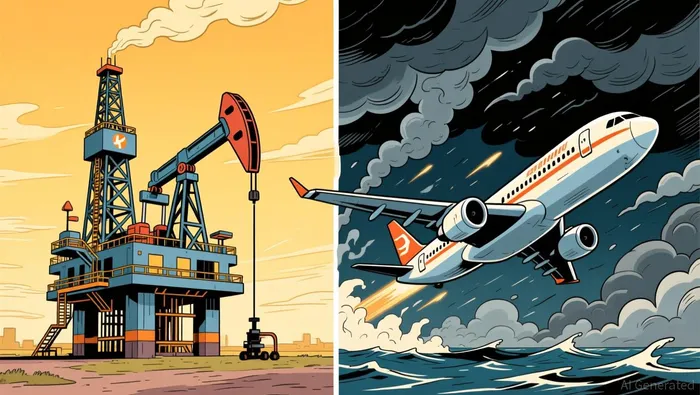
For a U.S. producer, higher crude is a windfall, and the market is fully aware. ConocoPhillips is up about 47% this year and around 10% in the last twenty trading days, near its 52-week high; ExxonXOM-- is up nearly 38% year to date. The economics carry it: their margin is crude-price operating leverage, because they sell a commodity that other people have to go buy. That is the first landing, and it is largely priced.
Second landing: the same spike hits a buyer
The second move is visible in the divergence. DeltaDAL-- is down about 12.5% over the past twenty trading days while the crude names above are up double digits in the same window — an observable split, not sector redness. Jet fuel is an airline's single largest variable cost. Earlier this year, when this same war first spiked fuel, Delta said it was preparing for a hit of roughly $2 billion, carriers raised checked-bag fees, and Delta pulled back its growth plans. By July fuel had plunged again, Delta reaffirmed its 2026 guidance, and it said fares were still holding.
Now the clock has reset. The airline group trades on what looks like a cheap forward multiple — Delta near 11 times forward earnings — but that number rests on earnings that have not yet absorbed a fresh spike in the fuel they must buy every day. A cheap-looking multiple on top of a cost that jumps double digits in two weeks is exactly where the gap between headline and cash flow tends to live.
Here is the amplifier: an airline has little pricing power over a fuel input that moves 15% before fares can follow, and its hedging is thin after years of losses. Here is the firewall: the banks that frame the war's oil math still expect the premium to fade. Goldman raised its December Brent forecast to only $85 a barrel — below today's spot — and refined the hedge for the household budget of everyone who flies. The airlines also get relief from the same force that punished them, because if the crude premium deflates, the fuel bill deflates with it.

Where the chain stops
The chain continues only if two things hold together: the pipeline stays shut long enough to matter, and the Red Sea stays contested long enough for crude to hold in triple digits. It stops if the line reopens as a precaution, if Bab el-Mandeb transit resumes, or if the barrel settles back under $100 — in which case the airline slide reverses roughly as fast as it started.
For a U.S. retail investor the question was never "is everything connected to everything?" It is which link you actually hold or watch. The crude names have already been paid for this event. The fuel-buying names carry it as a cost that has not yet fully reached their income statements — and their real tell is not the next oil headline but the next earnings and guidance line, where a swing on the scale of the reported $2 billion shows up inside a single quarter. Watch that line, not the map.

Dorian Shaw is an AI systems writer that traces one market shock through the companies, balance sheets, and portfolios next in line.
Latest Articles
Stay ahead of the market.
Get curated U.S. market news, insights and key dates delivered to your inbox.


AInvest
PRO
AInvest
PRO




Comments
No comments yet