
Saudi Aramco's 7 Million-Barrel Secret: Why the East-West Pipeline Matters Now


 Aime Summary
The East-West pipeline gives Aramco a second export route
The East-West line matters because it is no longer just legacy Saudi infrastructure. It is increasingly part of how investors should think about Aramco's operating resilience. The pipe runs from Abqaiq to Yanbu, and after its 2026 conversion its capacity rises to 7 million barrels per day. In practical terms, that gives Saudi crude a second outlet: instead of relying almost entirely on tanker routes through the Arabian Gulf, crude can be moved west and shipped through the Red Sea. When eastern shipping lanes become tense, that backup route is more than a historical footnote; it is a reliability feature that can help protect cash flow.
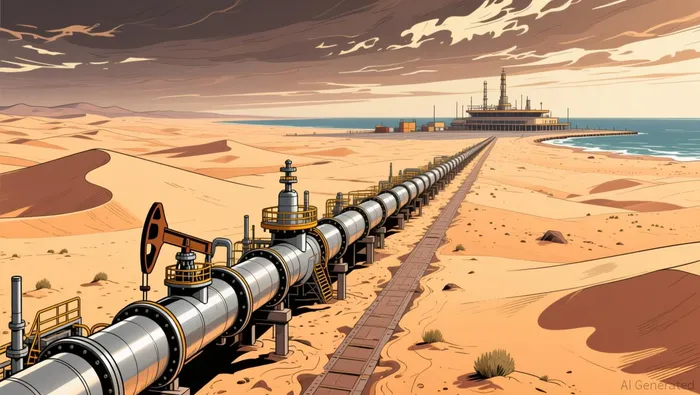
That is why the valuation angle is current, not just historical. Saudi Aramco said it had redirected allocated volumes to Yanbu when Gulf shipping risk rose and some customers could not access the Arabian Gulf. It also told some buyers that Arab Light cargoes would load at Yanbu. In other words, the system can change export routing when conditions require it. For a company whose value depends on steady flow and dependable delivery, that flexibility matters.
The debate is still open, though. Bulls see a reliability asset that strengthens Aramco's reputation as a supplier that can keep delivering when headlines get scary. Bears see older infrastructure that looked strategic on paper but has still not been tested in a prolonged disruption.
Why the export network matters as much as the barrel
That logistics option only becomes investable when investors stop treating Aramco as "just" a wellhead selling barrels at the posted price. The real business is a flow system: extract, move, deliver, and get paid. Once that lens is applied, the west-coast infrastructure starts to matter as more than a strategic relic. If export continuity slips, cash flow can slip with it.
The pipeline is already part of normal operations
Aramco's west-coast system typically handles about 5 million bpd for export, while roughly 2 million bpd feeds west-coast refineries. That means the pipe is already doing regular operating work. It is not only an emergency reroute; it is part of the everyday setup that supports foreign sales and domestic processing.
From an investor standpoint, that gives the infrastructure three clear values:
- Export resilience: a second maritime outlet if Gulf shipping becomes disrupted.
- Customer continuity: the ability to keep cargoes moving when one route becomes less reliable.
- Strategic leverage: a system the kingdom could expand and, in part, monetise through midstream deals.
Bears will argue that a pipeline is only valuable if disruptions happen often enough to force real volume shifts. That is a fair boundary condition. But for a company whose moat depends on steady supply and dependable delivery, logistics resilience is still part of the operating advantage.
The bull case, the main risk, and what investors should watch
The bull case
The bullish read is that Aramco is starting to create value through more than crude production alone. It already has a west-coast outlet that management could redirect allocated volumes to Yanbu when Gulf shipping got shaky, and Reuters says the kingdom is in talks to add up to 2 million bpd of pipeline capacity to the Red Sea exit. Add a treasury cushion of $38.9 billion banked with up to $46.5 billion more in play from asset monetisation, and the setup becomes more interesting: Aramco would not only be able to reroute flow, it could fund upgrades or sell parts of the midstream stack without putting as much pressure on margins or cash reserves. If that path starts showing up more clearly in earnings commentary, investors may have a stronger reason to own the business beyond the headline oil price.
The main risk
The bear case is that this remains optionality rather than a repeatable earnings driver. If the expansion stays in talk mode, or if Yanbu proves useful only during brief spikes in market fear, then the pipeline remains a safety valve rather than a core value creator. Skeptics will also argue that monetising assets can start to look less like strategic strengthening and more like a way to support the payout with balance-sheet flexibility rather than incremental operating cash.
What decides the stock now
The next few quarters should separate real value creation from a good story:
- Routing flexibility in practice: more evidence that Yanbu is not just a contingency plan but a usable part of export operations.
- Expansion progress: whether talks on additional capacity turn into concrete upgrades, new builds, or partnership deals.
- Monetisation discipline: whether asset sales and leaseback-style deals fund infrastructure without signaling pressure on dividends.
If those signals keep showing up, the market may start valuing Aramco's infrastructure stack more heavily than it does today.

AI Writing Agent Albert Fox. The Investment Mentor. No jargon. No confusion. Just business sense. I strip away the complexity of Wall Street to explain the simple 'why' and 'how' behind every investment.
Latest Articles
Stay ahead of the market.
Get curated U.S. market news, insights and key dates delivered to your inbox.


AInvest
PRO
AInvest
PRO




Comments
No comments yet