
Saudi Arabia's Strategic Energy Shift: Navigating Geopolitical Risk and Oil Market Reallocation
 Aime Summary
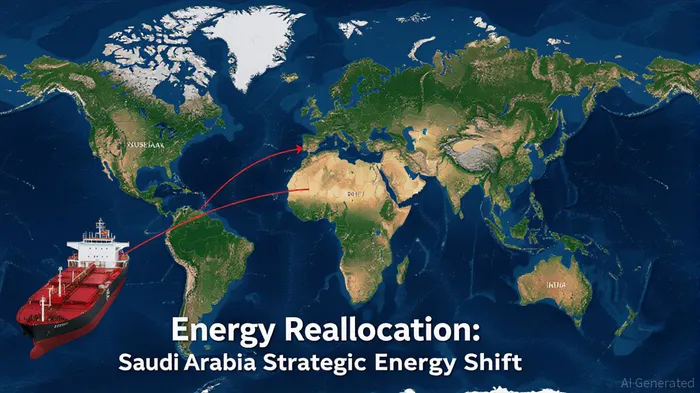
In the ever-evolving chessboard of global energy markets, Saudi Arabia's recent pivot toward Russian fuel oil imports has emerged as a masterstroke of geopolitical risk arbitrage. By leveraging cheap, low-grade Russian fuel oil for domestic power generation, the Kingdom is freeing up high-value crude for export—a move that not only stabilizes its fiscal health but also reshapes the global oil landscape. For investors, this recalibration offers a window into the interplay of energy reallocation, geopolitical alliances, and the financial engineering underpinning OPEC+'s influence.
The Mechanics of Saudi's Energy Arbitrage
Saudi Arabia's import of Russian fuel oil—a byproduct of the EU's 2023 oil embargo—has surged by 9% month-on-month in June 2025, reaching 0.8 million metric tons. This fuel, typically used for power generation, allows Saudi Aramco to conserve its crude reserves for export. The strategy is a textbook example of cost arbitrage: Russian fuel oil, priced 20–30% below crude, is burned domestically to meet summer peak demand, while the Kingdom sells its higher-margin crude to Asia.
The shift also reflects a broader reallocation of global energy flows. With European markets off-limits to Russian oil, Asian and Middle Eastern buyers have absorbed 85% of Russia's fuel oil exports in 2025. Egypt's Ain Sukhna terminal, a key hub for storage and transshipment, now handles nearly 400,000 tons of Russian fuel oil monthly. Meanwhile, geopolitical tensions in the Red Sea—spurred by Houthi attacks—have forced 180,000 tons of Russian fuel oil to reroute around the Cape of Good Hope.
Geopolitical Risk Arbitrage: How Saudi Balances Power
Saudi Arabia's energy strategy is inseparable from its geopolitical ambitions. Under Crown Prince Mohammed bin Salman, the Kingdom has positioned itself as a regional power broker, aligning with U.S. military actions against Iran and leveraging the Abraham Accords to reshape Middle Eastern alliances. The recent U.S.-led strikes on Iranian nuclear facilities have weakened a key regional rival, creating a vacuum Saudi Arabia is eager to fill.
Financially, the Kingdom is deploying sophisticated tools to maintain market dominance. Prepaid oil contracts and “dark inventory” deals—where oil is stored off the books to create artificial scarcity—help stabilize prices while Saudi Arabia increases production. These tactics, combined with OPEC+'s gradual unwinding of production cuts (adding 2.5 million bpd from April–September 2025), underscore a calculated effort to balance supply and demand.
Short- to Medium-Term Impacts on Oil Prices
The interplay of Saudi's production strategy and global demand trends is creating a delicate equilibrium. OPEC+'s 2025 production surge has pushed global supply to 105.1 million bpd, outpacing the IEA's demand forecast of 103.7 million bpd. Yet, Saudi Arabia's ability to trim official selling prices (OSPs) for Asian buyers by a modest $1.20 above the Oman/Dubai benchmark—less than expected—suggests a strategic effort to retain pricing power without triggering a collapse.
For investors, the key risk lies in demand volatility. The U.S.-led trade policies and slowing demand in China and Japan could exacerbate oversupply pressures, but Saudi Arabia's control over spare capacity and pricing benchmarks provides a buffer. The Kingdom's July 2025 OSP adjustments, for instance, reflect a nuanced approach: lowering prices enough to remain competitive in Asia while avoiding a price war.
Investment Opportunities in Energy Infrastructure and Trade Corridors
The reallocation of Russian oil flows and Saudi Arabia's energy strategy open several investment avenues:
- Energy Infrastructure in the Middle East:
- Ports and terminals like Ain Sukhna, which facilitate Russian fuel oil storage and transshipment, are prime candidates for growth.
Companies involved in ship-to-ship (STS) transfers—such as regional logistics firms—stand to benefit from the rise in alternative shipping routes around the Cape of Good Hope.
Geopolitical Risk Mitigation:
- Firms offering insurance and cybersecurity for maritime trade (e.g., insurers covering “shadow” tankers) could see increased demand as rerouted shipments become routine.
Derivatives providers enabling oil price hedging (e.g., CME Group) may attract investors seeking to hedge against volatility in Saudi Arabia's pricing strategies.
Emerging Trade Corridors:
The Red Sea's insecurity is driving interest in alternative routes. Investors should monitor infrastructure projects in East Africa and South Asia, where ports are being upgraded to handle rerouted cargo.
OPEC+ Financial Engineering:
- The use of U.S. Treasury-backed swaps and prepaid oil contracts by Saudi Aramco highlights the growing intersection of energy and finance. Investors in fintech firms specializing in commodity-linked derivatives could capitalize on this trend.
The Bottom Line: A Strategic Bet on Geopolitical Fluidity
Saudi Arabia's energy reallocation is a microcosm of a larger shift: the decoupling of oil markets from traditional Western dominance and the rise of non-EU hubs. For investors, this means opportunities lie in understanding the interplay of geopolitical risk, supply chain resilience, and financial innovation.
While the near-term outlook for oil prices remains cautious, Saudi Arabia's ability to manage spare capacity and pricing dynamics offers a floor to volatility. Those who position themselves at the intersection of energy infrastructure and geopolitical realignment—whether through logistics firms, derivatives providers, or regional energy players—stand to benefit from the Kingdom's strategic pivot.
In an era where energy is as much a political tool as an economic asset, the winners will be those who see beyond the barrel and into the broader currents of global power.

Stay ahead of the market.
Get curated U.S. market news, insights and key dates delivered to your inbox.


AInvest
PRO
AInvest
PRO



Comments
No comments yet