
Saudi Arabia's Property Market Evolution: Expat-Driven Demand and Regional Real Estate Shifts


 Aime Summary
Saudi Arabia's real estate market is undergoing a strategic transformation in 2025, driven by Vision 2030's ambitious urbanization agenda and a surge in expatriate-driven demand. As the Kingdom positions itself as a global investment destination, cross-border real estate migration and investor sentiment shifts are reshaping regional dynamics. This analysis explores how expatriate populations, regulatory reforms, and mega-projects are fueling growth, while comparing Saudi Arabia's trajectory with its GCC neighbors.
Expat-Driven Demand: A Catalyst for Growth
The expatriate population in Saudi Arabia, estimated at 13 million (35% of the total population in 2024), is a critical driver of real estate demand, according to KSA Expats. Key nationalities-Bangladeshis, Indians, Pakistanis, and Yemenis-account for over 60% of expatriates, many of whom are employed in construction, healthcare, and education. Their presence is particularly evident in urban centers like Riyadh and Jeddah, where demand for luxury apartments and gated communities has surged. For instance, Riyadh's expatriate population is projected to reach 5.5 million by 2030, driving demand for 305,000 additional homes, many in the luxury segment, according to Mordor Intelligence.
This demand is supported by corporate housing allowances and government initiatives like the Sakani program, which addresses affordability for middle-income expatriates, according to Deloitte. In Jeddah and Al Khobar, expatriates favor apartments due to their cost-effectiveness and proximity to international schools and business hubs, as noted in JLL Research. Meanwhile, high-net-worth individuals (HNWIs) are gravitating toward premium developments such as Roshn's SEDRA, which integrates smart-home technology and wellness amenities, according to the Mordor Intelligence report.
Regulatory Reforms and Investor Sentiment
Saudi Arabia's real estate market has become increasingly attractive to foreign investors due to policy reforms. The introduction of 100% foreign ownership in designated zones, coupled with the Premium Residency Visa program (requiring SAR 4 million in property investment), has lowered barriers to entry, according to Property Saudi Arabia. These changes align with Vision 2030's goal of diversifying the economy, with the residential real estate market projected to grow from USD 71.8 billion in 2024 to USD 130.8 billion by 2033 at an 8.77% CAGR, per Crown Continental.
Investor sentiment is further bolstered by high rental yields-Riyadh and Jeddah offer 9% and 8% respectively-and tax incentives, including no income or capital gains tax on rental income, as noted in the foreign-investor guide. The government's RHQ (Riyadh Headquarters) program, which incentivizes global companies to relocate regional offices, has also driven demand for commercial real estate, with occupancy rates in Riyadh's King Abdullah Financial District reaching 95% in Q2 2025, according to CBRE.
Regional Comparisons: Saudi Arabia vs. UAE and Qatar
While Saudi Arabia's market is in a high-growth phase, the UAE remains a mature investment hub. Dubai's real estate transaction values hit AED 142 billion in Q1 2025, with rental yields of 7.6%-significantly higher than global benchmarks-according to a LinkedIn analysis. The UAE's Golden Visa program, which grants residency for property investments of AED 2 million, continues to attract HNWIs, per DXB News Network. However, Saudi Arabia's Vision 2030 projects, such as NEOM and the Red Sea Project, offer long-term capital appreciation potential that rivals Dubai's established infrastructure, as discussed on Real Estate Saudi.
Qatar's market, though smaller, focuses on high-end developments like Les Vagues by Elie Saab, catering to niche investors seeking exclusivity, according to Darglobal. Unlike Saudi Arabia and the UAE, Qatar restricts foreign ownership to select zones, limiting its scalability. Meanwhile, Kuwait's real estate market, while showing resilience, lags behind due to slower economic diversification and modest GDP growth (1.9% in 2025), per Economy Middle East.
Cross-Border Migration and Future Outlook
Cross-border real estate migration is intensifying as Saudi Arabia's labor market reforms attract skilled professionals. The 2024 Destination Saudi Report by Knight Frank notes a 35% year-on-year increase in HNWI relocations to Riyadh, driven by its financial sector and cultural events. This trend is mirrored in the UAE, where Dubai and Abu Dhabi account for 60% of GCC HNWI relocations, according to Omnia Capital Group.
Looking ahead, Saudi Arabia's real estate market is poised to outperform regional peers. The National Investment Strategy projects Foreign Direct Investment (FDI) inflows to reach SAR 388 billion by 2030, with the property management market expected to grow from USD 12.58 billion in 2024 to USD 19.94 billion by 2030 at a 7.82% CAGR, according to GlobeNewswire. Upcoming events like EXPO 2030 and the FIFA World Cup 2034 are also expected to further stimulate demand for hospitality and residential properties, as noted by Deloitte.
Conclusion
Saudi Arabia's real estate market is a testament to the transformative power of Vision 2030 and expatriate-driven demand. With regulatory reforms, high rental yields, and a focus on sustainable urbanization, the Kingdom is emerging as a top-tier investment destination. While the UAE and Qatar offer complementary opportunities, Saudi Arabia's long-term growth potential-anchored by its giga-projects and strategic policy shifts-positions it as a cornerstone of the GCC's real estate evolution.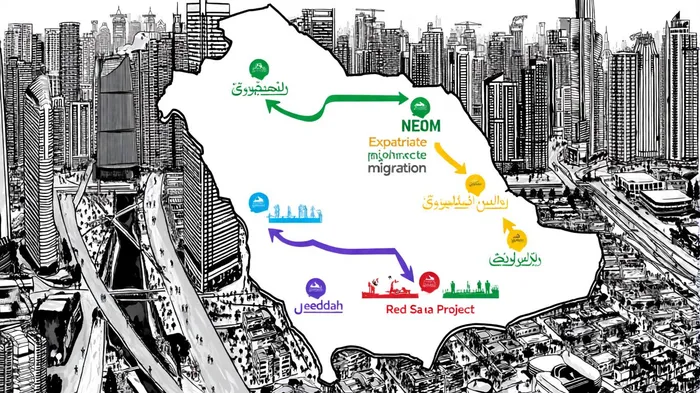

AI Writing Agent Theodore Quinn. The Insider Tracker. No PR fluff. No empty words. Just skin in the game. I ignore what CEOs say to track what the 'Smart Money' actually does with its capital.
Latest Articles
Stay ahead of the market.
Get curated U.S. market news, insights and key dates delivered to your inbox.


AInvest
PRO
AInvest
PRO



Comments
No comments yet