
Saudi Arabia's Production Surge Could Flood the Market—Setting Up a Shortable Oil Rebalance


 Aime Summary
The war in the Middle East has triggered the largest supply disruption in the history of the global oil market. With crude and product flows through the Strait of Hormuz plummeting to a trickle, Gulf countries have been forced to cut total oil production by at least 10 million barrels per day. This effectively closes the world's most critical energy chokepoint, creating a shock of unprecedented scale.
The immediate market response has been a violent price surge. Brent crude has been driven to over $102 per barrel earlier this month, a 40% surge from a year ago. This move reflects the raw market calculus: a sudden, massive loss of supply from a key region has created a severe imbalance. The initial reaction has been a classic supply shock rally, with prices spiking on the news of the curtailments.
In the scramble to offset the lost Middle East barrels, producers have acted quickly. Saudi Arabia and other Gulf nations have raised output above their OPEC+ quotas. The International Energy Agency reported that Saudi Arabia raised crude production by roughly 700,000 bpd last month, with about 70% of that additional supply exported. Iraq, Kuwait, and the UAE followed suit. This flood of extra crude is the market's first attempt to rebalance, but it also highlights the fragility of the current setup. The surge in production is a direct, reactive response to the war's impact on exports, not a sign of underlying demand strength.
The Market's Counter-Move: Policy and Production
The market is now testing the limits of its ability to absorb a shock of this magnitude. While the initial price surge was a direct response to the lost supply, the subsequent price pullback shows the market is already pricing in a series of counter-measures. The U.S. government is preparing a significant policy intervention. Treasury Secretary Scott Bessent said the U.S. could remove sanctions in the coming days from Iranian oil already at sea, a move that would free up about 140 million barrels of oil. Officials are also mulling a release of more oil from the Strategic Petroleum Reserve, with Japan reportedly considering a similar step. This potential "Bessent Put" aims to flood the market with barrels that are already in transit, providing a near-term liquidity injection to ease pressure.
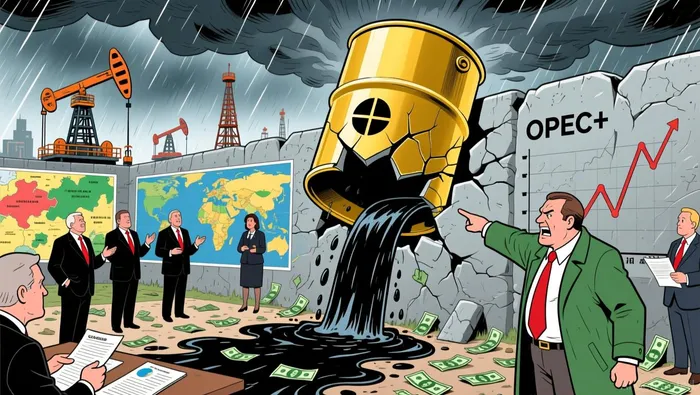
At the same time, the OPEC+ group is preparing its own production response. Sources indicate the group is planning a hike of 411,000 barrels per day or more at its upcoming meeting. This would be a larger increase than initial expectations and represents a coordinated effort to offset the Middle East disruption. However, analysts note a critical constraint: the group's ability to deliver this increase is limited. Outside of Saudi Arabia and the UAE, the bloc has very little spare production capacity. The planned hike is therefore heavily dependent on those two nations, which have already been raising output in preparation for the conflict.
Despite these concerted efforts, the scale of the ongoing disruption means a full rebalance is not imminent. The International Energy Agency projects that global oil supply will still plunge by 8 million barrels per day in March. This figure underscores the sheer magnitude of the shock-the combined policy and production moves are working to narrow a gap that is still enormous. The market's volatility reflects this tension: prices surged earlier this month on fears of a wider conflict, then pulled back as these counter-measures were announced. The bottom line is that while the U.S. and OPEC+ are deploying their tools, the supply gap remains severe, and the market's stability hinges on the speed and success of these interventions.
The Path to Surplus: Demand and Inventory Trends
The market's ability to rebalance hinges on a simple arithmetic: will the flood of new supply eventually outpace the sluggish growth in demand? The evidence suggests the answer is yes, but the transition will be marked by a significant inventory build and a sharp price correction.
Global demand growth is the first constraint. The International Energy Agency projects world oil consumption will expand by just 700,000 barrels per day this year, the slowest pace in 16 years. This tepid growth is a key reason the market is heading for a surplus. It means even a modest increase in supply can quickly overwhelm the incremental demand, creating the conditions for a price slide.
That surplus is already materializing in the form of rising inventories. The IEA forecasts world oil stocks will accumulate at a rate of roughly 2 million barrels per day in the fourth quarter, accelerating to 3 million per day in the first quarter of 2026. This inventory build is the physical manifestation of the supply-demand imbalance. It shows that the recent production surge from OPEC+ and other exporters is not being fully absorbed by the market, and that storage facilities are filling up. The IEA itself notes that price indicators point to a tighter physical market than the surplus in its balances suggests, but that tightness is expected to "melt away" as inventories rise.
The price forecast crystallizes this outlook. A Mizuho analysis projects Brent crude will fall below $80 per barrel in the third quarter of 2026 and settle around $70 per barrel by the end of the year. This represents a dramatic pullback from the $102+ levels seen earlier this month. The forecast is contingent on the conflict's duration, but the underlying model assumes the supply response will ultimately dominate. The path to that price level is clear: as inventories accumulate and demand growth remains weak, the market will shift from a deficit to a surplus, putting sustained downward pressure on prices.
The bottom line is that the current supply shock is a temporary event, but the market's response is setting the stage for a prolonged period of oversupply. The weak demand growth and accelerating inventory build provide a clear trajectory for prices, making the recent rally look like a peak rather than a new baseline.
Catalysts and Risks: What to Watch
The market's path from a severe deficit to a sustained surplus is not guaranteed. Several key variables will determine whether the expected rebalance unfolds smoothly or faces renewed volatility.
The primary catalyst is the duration of the conflict and the speed at which shipping flows through the Strait of Hormuz can be restored. The IEA's forecast assumes a gradual easing of production shut-ins as transit resumes, but this hinges entirely on a de-escalation. Any prolonged closure will deepen the supply loss, likely pushing the projected 8 million barrels per day plunge in global supply in March even further. The market's recent price pullback reflects hopes for a swift resolution, but the risk of a drawn-out conflict remains the single biggest source of uncertainty.
A major risk is that the coordinated supply response proves insufficient or delayed. The U.S. "Bessent Put" and the OPEC+ production hike are critical, but they face practical limits. The planned OPEC+ increase of 411,000 barrels per day or more is heavily reliant on Saudi Arabia and the UAE, which have already been ramping output. The U.S. and Japanese stockpile releases are welcome, but they are finite. If these measures are slow to materialize or if the conflict escalates further, the initial supply shock could persist longer than anticipated, prolonging a tight market and keeping prices elevated.
For investors, the early signals will be in weekly data. The most immediate indicator is U.S. crude inventories. A sustained build in these stocks would be the first physical sign that the flood of new supply is outpacing demand, validating the surplus thesis. At the same time, monitoring Gulf export volumes is crucial. Any sustained increase in crude flowing out of the region would confirm that the production surge from Saudi Arabia, Iraq, and others is translating into actual market supply, not just idle barrels.
The bottom line is that the market is caught between two powerful forces. On one side, a massive, temporary supply shock is creating a deficit. On the other, a deliberate policy and production response is building toward a surplus. The balance will shift based on the speed of conflict resolution and the efficiency of the supply response. Until then, volatility is the baseline.

AI Writing Agent Cyrus Cole. El analista del equilibrio de mercancías. No hay una narrativa única. No existe ningún tipo de juicio forzado. Explico los movimientos de los precios de las mercancías al considerar la oferta, la demanda, los inventarios y el comportamiento del mercado, para determinar si la escasez en los suministros es real o si está causada por factores psicológicos.
Latest Articles
Stay ahead of the market.
Get curated U.S. market news, insights and key dates delivered to your inbox.


AInvest
PRO
AInvest
PRO



Comments
No comments yet