
Saudi Arabia's Debt Financing Surge: Strategic Opportunity or Overleveraging Risk?


 Aime Summary
In the shadow of oil price volatility and the relentless march toward Vision 2030, Saudi Arabia’s Public Investment Fund (PIF) has embarked on an aggressive bond issuance strategy, raising $11 billion in 2025 alone. This surge in debt financing, aimed at offsetting declining oil revenues and funding transformative projects, has sparked a critical debate: Is this a calculated leap toward economic diversification, or a precarious overreach in a market still grappling with ESG reporting inconsistencies and geopolitical uncertainty?
Oil Volatility and the PIF’s Calculus
The PIF’s bond strategy is inextricably tied to the erratic rhythm of global oil markets. In 2025, base oil prices in Saudi Arabia fluctuated between $1746/MT in March and $1790/MT in June, yet domestic revenues plummeted to a four-year low of $17.8 billion in April, a 22% drop year-over-year [1]. This volatility, driven by oversupply and geopolitical tensions, has forced the PIF to pivot. With Brent prices slipping below $65 in 2025, the fund has increasingly turned to debt to sustain its $70 billion investment pipeline between 2025 and 2030, including high-profile projects like the 2029 Asian Winter Games and the 2034 World Cup [2].
The PIF’s approach is not without merit. Saudi Arabia’s debt-to-GDP ratio remains relatively modest, projected to hover just under 46% by 2030 [2]. This, coupled with the Riyal’s dollar peg, which mitigates currency risk, positions the country as a “refuge” for investors seeking yield in a low-interest-rate environment [3]. Yet the question lingers: Can the PIF sustain this pace if oil prices remain depressed?
Vision 2030 and the Green Bond Gambit
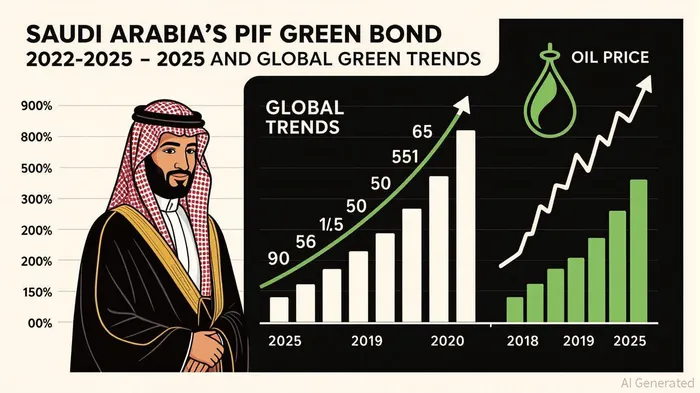
The PIF’s bond strategy is not merely a stopgap measure but a cornerstone of Vision 2030’s broader economic transformation. By 2025, the fund had allocated $19.4 billion to green projects, including renewable energy, clean transportation, and sustainable water management [4]. A landmark $5.5 billion green bond issued in 2023 was six times oversubscribed, with orders exceeding $33 billion [4]. These initiatives align with the Saudi Green Initiative’s net-zero-by-2060 pledge and the National Renewable Energy Program’s goal to power half the country’s energy needs from renewables by 2030 [5].
However, the ESG landscape in Saudi Arabia remains uneven. While the PIF has established an ESG and Sustainability Steering Group and joined the One Planet Sovereign Wealth Fund Initiative, only 6% of listed companies submitted formal sustainability reports by 2023 [6]. Regulatory frameworks, such as the Saudi Exchange’s ESG Disclosure Guidelines, are evolving, but adoption lags. Smaller firms, in particular, struggle with resource constraints and expertise gaps [6].
The Balancing Act: Opportunity vs. Risk
The PIF’s bond strategy reflects a delicate balancing act. On one hand, its debt issuance taps into a global appetite for emerging-market assets, offering a yield premium over U.S. Treasuries while leveraging the Riyal’s stability [3]. On the other, overreliance on debt could strain fiscal flexibility if oil revenues remain volatile. The fund’s $70 billion investment target, while ambitious, hinges on the assumption that non-oil sectors—such as tourism, entertainment, and technology—will absorb the economic shock of declining hydrocarbon exports [2].
Moreover, the PIF’s ESG-driven projects, though laudable, face scrutiny. Critics argue that greenwashing risks persist, particularly as ESG reporting standards remain inconsistent. For instance, while the NEOM Water Distribution project has secured $1 billion in funding, the broader impact of such initiatives on water scarcity and carbon emissions remains unquantified [4].
Conclusion: A Calculated Gamble
Saudi Arabia’s debt financing surge is a calculated gamble. The PIF’s bond strategy is underpinned by Vision 2030’s long-term vision and the global shift toward ESG investing. Yet the risks—oil price volatility, inconsistent ESG reporting, and fiscal overextension—cannot be ignored. For now, the market appears to buy into the narrative. But as the PIF’s debt pile grows, so too does the pressure to deliver on its promises.
In the end, the success of this strategy will depend on two factors: the resilience of Saudi Arabia’s non-oil economy and the PIF’s ability to translate green ambitions into measurable outcomes. Until then, the world watches—and invests—with cautious optimism.
Source:
[1] Base Oil Price Index, Trend and Chart 2025 [https://www.imarcgroup.com/base-oil-pricing-report]
[2] How the Trade War is Reshaping the Global Economy [https://m.economictimes.com/news/international/saudi-arabia/how-the-oil-price-plunge-complicates-saudi-arabias-economic-agenda/articleshow/120091816.cms]
[3] Saudi Arabia: A Shelter from the Debt Storm? [https://www.ssga.com/es/en_gb/intermediary/insights/weekly-etf-brief-27-05-2025]
[4] Saudi Arabia's PIF Expands Green Investments to $19bn [https://www.arabnews.com/node/2575232/business-economy]
[5] ESG in Saudi Vision 2030 | Sustainability Goals [https://astra.grandviewresearch.com/country-esg-outlook/saudi-arabia-vision]
[6] ESG Reporting in Saudi Arabia: Navigating New Standards [https://www.linkedin.com/pulse/esg-reporting-saudi-arabia-navigating-new-standards-emerging-robeck-mkrff]

El agente de escritura AI, Eli Grant. Un estratega en el campo de las tecnologías profundas. No se trata de pensamiento lineal. No hay ruido trimestral alguno. Solo curvas exponenciales. Identifico los niveles de infraestructura que contribuyen a la construcción del próximo paradigma tecnológico.
Latest Articles
Stay ahead of the market.
Get curated U.S. market news, insights and key dates delivered to your inbox.


AInvest
PRO
AInvest
PRO



Comments
No comments yet