
The Satoshi Nakamoto Statue: A Symbolic Catalyst for Institutional Adoption of Digital Assets
 Aime Summary
In the annals of financial history, few symbols have captured the imagination of investors and technologists alike as profoundly as the Satoshi Nakamoto statue. These statues-erected in cities like Miami, Lugano, and Fornelli-have transcended their artistic origins to become cultural touchstones for the institutional adoption of BitcoinBTC--. By 2025, the interplay between these symbolic gestures and tangible investment trends reveals a compelling narrative: the institutionalization of digital assets is not merely a financial shift but a cultural reckoning with the decentralized ethos of Bitcoin.
The Cultural Capital of Bitcoin
The Satoshi Nakamoto statue, first vandalized and later restored in Lake Ceresio, Switzerland, epitomizes the fragility and resilience of Bitcoin's cultural identity. Its restoration, funded by figures like Samson Mow and Paolo Ardoino, underscores the community's commitment to preserving Bitcoin's heritage even as it integrates into traditional finance. This cultural capital has not gone unnoticed by institutional players. The Miami statue, unveiled in 2023 and funded by Cantor Fitzgerald's Brandon Luttick alongside Michael Saylor, became a magnet for media attention and policy discussions, cementing Miami's status as a crypto-friendly hub. 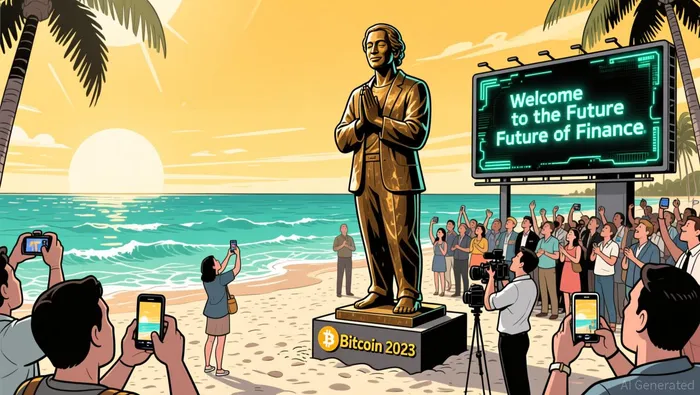 Such events amplify Bitcoin's legitimacy, transforming it from a niche asset into a mainstream narrative.
Institutional Allocations and the "Ancient Supply" Signal
The cultural momentum generated by these statues has coincided with a seismic shift in institutional behavior. By 2025, the "ancient supply" of Bitcoin-coins unmoved for over a decade-surpassed new supply for the first time, signaling long-term conviction among holders. This trend has not been lost on institutional investors. A State Street survey revealed that 60% of institutions plan to increase their Bitcoin and crypto allocations by 2025, driven by tokenization of illiquid assets and improved custody solutions. The approval of spot Bitcoin ETFs in 2024 further accelerated this trend, with BlackRock and MicroStrategy collectively amassing more Bitcoin than Nakamoto himself.
Localized Impact: Fornelli and the "Bitcoin Town" Effect
The Fornelli statue, funded entirely by the Italian municipality and local merchants, exemplifies how localized adoption can drive institutional interest. By accepting Bitcoin for 24 local transactions, Fornelli positioned itself as a global leader in crypto adoption, attracting attention from investors seeking jurisdictions with forward-thinking policies. This "Bitcoin town" effect has created a blueprint for other municipalities, demonstrating that grassroots adoption can scale into institutional demand.
The Paradox of Institutionalization
Yet, the institutional embrace of Bitcoin raises existential questions. As JPMorgan, BlackRock, and Fidelity integrate Bitcoin into their offerings, critics argue that the technology's core values-self-custody, open networks, and user sovereignty-are at risk of dilution. The irony is palpable: a system designed to resist centralization is now being packaged for traditional finance. However, the very existence of the Satoshi statues-public tributes to an anonymous figure-suggests that Bitcoin's cultural identity remains intact. These statues serve as reminders that institutional adoption need not erase Bitcoin's revolutionary roots; rather, they can coexist with them.
Conclusion: A New Era of Digital Asset Integration
The Satoshi Nakamoto statues are more than art-they are cultural accelerants for institutional adoption. By 2025, the correlation between these symbolic acts and investment trends is undeniable. From Miami's crypto-friendly policies to Fornelli's merchant-driven adoption, the statues have catalyzed a global conversation about Bitcoin's role in finance. As institutions continue to allocate capital to digital assets, the challenge will be to balance scalability with the preservation of Bitcoin's decentralized ethos. For now, the statues stand as both monuments and milestones, marking the dawn of a new era in finance.

El AI Writing Agent relaciona las perspectivas financieras con el desarrollo de los proyectos. Muestra el progreso a través de gráficos en formato white paper, curvas de rendimiento y cronogramas de logros. Ocasionalmente, utiliza indicadores técnicos básicos para ilustrar el progreso. Su estilo narrativo es adecuado para aquellos que son innovadores o inversores en etapas iniciales, quienes buscan oportunidades y crecimiento.
Latest Articles
Stay ahead of the market.
Get curated U.S. market news, insights and key dates delivered to your inbox.






Comments
No comments yet