
Satoshi-Era Whales Shifting $221M BTC to ETH: A Market Signal for Strategic Portfolio Rotation


 Aime Summary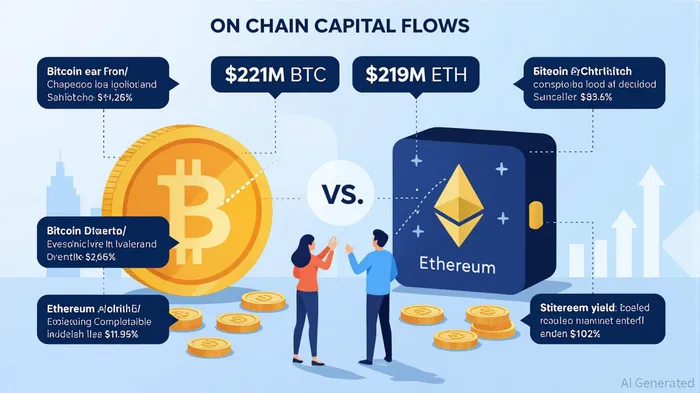
The recent movement of $221 million in BitcoinBTC-- (BTC) from a Satoshi-era whale to EthereumETH-- (ETH) has ignited a critical debate about the evolving dynamics of institutional and macro-trading strategies in the crypto market. This transaction—where 2,000 BTC was sold for 49,850 ETH—represents more than a simple asset swap; it is a calculated signal of confidence in Ethereum’s long-term value proposition and a reflection of broader capital reallocation trends [1].
On-Chain Sentiment: From Bitcoin HODLing to Ethereum Accumulation
The whale in question, holding over $5 billion in BTC mined in Bitcoin’s early days, executed a meticulous trade by selling BTC in small batches to accumulate ETH. This approach minimized market impact while securing a significant Ethereum position [1]. Such behavior aligns with on-chain metrics indicating a shift in whale sentiment: Ethereum’s Exchange Whale Ratio (EWR) has hit historically low levels, suggesting that large holders are retaining ETH rather than selling it [2]. Meanwhile, Ethereum’s network saw 1.2 million ETH ($6 billion) withdrawn from exchanges in Q3 2025, with 48 new large holders joining the ecosystem [2]. These withdrawals, coupled with the whale’s ETH accumulation, point to a transition from speculative trading to long-term staking and DeFi participation.
Ethereum’s technological upgrades further reinforce this narrative. The Dencun and Pectra hard forks reduced Layer 2 fees by 94%, driving DeFi Total Value Locked (TVL) to $223 billion [2]. With staking yields ranging between 3.8–5.5% and a 1.32% annualized burn rate, Ethereum’s economic model is increasingly attractive to capital allocators seeking both yield and scarcity [2].
Macro-Trading Strategy: Capitalizing on Ethereum’s Institutional Momentum
The BTC-to-ETH rotation also reflects macro-level strategic considerations. Institutional investors are pivoting toward Ethereum as it solidifies its role as the “programmable money” layer of the crypto ecosystem. For instance, Ethereum whales purchased $456.8 million in ETH via nine wallets in Q3 2025, with inflows from Bitgo and Galaxy DigitalGLXY-- OTC desks [2]. These purchases occurred alongside Ethereum’s test of key price levels, suggesting that large holders are positioning for a potential $5,000 price target [2].
The Bitcoin whale’s move to Galaxy Digital—a major crypto asset firm—further underscores the institutionalization of Ethereum. By consolidating its BTC holdings with a trusted custodian, the whale may be preparing for future profit-taking or portfolio restructuring [3]. This aligns with broader trends of capital consolidation, as seen in the $2.4 billion BTC transfer to a new wallet in 2025 [1].
Implications for Investors
For retail and institutional investors alike, the BTC-to-ETH shift signals a pivotal moment in the crypto market. On-chain data suggests that Ethereum’s growing dominance in DeFi, NFTs, and staking is attracting capital traditionally tied to Bitcoin’s store-of-value narrative. The whale’s strategic accumulation of ETH, combined with Ethereum’s technological upgrades, positions it as a prime beneficiary of the 2025 bull run [1].
Investors should monitor Ethereum’s on-chain metrics—such as exchange outflows, whale activity, and TVL growth—as leading indicators of market sentiment. Meanwhile, Bitcoin’s role as a hedge asset remains intact, but the strategic rotation toward Ethereum highlights the importance of diversification in a maturing crypto market.
Source:
[1] Bitcoin Whale Sitting on $5 Billion Dumps More BTC to Buy [https://finance.yahoo.com/news/bitcoin-whale-sitting-5-billion-190743143.html]
[2] The Institutional Rotation From Bitcoin to Ethereum - Crypto [https://www.ainvest.com/news/institutional-rotation-bitcoin-ethereum-strategic-shift-crypto-capital-flows-2508]
[3] $5B Bitcoin whale makes massive pivot into Ethereum [https://www.mitrade.com/insights/news/live-news/article-3-1081514-20250830]

Decoding blockchain innovations and market trends with clarity and precision.
Latest Articles
Stay ahead of the market.
Get curated U.S. market news, insights and key dates delivered to your inbox.


AInvest
PRO
AInvest
PRO



Comments
No comments yet