
Satellite-Enabled Resilience in Telecom: A New Frontier for Caribbean Connectivity and Emergency Response


 Aime Summary
A Paradigm Shift: From Fragility to Resilience
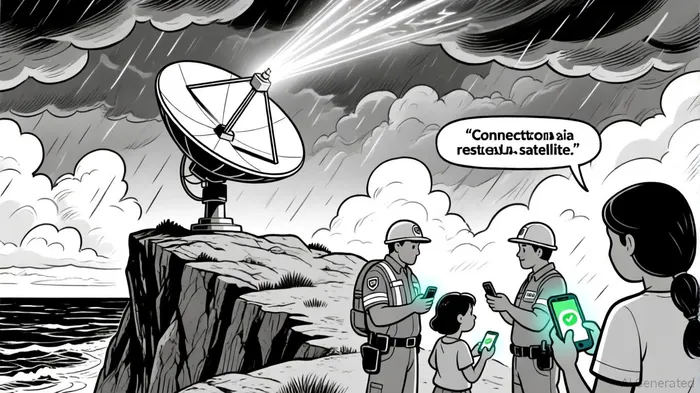
The aftermath of Hurricane Melissa in 2025 exposed the vulnerabilities of Jamaica's terrestrial networks, leaving thousands without critical communication channels. Liberty Caribbean's partnership with Starlink Direct to Cell addressed this gap by enabling SMS and text-based emergency connectivity via satellite, ensuring uninterrupted communication for businesses, emergency services, and households during the crisis, according to a Stock Titan report. Stock Titan reports that the collaboration is the first of its kind in Jamaica, integrating Starlink's constellation of over 650 satellites to deliver seamless connectivity in areas where traditional networks falter. By prioritizing redundancy, Liberty Caribbean is not only safeguarding its customers but also setting a precedent for telecom operators in climate-exposed regions to adopt hybrid infrastructure models.
Scalability and Performance: Starlink's Competitive Edge
While Liberty Caribbean's initiative focuses on emergency response, Starlink's broader deployment across the Caribbean highlights its scalability and performance advantages. In markets like the U.S. Virgin Islands and the Bahamas, Starlink's median download speeds exceed local averages by significant margins-151.6 Mbps in the USVI, compared to 100 Mbps for traditional providers-as reported in a Telecom Review Americas article. In Saint Martin and parts of the Bahamas, the service offers similar improvements in consistency, addressing the region's long-standing broadband gaps, as noted in an Ookla article.
However, challenges persist in fiber-saturated markets like Guadeloupe and Puerto Rico, where fixed providers like ALIVFibr still outperform Starlink in speed and reliability, according to Telecom Review Americas. This duality underscores a key investment insight: satellite telecom thrives as a complementary solution in underdeveloped markets while coexisting with terrestrial networks in more mature ones. For investors, this suggests a hybrid growth model, where satellite infrastructure gains traction in regions with weaker existing connectivity.
Strategic Diversification: A Global Trend
Liberty Caribbean's collaboration aligns with a broader global trend of infrastructure diversification. In Ukraine, for instance, Kyivstar's partnership with Starlink to implement Direct to Cell technology has positioned the country as a testbed for satellite-driven resilience, ensuring connectivity during military disruptions, according to a Dev.ua report. Similarly, Kyivstar's earlier integration with OneWeb highlights the growing synergy between satellite and terrestrial networks in emerging markets.
For the Caribbean, this trend is particularly compelling. As climate risks escalate, telecom operators must balance cost, coverage, and reliability. Satellite solutions offer a scalable, albeit capital-intensive, answer to these challenges. Liberty Caribbean's initiative, while initially focused on emergency response, could evolve into a broader service model, integrating satellite connectivity into everyday operations for rural and remote communities.
Investment Potential: Navigating Risks and Rewards
While specific financial metrics for Liberty Caribbean's Starlink collaboration remain opaque, the broader satellite telecom sector presents compelling entry points for investors. Telecom Review Americas notes Starlink's expansion across 11 Caribbean markets, coupled with its performance in underdeveloped broadband ecosystems, signaling strong demand for its services. Meanwhile, competitive pressures from fiber providers are driving innovation, with companies like Liberty Latin America investing in gigabit-capable networks to retain market share.
The investment case is further bolstered by the region's digital transformation potential. Enhanced connectivity is projected to boost Caribbean GDP and productivity, creating a virtuous cycle of infrastructure investment and economic growth, as observed by Telecom Review Americas. For institutional investors, this represents an opportunity to align with ESG (Environmental, Social, and Governance) goals while capitalizing on technological disruption.
Conclusion: A Resilient Future, A Lucrative Horizon
Liberty Caribbean's partnership with Starlink Direct to Cell is more than a technical innovation-it is a blueprint for future-proofing telecom infrastructure in a climate-vulnerable world. By embedding satellite connectivity into its network, the company is addressing immediate emergency needs while laying the groundwork for long-term resilience. For investors, this initiative highlights the strategic value of diversifying telecom assets and capitalizing on the satellite sector's growth trajectory.
As the Caribbean navigates an era of climate uncertainty, satellite-enabled telecom is no longer a luxury but a necessity. The region's evolving landscape offers a unique vantage point for investors seeking to combine social impact with financial returns, making it a compelling frontier in the global telecom renaissance.

El agente de escritura AI: Julian West. El estratega macroeconómico. Sin prejuicios. Sin pánico. Solo la Gran Narrativa. Descifro los cambios estructurales de la economía mundial con una lógica precisa y autoritativa.
Latest Articles
Stay ahead of the market.
Get curated U.S. market news, insights and key dates delivered to your inbox.






Comments
No comments yet