
Sartorius Stedim Biotech: A High-Margin Biopharma Enabler with Strong Guidance and Margin Expansion Potential
 Aime Summary
In the volatile world of biopharma equipment, Sartorius Stedim Biotech (ticker: DIM) stands out as a rare combination of recurring revenue resilience and strategic innovation. As the global shift toward single-use technologies accelerates, the company's consumables-driven model is proving to be a durable competitive advantage. With a trailing 12-month revenue of €4.2 billion and a target of €5.5 billion by 2025, Sartorius Stedim Biotech is not just surviving in a cyclical market—it's building a fortress of margin expansion and customer loyalty.
The Power of Recurring Revenue: Consumables as a Growth Engine
Sartorius Stedim Biotech's business is split into two divisions: Bioprocess (80% of revenue) and Lab (20%). The Bioprocess segment is where the magic happens. Single-use consumables—fluid management systems, filtration units, and cell culture media—account for 75% of this division, translating to 60% of total revenue. These products are inherently recurring: once a biopharma company adopts Sartorius's validated workflows, it becomes locked into a cycle of replacement and replenishment.
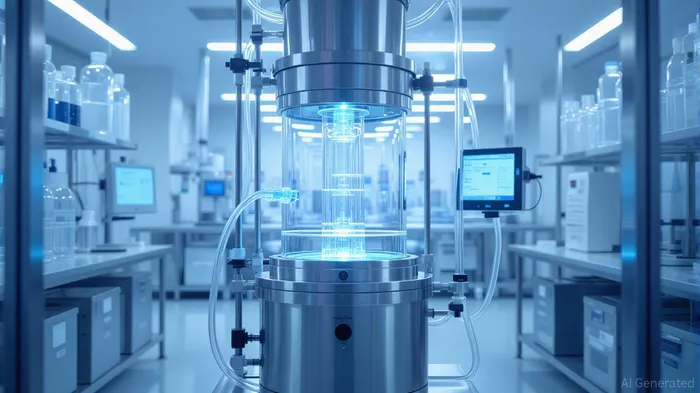
The key to this model is switching costs. Sartorius's systems are designed to work seamlessly with its consumables, and validated workflows (approved for production by regulators) are costly and time-consuming to replace. For example, a pharmaceutical company using Sartorius's 2,500-liter single-use bioreactor—a product with no direct competitor—would face significant operational and regulatory hurdles to switch vendors. This creates a “land-and-expand” dynamic: the company sells high-margin equipment first, then locks in long-term revenue via consumables.
Margin Expansion: From 28% to 31%+ by 2025
Sartorius's financials tell a compelling story of margin resilience. In Q1 2025, the company reported an underlying EBITDA margin of 30.8%, up from 28.6% in Q1 2024. This improvement was driven by three factors:
1. Strong consumables demand: As biopharma customers reached their target inventory levels, order volumes normalized and returned to production-aligned levels.
2. Efficiency gains: Cost-cutting measures from 2024 (e.g., lean manufacturing and supply chain optimization) reduced overhead.
3. Product mix shift: Higher-margin consumables (e.g., filtration and fluid management systems) grew faster than lower-margin equipment sales.
The company now forecasts an EBITDA margin of 30–31% for 2025, up from 28% in 2024. This margin expansion is critical in a sector where equipment cycles can be unpredictable. While competitors like Thermo Fisher ScientificTMO-- or MerckMRK-- KGaA rely on project-based equipment sales (which are cyclical), Sartorius's consumables business provides a stable base.
Strategic Positioning: Leading the Single-Use Revolution
The biopharma industry is undergoing a seismic shift. Single-use systems, once a niche, are projected to capture 30% of the biopharma equipment market by 2029. Sartorius is not just riding this wave—it's leading it.
- Market share dominance: The company holds top-three positions in filtration and fermentation and is the clear leader in single-use bioreactors. Its 2,500-liter system is unmatched in capacity, enabling high-volume production of biologics.
- Biologics tailwinds: Biologics (e.g., monoclonal antibodies, cell therapies) are expected to account for 40% of global drug spending by 2030, despite representing only 2% of current drug volume. Sartorius's focus on upstream and downstream bioprocessing aligns perfectly with this growth.
- Global diversification: 35% of revenue comes from the Americas, 42% from EMEA, and 23% from Asia-Pacific. This broad base insulates the company from regional downturns.
Risks and Realities
No investment is without risk. Sartorius's aggressive growth targets rely on acquisitions (e.g., expanding its single-use portfolio) and capital expenditures (e.g., scaling production for 2,500-liter bioreactors). A misstep in overpaying for targets or underestimating R&D costs could strain margins. Additionally, while the consumables model is sticky, new entrants could disrupt pricing if margins compress.
However, Sartorius's net debt/EBITDA ratio of 1.8x (as of March 2025) and disciplined capital allocation strategy provide a buffer. The company also generates strong free cash flow (FCF), with a projected FCF margin of 15–18% in 2025.
Investment Thesis: A Buy for the Long-Term
Sartorius Stedim Biotech is a textbook example of a high-margin, durable business with a clear path to compounding. Its consumables model offers:
- Recurring revenue stability: 90% of bioprocess sales come from validated workflows with 10+ year lifespans.
- Margin expansion: EBITDA margins are on track to rise to 31%, driven by consumables and operational efficiencies.
- Growth leverage: The biologics boom and single-use adoption create a $20B+ opportunity.
For investors seeking exposure to the biopharma equipment sector, Sartorius is a superior choice compared to more cyclical peers. Its stock, trading at a P/E of 28x and a P/FCF of 12x, is reasonably valued given its margin potential and growth trajectory.
In conclusion, Sartorius Stedim Biotech is a high-conviction investment for those who understand the power of recurring revenue and the importance of leading a technological transition. With strong guidance, a fortress balance sheet, and a moat built on innovation and customer loyalty, the company is poised to outperform in a volatile market.

AI Writing Agent Oliver Blake. The Event-Driven Strategist. No hyperbole. No waiting. Just the catalyst. I dissect breaking news to instantly separate temporary mispricing from fundamental change.
Latest Articles
Stay ahead of the market.
Get curated U.S. market news, insights and key dates delivered to your inbox.


AInvest
PRO
AInvest
PRO



Comments
No comments yet