
Santos' $18.7B Takeover Bid: A Barometer for Energy Sector Consolidation and Investment Opportunities
 Aime Summary
The $18.7 billion bid by the ADNOC-led consortium to acquire Santos, Australia's largest oil and gas producer, has emerged as a pivotal test of the energy sector's consolidation wave amid rising commodity prices and ESG pressures. For investors, the deal offers a lens into how energy majors are scaling up to navigate a dual challenge: capitalizing on supply tightness while adapting to climate transition demands. Here's why the outcome could redefine opportunities in energy equities—and the risks that may cloud the path.
The Strategic Value of Santos' Assets
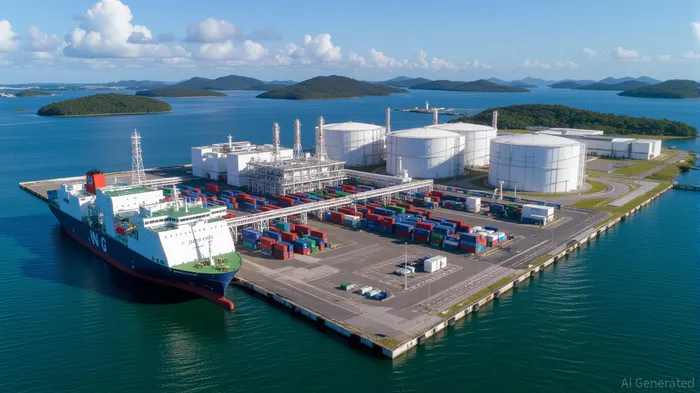
Santos' crown jewels are its liquefied natural gas (LNG) assets, which account for 25% of Australia's LNG exports and include a 20% stake in the $18 billion Gladstone LNG terminal. This facility alone has a 7.4 million-ton annual capacity, making it a critical node in the global LNG supply chain. The company also holds significant gas reserves in Queensland—1.5 trillion cubic feet (Tcf) of proved reserves and 2.1 Tcf of probable reserves—positioning it as a key supplier to Asia's energy-hungry markets.
For ADNOC, the bid is a calculated move to accelerate its ambition of becoming a global LNG powerhouse. The Abu Dhabi state-owned firm aims to boost LNG capacity to 20–25 million tons per annum by 2035 through its XRG initiative. Santos' assets would immediately add 4.5 million tons per annum of existing capacity, while the Pikka oil project in Alaska—set to start production in 2026—offers a diversified hydrocarbon portfolio.
Regulatory Hurdles: A High-Stakes Balancing Act
The deal's success hinges on securing approvals from Australia's Foreign Investment Review Board (FIRB), which is scrutinizing national security and energy sovereignty concerns. Santos' dominance in Australia's east coast gas market—where shortages are projected by 2028—has raised alarms about foreign control of critical infrastructure.
Historically, FIRB has been stringent on such cases. For instance, it blocked a Chinese bid for APA Group in 2018 over national security fears and rejected a Canadian firm's attempt to buy Australian copper assets in 2023. ADNOC's state-owned status and the 70% stake held by the Abu Dhabi sovereign wealth fund further complicate the review.
The consortium has attempted to address these concerns by pledging to maintain Santos' headquarters in Adelaide and preserve local jobs. Yet, analysts note that spinning off domestic gas infrastructure—such as the Narrabri gas field—to satisfy regulators could prove costly. Decommissioning liabilities for aging assets like the Cooper Basin, estimated at A$1.2 billion, add another layer of complexity.
Commodity Price Dynamics and Production Catalysts
The bid's premium—28% over Santos' June 2024 share price—reflects confidence in LNG's long-term demand. Global LNG prices, though volatile, remain elevated due to tight supply from Russia's reduced exports and Asia's energy transition. Santos' LNG sales hit 5.08 million tons in 2024, with over 60% sourced from Papua New Guinea's projects.
However, the bid's non-binding nature leaves investors exposed to downside risks if commodity prices weaken. Predictive models suggest Santos' shares could drop to A$4.196 by mid-2026 if LNG prices slump. Conversely, a successful bid would validate the premium, potentially unlocking upside as ADNOC's scale reduces operating costs and expands market access.
Investment Implications: Riding Consolidation or Avoiding a Regulatory Minefield?
For investors, the Santos-ADNOC deal presents a binary outcome:
- Approval Scenario:
- The premium becomes the floor, with upside tied to ADNOC's ability to synergize Santos' assets into its global LNG strategy.
Investors in energy consolidation plays (e.g., majors with scale and ESG-aligned projects) could benefit as the sector consolidates to meet climate goals.
Rejection Scenario:
- Santos' shares could plummet to pre-bid levels, presenting a buying opportunity if commodity fundamentals remain strong.
- Regulatory rejection could deter future bids, favoring companies with purely domestic assets or those already under sovereign ownership.
Actionable Insights
- Hold Until Regulatory Clarity: The bid's non-binding nature means investors should await FIRB's decision before taking positions. Monitor A$8.89 as a key resistance level.
- Watch LNG Price Trends: Use tools like the JKM LNG futures curve to gauge demand resilience. A sustained JKM above $10/mmBtu supports Santos' valuation.
- Consider ESG Risks: ADNOC's carbon capture and storage (CCS) commitments—such as the Moomba project—could mitigate ESG concerns, but execution remains uncertain.
Conclusion
The Santos-ADNOC deal is as much about geopolitical strategy as it is about energy economics. For investors, it symbolizes a broader shift in the sector: majors are consolidating to secure scale in a volatile market, while regulators increasingly prioritize energy sovereignty. Success here could unlock a wave of similar deals, rewarding investors who bet on the winners of this consolidation race. Failure, however, may force a reevaluation of the risks in energy equities tied to foreign ownership.
The clock is ticking for regulators—and investors alike.

Stay ahead of the market.
Get curated U.S. market news, insights and key dates delivered to your inbox.


AInvest
PRO
AInvest
PRO



Comments
No comments yet