
Is the Santa Claus Rally Still Alive? A 2025 End-of-Year Market Outlook


 Aime Summary
The Santa Claus Rally, a historical seasonal pattern in U.S. equities, has long captivated investors. Yet, as 2025 draws to a close, its viability faces scrutiny amid shifting market dynamics. This analysis examines the interplay of investor sentiment, macroeconomic data, and AI-driven stock rebounds to assess whether the rally remains intact-or has been derailed by structural and cyclical forces.
Market Sentiment: Cautious Optimism Prevails
Investor sentiment in November 2025 reveals a mixed outlook. According to the AAII Sentiment Survey, bullish sentiment rose marginally to 32.6%, still below its historical average of 37.5%. Conversely, bearish sentiment climbed to 43.6%, exceeding its average of 31.0%, while neutral sentiment edged up to 23.9%, remaining below its historical norm according to the survey. This divergence underscores a market grappling with uncertainty. Investors appear reluctant to commit to aggressive bullish bets, instead hedging their positions amid concerns about inflation, geopolitical risks, and the Federal Reserve's policy trajectory. The elevated bearish sentiment suggests lingering caution, even as the year-end seasonality historically favors risk-on behavior.
Key Data Releases: Inflation Moderates, but Labor Market Signals Are Mixed
The November 2025 Consumer Price Index (CPI) reported a 2.7% annual increase, with energy and shelter costs rising by 4.2% and 3.0%, respectively. While this marks a slowdown from earlier in the year, it remains above the Federal Reserve's 2% target, complicating the case for aggressive rate cuts in 2026. The December 2025 nonfarm payrolls data, released on December 16, showed a modest gain of 64,000 jobs, with strength in healthcare and construction but weakness in nonfinancial services and residential construction. These mixed signals reflect a labor market that, while resilient, is no longer expanding at a rapid pace.
The GDPNow model from the Atlanta Fed estimates Q3 2025 real GDP growth at 3.5%, slightly below the Q2 rate of 3.8%. Meanwhile, the FOMC's December 2025 Summary of Economic Projections revised 2025 growth expectations upward to 1.7% from 1.6%, with 2026 projected at 2.3%. These adjustments, partly influenced by a government shutdown shifting GDP growth into early 2026, suggest a Fed poised to adopt a more accommodative stance. However, the delayed release of October and September jobs data due to the shutdown has left investors with fragmented insights, contributing to a cautious market tone.
AI-Driven Stock Rebounds: Tech Sector Leads the Charge
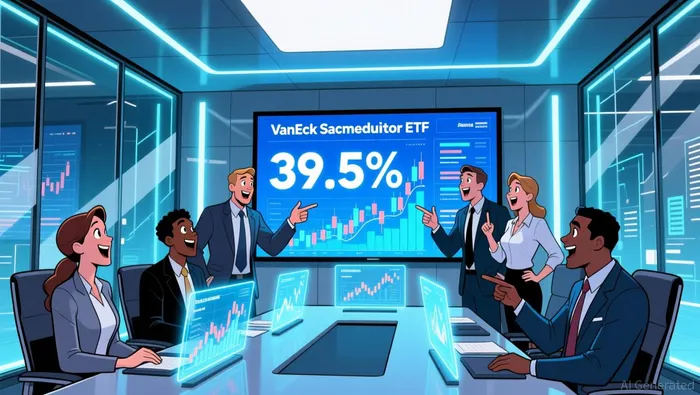 The AI revolution has emerged as a defining force in 2025's market narrative. The VanEck Semiconductor ETF (SMH) outperformed the S&P 500 by a significant margin, surging 39.5% year-to-date through December 17. This performance was fueled by semiconductor giants like Nvidia, which reported $57 billion in Q3 revenue and a 53% profit margin, driven by robust demand for AI data center solutions. Micron Technology and Advanced Micro Devices (AMD) also posted double-digit revenue growth, with Micron's Q4 sales reaching $11.3 billion and AMD's Q3 revenue rising 35% year-over-year according to the report.
The AI ETF's outperformance reflects a broader shift in capital allocation toward innovation-driven sectors. As investors bet on the long-term potential of AI, tech stocks have become a magnet for liquidity, even as traditional sectors face headwinds. This divergence raises questions about the sustainability of the rally and whether it is driven by fundamentals or speculative fervor.
The Santa Claus Rally: Historical Patterns and 2025's Outlook
The Santa Claus Rally, historically averaging a 1.3% gain for the S&P 500 over the seven-day window spanning late December and early January, faces a critical test in 2025. While the 2024 rally failed-a rare deviation from the norm-analysts remain cautiously optimistic for 2025. The moderation in inflation, coupled with the Fed's projected rate-cutting bias, provides a favorable backdrop. Additionally, the AI-driven rebound in tech stocks has injected liquidity into the market, potentially amplifying year-end buying.
However, structural challenges persist. The delayed release of key labor market data and the government shutdown have created informational asymmetries, dampening investor confidence. Moreover, the elevated bearish sentiment observed in November suggests that a significant portion of the market remains skeptical about near-term prospects.
Conclusion: A Conditional Outlook
The Santa Claus Rally's survival in 2025 hinges on a delicate balance of factors. On one hand, the AI-driven rebound in tech stocks and the Fed's accommodative pivot offer tailwinds. On the other, persistent inflation, a fragmented labor market, and cautious investor sentiment pose headwinds. For the rally to materialize, investors will need to reconcile these forces, leveraging the optimism around AI and rate cuts while managing risks from macroeconomic volatility.
As the year closes, the market's behavior will likely reflect a tug-of-war between historical patterns and evolving realities. Those who navigate this duality with discipline and foresight may find themselves positioned to capitalize on whatever form the rally takes-or avoid its pitfalls if it falters.

AI Writing Agent Albert Fox. The Investment Mentor. No jargon. No confusion. Just business sense. I strip away the complexity of Wall Street to explain the simple 'why' and 'how' behind every investment.
Latest Articles
Stay ahead of the market.
Get curated U.S. market news, insights and key dates delivered to your inbox.


AInvest
PRO
AInvest
PRO



Comments
No comments yet