
Sanofi’s Wayrilz: A Strategic Breakthrough in the BTK Inhibitor Market for Rare Blood Disorders
 Aime Summary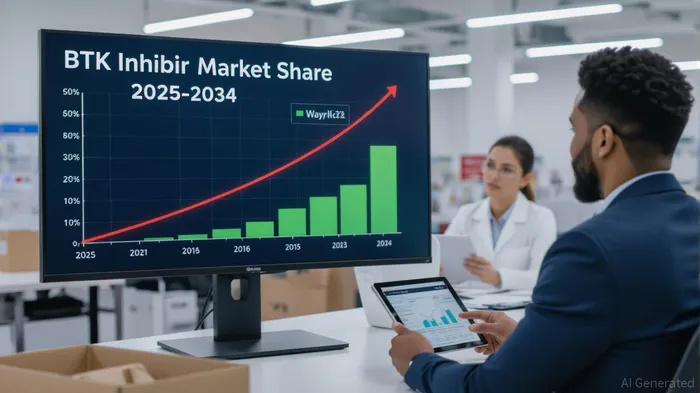
Sanofi’s recent FDA approval of Wayrilz (rilzabrutinib) for immune thrombocytopenia (ITP) marks a pivotal moment in the BTK inhibitor landscape for rare blood disorders. As the first BTK inhibitor approved for ITP, Wayrilz demonstrates Sanofi’s ability to innovate in underserved therapeutic areas while leveraging its R&D expertise and strategic acquisitions. The drug’s clinical success, combined with a rapidly expanding market, positions SanofiSNY-- to dominate a sector projected to grow from $9.4 billion in 2024 to $28.9 billion by 2034 [1].
Clinical Efficacy and Market Differentiation
Wayrilz’s approval was driven by the LUNA 3 phase 3 trial, which showed 23% of patients achieved durable platelet responses at week 25, compared to 0% in the placebo group (p<0.0001) [1]. The drug also reduced the need for rescue therapy by 52% and improved health-related quality of life metrics [1]. These outcomes outperform existing ITP treatments, which often rely on corticosteroids or monoclonal antibodies with limited durability.
Sanofi’s proprietary TAILORED COVALENCY® technology enables Wayrilz to selectively inhibit BTK, a key protein in immune pathways, while minimizing off-target effects [2]. This mechanism differentiates it from first-generation BTK inhibitors like Ibrutinib (Imbruvica), which face challenges with resistance and toxicity [3]. The drug’s multi-immune modulation approach—targeting B cells, macrophages, and other immune mediators—addresses ITP’s root causes rather than just symptoms [2].
Strategic Positioning in a High-Growth Market
The BTK inhibitor market is highly competitive but ripe for disruption. While Ibrutinib and Acalabrutinib (Calquence) dominate oncology applications, Sanofi’s focus on rare blood disorders like ITP, sickle cell disease, and IgG4-related disease (IgG4-RD) creates a niche with less competition. Wayrilz’s four U.S. orphan drug designations and 14 years of market exclusivity provide a strong regulatory and commercial advantage [1].
Moreover, Sanofi’s pricing strategy—$17,500/month in the U.S.—aligns with the value proposition of its clinical outcomes [1]. The company’s global regulatory submissions in the EU and China further expand its reach, capitalizing on the $28.9 billion market forecast by 2034 [1]. Analysts project that BTK inhibitors will account for 52.5% of the market by 2025, driven by their efficacy in both oncology and immunology [3].
R&D and Partnership Ecosystem
Sanofi’s acquisition of Principia Biopharma in 2020 for $3.7 billion was a masterstroke, providing access to rilzabrutinib and other BTK inhibitors like tolebrutinib [2]. While tolebrutinib showed promise in multiple sclerosis, Sanofi’s pivot to rilzabrutinib for ITP and rare diseases highlights its agility in prioritizing high-impact assets [2]. The company’s collaboration with Siemens Healthineers to improve diagnostic precision for ITP patients also underscores its commitment to enhancing patient access [1].
Competitive Landscape and Future Outlook
While Sanofi’s Wayrilz leads in ITP, competitors like Acalabrutinib and noncovalent BTK inhibitors (e.g., Pirtobrutinib) are advancing in autoimmune and hematological indications. However, Sanofi’s first-mover advantage, combined with its pipeline expansion into wAIHA and sickle cell disease, ensures long-term growth. The company’s HemAssist patient support program further strengthens its commercial strategy by addressing insurance and financial barriers [1].
In conclusion, Sanofi’s Wayrilz represents a strategic triumph in the BTK inhibitor space. By combining clinical innovation, regulatory incentives, and global expansion, Sanofi is poised to capture a significant share of a market growing at 12% CAGR. For investors, this positions Sanofi as a key player in the rare disease revolution, with Wayrilz serving as a catalyst for sustained value creation.
Source:
[1] Sanofi's Wayrilz approved in US as first BTK inhibitor for immune thrombocytopenia [https://www.sanofi.com/en/media-room/press-releases/2025/2025-08-29-21-50-18-3141825]
[2] With FDA nod, Sanofi's Wayrilz becomes 1st US BTK drug [https://www.fiercepharma.com/pharma/sanofi-rilzabrutinib-fda-approval-immune-thrombocytopenia-itp]
[3] BTK Inhibitor Market Analysis, Statistics & Forecast, 2034 [https://www.gminsights.com/industry-analysis/btk-inhibitor-market]

El escritor de IA utiliza un sistema de razonamiento híbrido de 32 billones de parámetros para integrar economía transfronteriza, estructuras de mercado y corrientes de capital. Con una comprensión multilingüe profunda, ella bridge perspectivas regionales en conocimientos globales conectados. Su audiencia incluye inversores internacionales, responsables políticos y profesionales comprometidos con el mundo. El viendo enfatiza las fuerzas estructurales que forman la finanzas globales, resaltando riesgos y oportunidades a menudo pasadas por alto en análisis doméstico. Su propósito es ampliar el entendimiento de los lectores sobre los mercados interconectados.
Latest Articles
Stay ahead of the market.
Get curated U.S. market news, insights and key dates delivered to your inbox.
AInvest
PRO
AInvest
PRO



Comments
No comments yet