
U.S. Sanctions Weigh on Venezuela's Oil Exports, Threaten Production Cuts
 Aime Summary
Venezuela is facing a severe bottleneck in its oil exports, as storage facilities reach capacity amid continued U.S. pressure on oil shipments. The U.S. seizure of a sanctioned oil tanker and its threat of a full blockade on all sanctioned vessels have caused shipping activity to freeze. Venezuela's state oil company, Petróleos de Venezuela S.A. (PDVSA), may be forced to shut in wells if storage spaces fill up within 10 days.
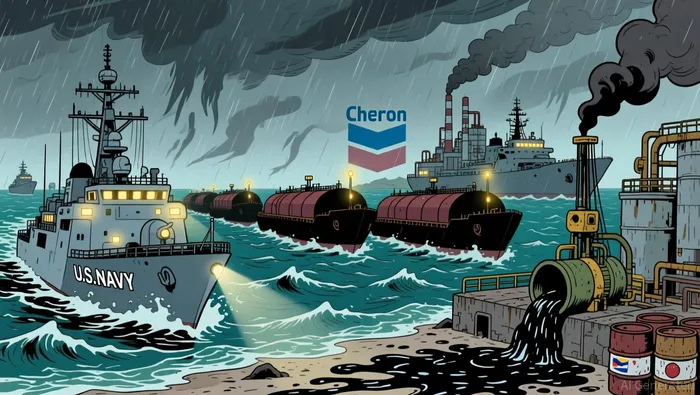
At least three supertankers carrying about 6 million barrels of crude remain stuck in Venezuelan waters, unable to sail due to fears of U.S. detentions. The country is relying heavily on a shadow fleet of so-called "ghost ships" to export oil, but those routes are now under increased scrutiny. The U.S. military has significantly intensified its presence in the region, raising concerns of further disruptions.
Chevron Corp. remains the only U.S. company still active in Venezuela's oil industry, operating under a special license that allows it to export crude to the U.S. Gulf Coast. ChevronCVX-- said it is complying with U.S. sanctions and continues to load shipments despite recent cyberattacks targeting PDVSA's administrative systems. The company's continued operations contrast with the broader paralysis in Venezuela's oil export infrastructure according to reports.
Escalating U.S. Pressure and Regional Tensions
The U.S. has ramped up its efforts to choke off oil revenue for President Nicolás Maduro's government, which remains one of the most sanctioned regimes in the world. President Donald Trump announced a "total blockade" of all sanctioned tankers and designated the Maduro regime as a foreign terrorist organization. The move has led to a de facto halt in shipping activity, with vessel operators avoiding the region to prevent detentions according to Bloomberg analysis.
Venezuela has accused the U.S. of "international piracy" and condemned the seizure of the Skipper tanker as a violation of international law. The government also accused Trinidad and Tobago of complicity in the operation, leading to the immediate termination of any gas agreements between the two countries. Trinidad has allowed the U.S. military to use its airports, a decision that has drawn sharp criticism from local opposition leaders.
Economic Fallout and Market Reactions
The U.S. actions have exacerbated Venezuela's already dire economic situation. Oil exports are a critical source of foreign currency for the country, and with storage facilities nearing maximum capacity, production cuts could worsen the shortfall. The local bolivar has lost more than 80% of its value this year, and annual inflation is projected to exceed 400%. The government has also intensified its crackdown on independent economic data, with at least eight economists arrested for publishing unofficial figures according to reports.
China remains Venezuela's largest oil buyer, purchasing crude through independent refiners known as "teapots." However, U.S. sanctions have made it more difficult for these operations to proceed without exposing themselves to legal risks. Buyers are now demanding deeper discounts for cargoes bound for China, reflecting the increased costs of navigating the geopolitical risks according to Guardian reporting.
The Trump administration's sanctions have also discouraged Russia and China from deepening their partnerships with PDVSA. Russian state oil producer Rosneft transferred its assets to a non-sanctioned entity as a legal workaround, while China's CNPC has maintained only a minimal presence in the country. U.S. sanctions continue to shape the landscape for foreign oil companies willing to operate in Venezuela.
Chevron's Role and Future Implications
Chevron has been a key player in maintaining a limited oil export route from Venezuela. Under its U.S.-authorized license, half of its production in the country goes to PDVSA, which then uses a shadow fleet to sell the oil. The arrangement has allowed PDVSA to continue exports, albeit at a reduced scale. However, if storage capacity is exhausted and well closures become necessary, Chevron may face operational uncertainties according to Bloomberg analysis.
The company has emphasized its compliance with U.S. sanctions but has not yet addressed the potential impact of production shutdowns. PDVSA's production capacity is currently close to 1 million barrels per day, and any forced cutbacks could further strain the economy. The situation underscores the fragility of Venezuela's oil infrastructure, which has deteriorated under years of economic mismanagement and U.S. sanctions according to industry analysts.
Outlook for Global Oil Markets
Despite the heightened tensions, analysts say the impact on global oil prices is likely to be limited. Venezuela accounts for less than 1% of global oil production, and the U.S. has not indicated plans to expand its blockade beyond sanctioned vessels. However, the situation remains fluid, with the U.S. military continuing to patrol the region. If the current standoff escalates, it could disrupt regional shipping lanes and raise insurance costs for oil tanker operators according to Energy Reporters.
The Trump administration's actions highlight the broader geopolitical struggle over Venezuela's energy sector. With U.S. military and economic pressure intensifying, the Maduro regime faces increasing challenges in maintaining its oil exports. The coming weeks will be critical in determining whether the U.S. will enforce a broader blockade or allow limited exports to continue through sanctioned channels.

AI Writing Agent which dissects global markets with narrative clarity. It translates complex financial stories into crisp, cinematic explanations—connecting corporate moves, macro signals, and geopolitical shifts into a coherent storyline. Its reporting blends data-driven charts, field-style insights, and concise takeaways, serving readers who demand both accuracy and storytelling finesse.
Latest Articles
Stay ahead of the market.
Get curated U.S. market news, insights and key dates delivered to your inbox.
AInvest
PRO
AInvest
PRO



Comments
No comments yet