
U.S. Sanctions on Russian Energy Giants Pose Risks for China’s Oil Industry
 Aime Summary
The U.S. sanctions imposed on major Russian energy companies, including Rosneft and Lukoil, have begun to influence the global oil market, with notable implications for China’s crude oil import strategy. These sanctions, announced in October, require all transactions involving the companies to wind down by November 21, 2025. China, , now faces the risk of supply disruptions as key players in the refining sector adjust to the new regulatory landscape.
The sanctions aim to restrict Moscow’s financial resources for its ongoing operations in Ukraine, and they have triggered a ripple effect across the global energy supply chain. With Rosneft and Lukoil among the largest contributors to Russia’s oil output, their exclusion from international markets will likely reduce the availability of discounted crude supplies. Chinese refiners, who have increasingly relied on Russian oil amid rising global prices, now stand to lose a significant and cost-effective source of feedstock.
Industry observers note that the Nov. 21 deadline creates a critical inflection point for market participants. Companies must finalize existing transactions before the cut-off date, which could lead to a temporary surge in short-term agreements or a scramble to secure alternative suppliers. However, the sudden removal of two major suppliers from global trading networks may limit options for replacement, especially as other buyers also compete for dwindling discounted crude supplies.
The impact is not isolated to China. In Europe, Lukoil’s in Bulgaria became a focal point as the government moved to assume control amid concerns over supply stability. While Bulgaria’s situation is distinct, it highlights the broader challenge of ensuring continuity in oil operations in the wake of sudden regulatory shifts. In India, which remains the second-largest buyer of Russian crude, imports have already begun to adjust in anticipation of sanctions, signaling a possible trend of early procurement ahead of restrictions.
, the market is bracing for increased volatility. The U.S. Treasury has already granted a temporary extension for Lukoil’s international asset sales, which now must be finalized by December 13. This extension, while helpful, does not eliminate the underlying uncertainty surrounding long-term access to these resources.
The broader implications for Chinese refiners remain significant. The winding down of Russian imports will require a strategic recalibration, potentially involving higher import costs and tighter supply margins. Given the scale of Chinese crude consumption, the market will closely watch how refiners adapt, including whether they accelerate investments in alternative energy sources or seek new supplier relationships in the coming months.
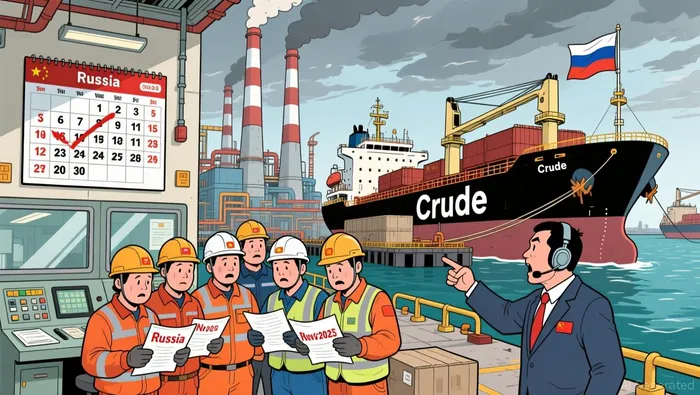
The U.S. measures, while targeting Russian entities, are reshaping global crude dynamics in ways that extend beyond Moscow’s borders. For China, the stakes are high as it navigates the transition period leading up to the Nov. 21 deadline, balancing energy security with the constraints of an evolving geopolitical and regulatory environment.

Stay ahead of the market.
Get curated U.S. market news, insights and key dates delivered to your inbox.






Comments
No comments yet