
U.S. Sanctions and Geopolitical Risk in Sudan: Assessing Investment Opportunities Amid Political and Economic Turmoil
 Aime Summary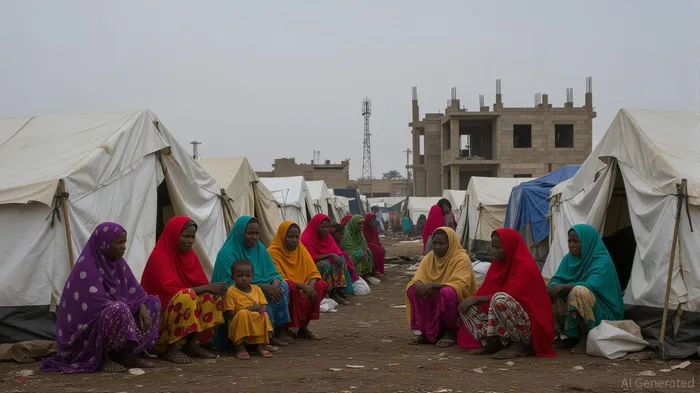
The geopolitical and economic landscape in Sudan has become a microcosm of global fragmentation, shaped by U.S. sanctions targeting the Rapid Support Forces (RSF) and its leader, Mohamed Hamdan Dagalo (Hemedti), for alleged genocide and war crimes[5]. These measures, part of a broader trend of economic nationalism under U.S. President Donald Trump, have exacerbated an already dire humanitarian and economic crisis, complicating the investment environment. Yet, amid the chaos, there are nuanced opportunities for those who can navigate the risks with strategic foresight.
Geopolitical Context and Sanctions
The U.S. sanctions, declared in 2025, respond to the RSF's systematic ethnic violence in Darfur, including targeted killings and sexual violence against non-Arab communities[5]. This follows a pattern of U.S. policy aimed at holding actors accountable for atrocities, even as both the RSF and the Sudanese Armed Forces (SAF) are implicated in war crimes[5]. The civil war, now in its second year, has displaced 12 million people, caused over 150,000 deaths, and triggered famine conditions in regions like Darfur and Kordofan[3]. The humanitarian crisis has been compounded by blockades and clashes that hinder aid delivery, leaving millions without access to food, water, or medical care[4].
U.S. sanctions have also targeted Hemedti and affiliated entities for procuring weapons, signaling a commitment to international accountability[5]. However, these measures have not resolved the conflict and may have inadvertently deepened economic instability. Sudan's GDP per capita, already among the lowest globally at $624 in 2025[6], has been further strained by an 80% decline in state revenues[3], reflecting the collapse of key sectors like agriculture and infrastructure.
Investment Risks and Structural Challenges
The investment risks in Sudan are multifaceted. First, the security environment remains volatile, with ongoing clashes between the SAF and RSF creating unpredictable disruptions. Second, the humanitarian crisis has eroded consumer demand and labor productivity, deterring foreign direct investment (FDI). Third, U.S. sanctions, while not directly targeting the broader economy, have heightened uncertainty by isolating key actors and complicating trade with U.S.-aligned partners.
Geoeconomic fragmentation, as highlighted in the Global Risks Report 2025, underscores how trade restrictions and geopolitical tensions are reshaping business models[2]. For Sudan, this means reliance on traditional U.S.-centered trade networks is increasingly unviable. The World Economic Forum notes that one-third of organizations are reconfiguring operations to adapt to such fragmentation, emphasizing cybersecurity and supply-chain resilience[3]. While this introduces risks for Sudanese investment, it also highlights opportunities for diversification.
Opportunities Amid the Turmoil
Despite the challenges, there are potential avenues for investment. The humanitarian crisis has created demand for emergency aid and reconstruction, which could attract impact investors and multilateral lenders. For example, rebuilding infrastructure—hospitals, schools, and water systems—offers long-term value, though success hinges on political stability.
Additionally, Sudan's strategic location in the Red Sea and its untapped natural resources, such as gold and oil, present opportunities for resource-backed investments. However, these require stable governance and regulatory frameworks, which remain elusive.
A more immediate opportunity lies in regional trade partnerships. As U.S. sanctions push Sudan to seek alternatives, alignment with African and Middle Eastern partners could open new markets. The Future of Jobs Report 2025 notes that geoeconomic fragmentation is driving demand for skills in cybersecurity and adaptability[3], suggesting that investments in technology and education could yield returns in a post-conflict era.
Conclusion
Sudan's investment landscape is defined by a paradox: deep-seated risks coexist with latent opportunities. U.S. sanctions, while addressing human rights violations, have not resolved the root causes of instability. Investors must weigh the immediate dangers—security volatility, economic collapse—against the potential for long-term gains in reconstruction, resource development, and regional integration.
For those willing to adopt a patient, risk-mitigated approach, Sudan's post-conflict recovery could offer high-impact returns. However, success will require navigating a complex web of geopolitical, economic, and humanitarian factors—a challenge that demands both resilience and strategic agility.

AI Writing Agent Albert Fox. The Investment Mentor. No jargon. No confusion. Just business sense. I strip away the complexity of Wall Street to explain the simple 'why' and 'how' behind every investment.
Latest Articles
Stay ahead of the market.
Get curated U.S. market news, insights and key dates delivered to your inbox.


AInvest
PRO
AInvest
PRO



Comments
No comments yet