
Sanctions vs. Diplomacy: The Structural Risks in the US-Iran Peace Talks Market
 Aime Summary
Lead
The Polymarket contract betting on the next formal senior-level round of US-Iran peace talks by April 1, 2027, captures the tension between escalating kinetic hostilities and fragile diplomatic backchannels. While recent bilateral talks between Pakistan and Iran suggest regional de-escalation efforts, the market remains deeply skeptical of imminent US-Iran engagement, particularly in the near term. Current pricing reflects a bifurcated sentiment: a near-even split for a late-2026 meeting, but a decisive skew toward failure by September 2026. This article dissects how aggressive secondary sanctions are reshaping the probability landscape, analyzing whether current prices reflect genuine geopolitical constraints or merely liquidity-driven noise.
Event Definition
This market resolves to "Yes" if the next formal, senior-level round of peace talks between the United States and Iran begins by April 1, 2027. A qualifying event requires a deliberate, in-person diplomatic meeting involving senior representatives of both governments acting in an official capacity. Technical follow-ups or non-senior engagements do not qualify. Settlement relies on official government statements or a consensus of credible media reporting confirming the meeting occurred.
Latest News & Information Increments
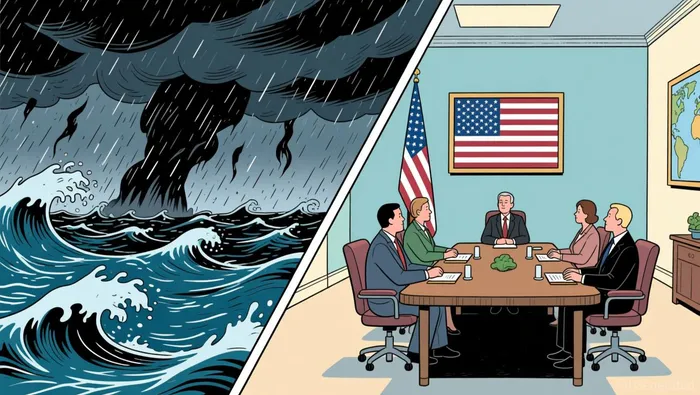
The market has been heavily influenced by a dual-track narrative: aggressive US economic isolation efforts juxtaposed with regional diplomatic mediation. On August 24, 2026, the Trump administration launched "Operation Economic Outcast," a comprehensive secondary sanctions plan targeting Iran’s vital lifelines in digital assets, technology, gold, aviation, and shipping. Treasury Secretary Scott Bessent described the move as an "economic D-Day," explicitly signaling that China, Iran’s top trading partner, would not be exempt from these penalties. This escalation was accompanied by sanctions on key military figures, including IRGC Commander-in-Chief Ahmad Vahidi, and the expansion of penalties against oil trader networks. Iran responded by warning that any country supporting US sanctions would be treated as an enemy at war, further hardening the diplomatic stance.
Simultaneously, regional mediation efforts gained momentum. Pakistan and Iran reported "significant progress" in talks held in Tehran on August 24, 2026, focusing on preventing further escalation, reopening the Strait of Hormuz, and expediting the termination of the US-Israeli war on Iran. These discussions, involving Pakistani Defence Forces chief Asim Munir and Iranian leadership, were framed as constructive steps toward a negotiated settlement. However, these bilateral talks do not constitute US-Iran negotiations. US House Speaker Mike Johnson expressed skepticism about Iran’s reliability, anticipating a new phase of conflict rather than immediate diplomatic resolution. Additionally, China stated it is actively committed to promoting peace talks, dismissing US sanctions as ineffective, which raises concerns about potential strain on bilateral ties ahead of the Trump-Xi summit. The confluence of harsh US sanctions and regional mediation creates a low-information regime regarding direct US-Iran dialogue, as the market must weigh the impact of economic strangulation against the potential for third-party brokered deals. The absence of direct US-Iran contact in this news cycle reinforces market skepticism regarding near-term meetings.
Market Resolution Rules Analysis
The resolution criteria are strict: the event must be a deliberate, in-person diplomatic meeting involving senior representatives of both governments acting in an official capacity. Technical follow-ups or non-senior engagements do not qualify. Settlement relies on official government statements or a consensus of credible media reporting confirming the meeting occurred. The time boundary is April 1, 2027, at 03:59 UTC.
Rule Risk Points & Disputed Scenarios
A primary risk lies in the distinction between qualifying senior talks and non-qualifying technical or follow-on meetings. For instance, follow-on technical talks from previous rounds will not count by themselves. Additionally, the requirement for explicit public acknowledgment or a consensus of credible media reporting creates a threshold for settlement. If a meeting occurs but is not widely reported or officially acknowledged by either government, it may not trigger a "Yes" resolution, potentially leading to disputes or delayed settlement.
Market Overview
The selected US-Iran diplomatic meeting markets exhibit a distinct probability structure ranging from near-even uncertainty to a pronounced skew toward negative outcomes. Specifically, the market for a meeting by December 31, 2026, appears to be in a state of equilibrium, with a mid-price of 0.505 and a last trade price of 0.5, suggesting a near-perfect 50/50 split in participant sentiment. In contrast, the March 31, 2027 horizon shows a clear bullish skew for a "Yes" outcome, trading at 0.675, while the September 30, 2026 window remains heavily skewed toward "No," with a "Yes" price of only 0.215. This distribution indicates that as the deadline extends, the perceived likelihood of a diplomatic breakthrough may be increasing, or conversely, that the immediate near-term constraints are viewed as more rigid than those in the medium term.
Regarding disagreement structure, the December 2026 market stands out as the primary site of high uncertainty, evidenced by its price hovering exactly at the 0.5 midpoint. This contrasts sharply with the other two markets, which display clear directional conviction; the September 2026 market is decisively skewed away from an agreement, while the March 2027 market reflects moderate confidence in a meeting occurring. The data alone cannot confirm whether this reflects fundamental geopolitical shifts or simply temporal discounting of diplomatic efforts.
In terms of volume and liquidity, all three markets demonstrate robust depth, with 24-hour volumes ranging from approximately $25,800 to $50,500 and liquidity numbers consistently above 86,000. The September 2026 market exhibits the highest 24-hour volume and liquidity, which may suggest its price is the most representative of current aggregate market sentiment, despite its lower probability score. All markets maintain tight bid-ask spreads of 0.01, indicating efficient trading conditions across the board.
Market Dynamics (Volatility & Volume)
Recent repricing activity reveals notable shifts, particularly in the longer-dated markets. The March 2027 "Yes" outcome has experienced a significant one-week price drop of 0.18, moving from a higher probability, while the September 2026 market has seen a modest one-week decline of 0.07. These changes suggest a recent cooling in optimism for later deadlines, although the absolute one-day changes remain relatively flat, implying the recent repricing occurred over a longer horizon. The market demonstrates exceptional global interest with massive trading activity, with total volume exceeding $10 million. The 24-hour trading volume between $50,000 and $150,000 indicates strong daily liquidity, supporting the current price levels. However, the divergence between the significant one-week drop in the longer-dated market and the flat one-day changes suggests that the price adjustment was driven by broader sentiment shifts rather than immediate news catalysts. This implies that the current pricing may be more reflective of long-term structural risks, such as the impact of secondary sanctions, rather than short-term diplomatic developments.
Trading Judgment & Follow-up Observation Points
The current pricing in the US-Iran peace talks market reflects a complex interplay of aggressive US economic pressure and regional diplomatic efforts. The sharp skew toward "No" in the near term (September 2026) suggests that traders do not anticipate direct US-Iran senior-level talks in the immediate future, likely due to the recent escalation in sanctions and the lack of direct engagement. However, the equilibrium in the December 2026 market and the bullish skew in the March 2027 market indicate that traders see a non-trivial probability of talks occurring later in the year or early next year, possibly facilitated by third-party mediation or a shift in US policy.
Going forward, key variables to track include: (1) any explicit public acknowledgment of US-Iran senior-level talks by either government or credible media; (2) the impact of "Operation Economic Outcast" on Iran’s economic stability and its potential to force Tehran back to the negotiating table; (3) developments in Pakistan and China’s mediation efforts, particularly ahead of the Trump-Xi summit; and (4) any changes in US political dynamics, such as the impact of the sanctions on midterm elections. Traders should also monitor the distinction between technical follow-ups and qualifying senior talks, as this distinction will be critical for market resolution. The market’s volatility, driven by sentiment shifts rather than immediate news, suggests that prices may remain sensitive to broader geopolitical narratives and liquidity flows in the near term.

Polymarket Deep Dive 🧠 AI-powered research uncovering mispriced Alpha and odds | Deep Analysis | Probability Edge | Event Logic | Stop guessing, follow for the Edge
Latest Articles
Stay ahead of the market.
Get curated U.S. market news, insights and key dates delivered to your inbox.


AInvest
PRO
AInvest
PRO




Comments
No comments yet