
Samsung warns of Q3 profit miss, what it means for the tech sector.
Samsung Electronics issued a rare apology after warning that its Q3 operating profit would fall below market expectations, with a preliminary estimate of 9.1 trillion won ($6.74 billion), down 12.8% from Q2 and below analysts’ projection of 11.456 trillion won. While sales are expected to rise 6.7% sequentially to 79 trillion won ($58.57 billion), the weaker-than-expected profit is a setback for the tech giant, which is struggling to keep pace with rivals in the AI chip market. Samsung cited inventory adjustments by mobile customers, increased supply from Chinese competitors, and delayed delivery of its high-bandwidth memory (HBM3E) chips as significant contributors to its underperformance.
Competitors like SK hynix and Micron Technology are making notable advances in the HBM space, with SK hynix recently launching mass production of the world's first 12-layer HBM3E product. These developments highlight the growing competition Samsung faces in the AI chip race, as it aims to catch up with its rivals, particularly in supplying advanced chips to major customers like Nvidia. Analysts have pointed out that the high-bandwidth memory market has become a "two-horse race" between Micron and SK hynix, raising concerns about Samsung’s ability to regain its competitive edge.
DRAM Market Share by quarter (2011-2024):
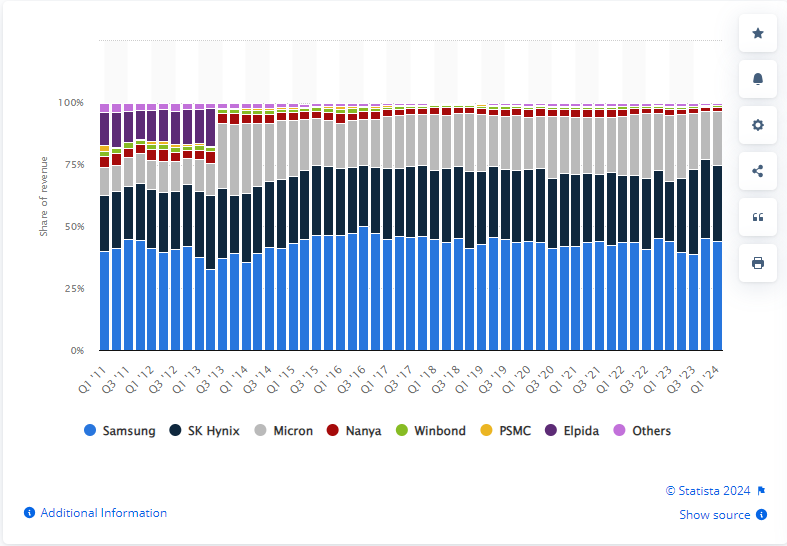
Samsung's management acknowledged the disappointing performance and the challenges it faces in maintaining its technological competitiveness, pledging to restore its market position and address internal issues. Jun Young-hyun, head of Samsung's Device Solutions Division, emphasized that the company would focus on improving its memory supply strategy and fixing organizational culture problems to prepare better for the future. This commitment will be crucial as Samsung aims to navigate the evolving chip landscape and compete more effectively against established players like SK Hynix and Micron.
The broader implications of Samsung's earnings guidance have caused ripples across the tech sector, particularly in South Korea's stock market, with Samsung's shares dropping 1.15% following the announcement. The Kospi index declined by 0.45%, and shares of SK hynix also fell 2.70%, reflecting investor concerns about the industry's overall outlook. Foreign investors have been offloading South Korean shares amid these developments, signaling a cautious stance on the region's tech and semiconductor stocks.
Commentary on the high-bandwidth memory (HBM) segment underscores the strategic importance of this technology for AI applications, with demand expected to grow as these chips become integral to next-generation processors. Samsung’s delayed shipments of HBM3E chips to major customers like Nvidia indicate potential vulnerabilities in its supply chain and raise questions about its ability to keep pace with rapidly evolving market demands. This delay gives rivals like SK hynix and Micron a window of opportunity to strengthen their positions in the AI chip market.
Samsung's Q3 earnings miss and its struggle to gain ground in the AI chip race highlight the broader challenges facing the tech industry, as companies navigate fluctuating demand, increased competition, and technological shifts. For the tech market, this underperformance emphasizes the need to adapt quickly to market changes, particularly as AI technology continues to evolve and drive demand for advanced memory solutions. Samsung's upcoming detailed financial results on October 31 will be closely watched for further insights into its recovery strategy and its efforts to regain competitiveness in the AI chip space.
Samsung Electronics has decided not to spin off its contract chip manufacturing or logic chip designing businesses, despite their ongoing financial losses, as Chairperson Jay Y. Lee recently confirmed to Reuters.
Analysts point out that these divisions have been a drag on Samsung's performance, incurring billions in annual losses due to weak demand. Samsung's expansion into logic chips and contract chip manufacturing aims to reduce its reliance on memory chips, with a long-term vision to overtake TSMC as the world's largest contract chipmaker by 2030.
Despite significant investments and new plants in South Korea and the U.S., Samsung has struggled to secure large orders to fully utilize this new capacity. Samsung also faces challenges with its chip factory in Texas, which has had its production timeline delayed to 2026, highlighting the company's difficulties in competing with TSMC, which holds major clients like Apple and Nvidia.

Senior Analyst and trader with 20+ years experience with in-depth market coverage, economic trends, industry research, stock analysis, and investment ideas.
Latest Articles
Stay ahead of the market.
Get curated U.S. market news, insights and key dates delivered to your inbox.
AInvest
PRO
AInvest
PRO



Comments
No comments yet