
Samsung Surpasses Apple in U.S. Smartphone Market Share Gain
 Aime Summary
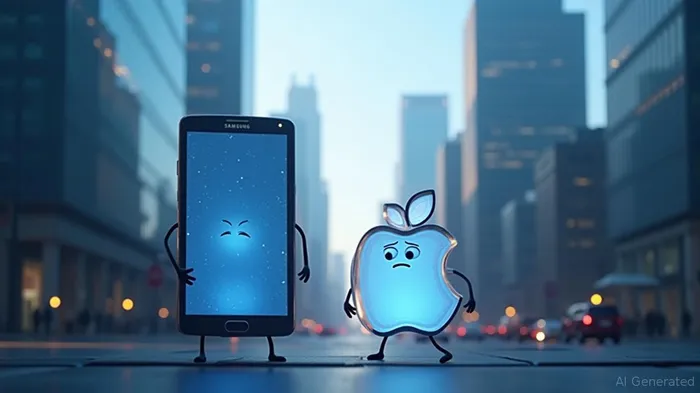
Samsung is steadily gaining ground in the U.S. smartphone market at Apple’s expense, driven by the rising demand for its foldable devices [1]. In Q2 2025, Apple’s market share in the U.S. fell from 56% to 49%, while Samsung’s share rose from 23% to 31%, according to Canalys. This marks one of the largest single-quarter shifts in recent memory and highlights the growing appeal of foldable technology [2].
Samsung’s strategy of pushing foldable innovation has proven effective, particularly with the launch of the Z Fold 7, the Z Flip, and the Galaxy S25 Edge in July. These models offer users a blend of portability and expansive display space, with the Z Fold 7 doubling as a tablet when opened. The Z Flip, which folds vertically, brings back the nostalgic flip phone form while integrating modern technology [2]. Samsung reported that the Z Fold 7 had 25% more preorders than any previous foldable model and is selling 50% faster than its predecessor [2].
The brand is also leveraging strong social media engagement. A viral video from last month showing the Z Fold 7 being folded over 200,000 times attracted over 15 million views on YouTube. Sprout SocialSPT-- recorded more than 50,000 mentions of Samsung’s premium phones in the past month, with 83% of the mentions being either neutral or positive [2].
Samsung’s success is also tied to its broader product portfolio. While Apple’s iPhone lineup remains in the $829 to $1,599 range, Samsung offers devices starting at $650 and going up to $2,400. This allows the company to target a wider range of consumers across different price points [2]. In contrast, AppleAAPL-- has yet to enter the foldable segment, with analyst Samik Chatterjee predicting its first foldable model will not arrive until September 2026 as part of the iPhone 18 line [2].
Foldable phones are also proving to be a strong fit for AI-driven features. Samsung phones come with access to Google’s Gemini AI model, which outperforms Apple’s Siri in most functions. Samsung VP Drew Blackard noted that features like circle-to-search work better on foldable screens, allowing for enhanced multitasking across dual displays [2].
Meanwhile, Apple’s next-gen Siri has been delayed until 2025, raising concerns about its ability to compete in the AI space. This delay comes as OpenAI, which recently spent $6.5 billion to acquire the design team led by Apple’s former chief designer Jony Ive, moves forward with screen-free hardware innovations [2].
Apple’s reluctance to enter the foldable market quickly aligns with its historical strategy of waiting for a technology to mature before adoption. However, the growing market share gains by Samsung and the stock performance—up 35% year-to-date compared to Apple’s 7.5% decline—suggest that investors are already betting on the future of flexible form factors [2].
While Apple remains a dominant player in the U.S. smartphone market, the rise of foldable phones is reshaping consumer expectations and giving Samsung a unique edge. As the technology continues to evolve, Apple may need to rethink its approach to maintain its position in the premium segment [1].
Source:
[1] title1.....................................(https://www.cnbc.com/)
[2] title2.....................................(https://coinmarketcap.com/community/articles/68a0c96df833201578471c58/)

Stay ahead of the market.
Get curated U.S. market news, insights and key dates delivered to your inbox.




Comments
No comments yet