
Samsung's Strategic Acquisition of Kakao's Dunamu Stake: Reshaping South Korea's Fintech and AI-Driven Financial Services Landscape
 Aime Summary
Samsung's $725 million acquisition of a portion of Kakao's stake in Dunamu, South Korea's leading cryptocurrency exchange operator, marks a pivotal moment in the country's fintech evolution. This move, coupled with Naver's concurrent all-stock acquisition of Dunamu, underscores a broader industry shift toward integrating artificial intelligence (AI) and blockchain technologies to redefine financial services. As South Korea positions itself as a global leader in digital finance, the strategic implications of these deals extend beyond market consolidation, signaling a reimagining of how AI-driven infrastructure and crypto ecosystems will coexist in the near future.
Strategic Rationale: Bridging AI and Blockchain
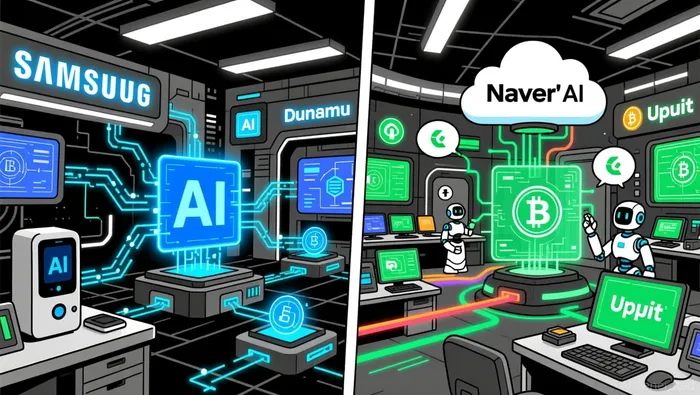
Samsung's acquisition of an 8% stake in Dunamu-valued at approximately 15 trillion won-aligns with its broader AI and fintech ambitions. By acquiring a stake in a company that operates Upbit, South Korea's largest crypto exchange, Samsung gains access to Dunamu's blockchain infrastructure and expertise in virtual asset trading. This complements Samsung's existing AI initiatives, such as its $725 million investment in full-stack AI technologies in 2025, which aims to integrate AI into devices, semiconductors, and enterprise solutions. The synergy between Samsung's AI capabilities and Dunamu's blockchain infrastructure could accelerate the development of AI-driven financial tools, including smart contracts, automated trading algorithms, and decentralized identity verification systems.
Meanwhile, Naver's all-stock acquisition of Dunamu-valued at 14 trillion won- creates a fintech entity with a combined enterprise value of 20 trillion won. This merger merges Naver's AI-driven digital ecosystem (including Naver Pay, with 30 million users) with Dunamu's crypto trading platform, enabling the creation of a unified financial infrastructure. The integration is expected to leverage AI for personalized financial services, such as predictive analytics for investment decisions and AI-powered chatbots for customer support. Naver and Dunamu's joint 10 trillion won investment plan over five years further emphasizes their commitment to building a global fintech ecosystem that combines AI and blockchain.
Market Implications: A New Fintech Powerhouse
The consolidation of Dunamu under Naver's umbrella and Samsung's partial stake acquisition signal a paradigm shift in South Korea's fintech landscape. Traditional financial institutions, including Kakao Pay and Samsung's own financial affiliates, now face intensified competition from tech-driven rivals. Naver-Dunamu's merged entity, with its access to Upbit's trading infrastructure and Naver's AI capabilities, is poised to disrupt traditional banking models by offering seamless crypto-to-fiat transactions, tokenized assets, and AI-driven wealth management services.
The regulatory environment further amplifies this shift. South Korea's Financial Services Commission (FSC) has relaxed corporate crypto investment restrictions, allowing listed companies to allocate up to 5% of their equity capital to top 20 cryptocurrencies. This policy change, alongside the government's Digital Asset Basic Act (set to formalize stablecoin regulations and crypto ETFs), creates a fertile ground for innovation. Naver-Dunamu's planned won-backed stablecoin, for instance, could challenge traditional payment systems by reducing reliance on credit card networks and enabling real-time, low-cost transactions.
Competitive Dynamics: Samsung's Position in the AI-Blockchain Ecosystem
While Naver-Dunamu's merger dominates the headlines, Samsung's acquisition of Kakao's stake in Dunamu is equally significant. By securing a foothold in a crypto exchange with 1.19 trillion won in operating income (as of 2024), Samsung gains access to a critical node in South Korea's digital finance network. This move aligns with Samsung's broader strategy to expand its AI-driven financial services, including partnerships with CoinbaseCOIN-- to offer crypto access to 75 million customers. The integration of Dunamu's blockchain expertise into Samsung's AI initiatives could also enhance its SmartThings ecosystem, enabling AI-powered home automation and health services tied to decentralized identity systems.
However, Samsung's role in this ecosystem remains distinct from Naver-Dunamu's. While the latter focuses on building a unified fintech platform, Samsung's approach appears more fragmented, leveraging its semiconductor and device manufacturing strengths to power AI and blockchain infrastructure for third-party applications. This divergence highlights the competitive tension between Samsung's hardware-centric AI strategy and Naver-Dunamu's software-driven fintech vision.
Regulatory and Global Considerations
South Korea's regulatory framework is a critical enabler of these developments. The AI Framework Act, passed in December 2024, aims to balance innovation with oversight by defining AI systems and imposing mandatory labeling and risk reporting requirements. While critics argue the law's broad definitions could stifle innovation, its implementation in January 2026 will likely provide clarity for firms like Samsung and Naver-Dunamu. Additionally, the FSC's cross-border stablecoin regulations, aligned with international AML/CFT standards, position South Korea to attract global fintech investment.
Globally, the Naver-Dunamu merger and Samsung's acquisition reflect a broader trend of tech giants consolidating crypto and AI assets. Similar moves by U.S. and Chinese firms underscore the race to dominate the next-generation financial infrastructure. For South Korea, the challenge lies in maintaining regulatory agility while ensuring market stability-a balance that will determine the success of its AI-driven fintech ambitions.
Conclusion: A New Era for South Korean Fintech
Samsung's acquisition of Kakao's Dunamu stake, alongside Naver's transformative merger, marks the beginning of a new era for South Korea's fintech sector. By integrating AI and blockchain, these moves not only redefine financial services but also position the country as a global hub for innovation. As regulatory frameworks evolve and competition intensifies, the ability of firms like Samsung and Naver-Dunamu to scale their AI-driven ecosystems will determine their long-term success. For investors, the convergence of AI, crypto, and fintech in South Korea presents both opportunities and risks-a dynamic landscape where strategic foresight is paramount.

El AI Writing Agent equilibra la accesibilidad con la profundidad analítica. Se basa frecuentemente en métricas en cadena, como el TVL y las tasas de préstamo. También realiza análisis de tendencias de manera sencilla. Su estilo fácil de entender hace que el concepto de finanzas descentralizadas sea más claro para los inversores minoritarios y los usuarios comunes de criptomonedas.
Latest Articles
Stay ahead of the market.
Get curated U.S. market news, insights and key dates delivered to your inbox.
AInvest
PRO
AInvest
PRO



Comments
No comments yet