
Samsung secures $16.5B Tesla contract, shares up 7%
 Aime Summary
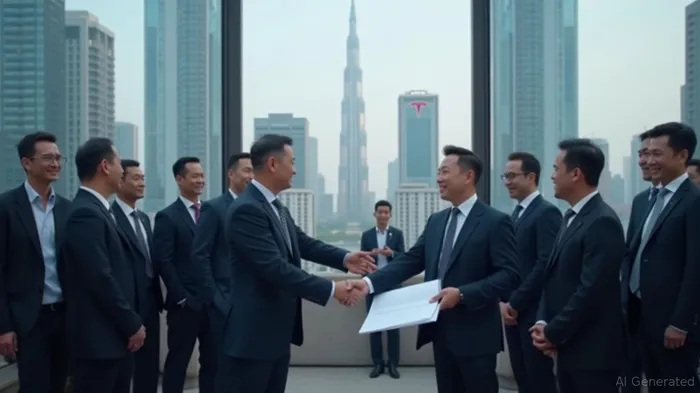
Samsung Electronics has secured a $16.5 billion contract to produce AI semiconductors for TeslaRACE--, marking a strategic pivot for the South Korean tech giant’s foundry division. The agreement, announced on July 29, 2025, involves constructing a new chip manufacturing plant in Taylor, Texas, to support Tesla’s AI6 chip development. Construction is expected to conclude by 2026, with the deal spanning through 2033. The partnership aims to bolster Samsung’s foundry operations, which have faced financial losses amid global competition, while enabling Tesla to reduce reliance on imported components and mitigate U.S. tariff risks [1].
The deal underscores Samsung’s bid to reclaim market share in the semiconductor sector. Its foundry business, long overshadowed by industry leader TSMCTSM--, has struggled with capacity underutilization and operational costs. By securing a high-profile client like Tesla, Samsung hopes to attract more customers and stabilize its financial position. The Texas facility, located near Austin—a hub for tech manufacturing—aligns with broader industry trends of localizing production to navigate geopolitical trade tensions. Tesla, meanwhile, seeks to integrate U.S.-made components into its autonomous vehicle strategy, a move that could enhance cost efficiency and regulatory compliance [1].
Market reactions were immediate. Samsung’s shares surged approximately 7% on the Korea Exchange, reflecting investor optimism about the deal’s potential to revive its foundry division. Tesla’s stock also rose modestly on the Nasdaq, signaling confidence in its supply chain diversification. Analysts note that the partnership could intensify competition in the AI semiconductor space, where demand for specialized chips is growing rapidly. However, Samsung’s ability to execute the project successfully will depend on factors such as timely construction, adherence to cost estimates, and maintaining Tesla’s trust in its manufacturing capabilities [1].
Tesla’s decision to partner with Samsung also highlights broader shifts in the automotive and tech industries. As electric vehicles and AI-driven systems become increasingly complex, automakers are prioritizing vertical integration and secure chip supplies. The Texas plant, if completed as planned, could serve as a model for future collaborations between tech manufacturers and automotive firms. For Samsung, the deal represents a critical opportunity to reposition its foundry business in a market dominated by TSMC and IntelINTC--, while demonstrating its capacity to deliver large-scale, cutting-edge projects [1].
The agreement’s success will hinge on both companies navigating overlapping challenges. Samsung must address its foundry’s historical struggles with profitability, while Tesla must ensure the AI6 chip meets performance benchmarks for autonomous driving. The deal’s $16.5 billion scale—among the largest in semiconductor history—also raises questions about cost management and long-term returns. However, the immediate stock price gains suggest that investors believe both firms can capitalize on their respective strengths: Samsung’s manufacturing expertise and Tesla’s innovation in AI and electric vehicles [1].
In the broader context, the partnership reflects the semiconductor industry’s evolving dynamics. As AI adoption accelerates, demand for custom chips tailored to specific applications is surging. Samsung’s focus on AI semiconductors aligns with this trend, positioning it to compete in a market where TSMC has traditionally held an edge. The Texas plant could also become a strategic asset, enabling Samsung to cater to other U.S.-based clients seeking to avoid international trade barriers. For Tesla, the move reinforces its strategy of embedding advanced AI capabilities into its vehicles, a differentiator in an increasingly competitive market [1].
The deal’s long-term implications remain to be seen, but its execution will be closely watched by investors and industry observers. Samsung’s foundry division has long been a battleground for global tech leaders, and this partnership with Tesla could mark a turning point. Similarly, Tesla’s reliance on U.S.-manufactured components may influence how other automakers and tech firms approach supply chain strategies in the AI era [1].
Source: [1] title:Samsung Electronics scores a major Tesla deal (url:https://fortune.com/2025/07/29/samsung-ai-semiconductors-tesla-cadence-design-meta-nvidia-paypal-tea/)

Stay ahead of the market.
Get curated U.S. market news, insights and key dates delivered to your inbox.


AInvest
PRO
AInvest
PRO



Comments
No comments yet