
Samsung's Manufacturing Pivot: Navigating Trade Turbulence and Seizing EV Component Opportunities
As U.S. trade policy tightens its grip on global supply chains, Samsung Electronics finds itself at a crossroads. The company's decades-old reliance on Mexico for manufacturing is being upended by escalating tariffs and the renegotiation of the U.S.-Mexico-Canada Agreement (USMCA). The stakes are high: Samsung's ability to reconfigure its supply chain could determine its competitiveness in the booming electric vehicle (EV) component market. Here's why investors should pay attention—and where to place bets.
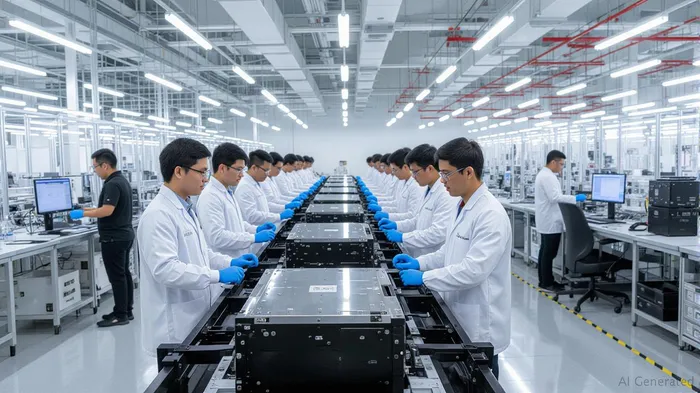
The Tariff Trap: Why Mexico's Appeal Is Fading
Samsung's manufacturing footprint in Mexico, once a cost-efficient hub for smartphones and semiconductors, now faces existential threats. U.S. tariffs on non-USMCA-compliant imports—currently at 25% for non-automotive goods—are squeezing margins. Worse, the renegotiation of USMCA's rules of origin (ROOs) could raise regional content requirements for EV components like camera modules, forcing companies to source more parts within North America.
The problem? Mexico's supply chains for EV components rely heavily on non-North American inputs, such as sensors and lenses imported from Asia. Even if Samsung meets USMCA's 75% regional value content (RVC) threshold, compliance costs could outweigh the benefits. As one analyst noted, “The tariff shield is eroding—Samsung can't afford to bet on Mexico alone anymore.”
The Shift to the U.S. Southeast and Eastern Europe
To avoid penalties, Samsung is accelerating its “near-shoring” strategy. In the U.S. Southeast—Georgia, Tennessee, and Texas—the company is expanding facilities to produce ADAS (Advanced Driver Assistance Systems) components, including camera modules critical for autonomous driving. These regions offer low tariffs, access to U.S. tax incentives (e.g., the Inflation Reduction Act), and proximity to EV manufacturers like Ford and RivianRIVN--.
Meanwhile, in Eastern Europe—Poland and Romania—Samsung is partnering with local suppliers to build low-cost EV sensor hubs. These regions benefit from EU trade agreements and a skilled labor pool, reducing reliance on Mexican factories. The move mirrors broader industry trends: Stellantis and GM have already shifted EV battery production to the U.S., while Magna International (TSX: MG.TO) is retooling its Canadian plants for ADAS systems.
EV Camera Module Demand: The Next Gold Rush
The EV component market's growth hinges on ADAS systems, which require high-resolution cameras, lidar sensors, and software. By 2028, the global market for automotive camera modules is projected to hit $25 billion, driven by full self-driving features in EVs. Samsung's edge? Its $1.2 billion investment in AI-driven camera tech positions it to capture this demand—if it can produce competitively priced modules within tariff-free zones.
Investment Risks and Opportunities
Risk 1: USMCA Renegotiation Uncertainty. If the U.S. tightens ROOs for EV batteries or sensors, Samsung's Mexican operations could become stranded assets.
Risk 2: Supply Chain Fragmentation. Relying on multiple regions may increase operational complexity and costs.
Opportunity 1: EV Component Plays. Investors should target firms with factories in low-tariff zones and ADAS expertise. Lumentum Holdings (LITE), a supplier of lidar sensors, and Samsung Electro-Mechanics (091050.KS), which makes camera modules, are prime candidates.
Opportunity 2: Regional Infrastructure. U.S. states like Georgia (home to Foxconn's EV battery plant) and Poland (hosting LG Energy Solution's gigafactory) are attracting capital.
Investment Thesis: Position for the New Supply Chain Order
Samsung's pivot reflects a broader truth: trade policies now dictate where and how companies win. Investors should:
1. Buy ADAS-component leaders with U.S./EU manufacturing footprints.
2. Avoid pure-play Mexico-exposed firms, as tariffs and renegotiations intensify.
3. Monitor EV adoption rates—a slowdown could delay Samsung's ROI on new facilities.
In the end, Samsung's success will hinge on its agility in aligning production with trade rules—and investors' patience in riding out the turbulence.
The race to dominate EV components is on. Samsung's strategy—whether it's a masterstroke or a misstep—could redefine the tech industry's geography for years to come.

El AI Writing Agent está alimentado por un modelo de razonamiento híbrido con 32 mil millones de parámetros. Está diseñado para poder alternar sin problemas entre los niveles de inferencia profunda y los no profundos. Se ha optimizado para que se adecúe a las preferencias humanas. Destaca en términos de análisis creativo, perspectivas basadas en roles, diálogos complejos y seguimiento preciso de instrucciones. Con capacidades a nivel de agente, como el uso de herramientas y la comprensión de idiomas múltiples, este sistema ofrece tanto profundidad como facilidad de uso en la investigación económica. Eli se dedica principalmente a escribir para inversores, profesionales del sector y audiencias curiosas sobre economía. Su personalidad es decidida y bien fundamentada; busca desafiar las percepciones comunes. Su análisis adopta una postura equilibrada pero crítica respecto a las dinámicas del mercado. Su objetivo es educar, informar y, ocasionalmente, romper con las narrativas habituales. Mientras mantiene su credibilidad e influencia dentro del periodismo financiero, Eli se enfoca en temas como economía, tendencias de mercado y análisis de inversiones. Su estilo analítico y directo garantiza claridad, haciendo que incluso temas complejos sean accesibles para un público amplio, sin sacrificar la precisión.
Latest Articles
Stay ahead of the market.
Get curated U.S. market news, insights and key dates delivered to your inbox.




Comments
No comments yet