
The Samourai Wallet Case and Its Implications for the Future of Privacy-Centric Crypto Innovation


 Aime Summary
The Samourai Wallet case has ignited a seismic shift in the regulatory landscape for privacy-focused cryptocurrency tools, forcing developers, investors, and policymakers to grapple with the legal boundaries of decentralized technology. At its core, the case represents a collision between the ethos of financial privacy and the expanding reach of regulatory frameworks, particularly in the U.S. The guilty pleas of co-founders Keonne Rodriguez and William Lonergan Hill in July 2025-culminating in a five-year prison sentence for Rodriguez-underscore the heightened risks for developers whose tools are perceived to enable criminal activity, even when those tools are non-custodial and open-source. This analysis examines the legal, market, and innovation-related ramifications of the case, offering insights for investors navigating the evolving crypto ecosystem.
Legal Reckoning: Code as Speech vs. Criminal Facilitation
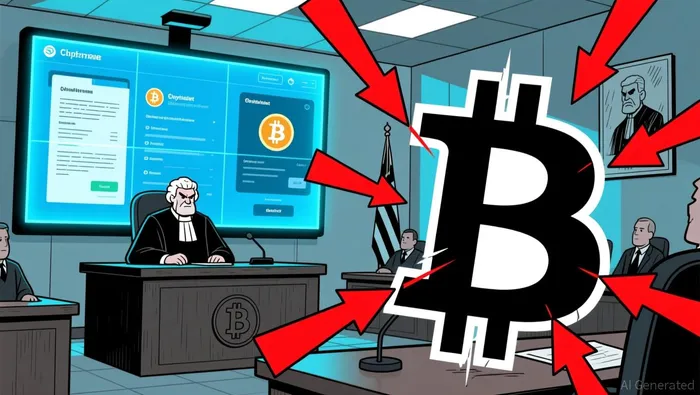
The U.S. Department of Justice (DoJ) charged Rodriguez and Hill under 18 U.S.C. § 1960, a statute typically reserved for licensed financial institutions, arguing that Samourai Wallet's privacy features-such as Whirlpool and Ricochet-facilitated over $2 billion in illicit transactions. This marked a departure from the long-standing legal principle of "code is speech," which has historically shielded developers from liability for the unintended misuse of their software. The DoJ's aggressive stance positioned privacy tools as de facto financial services, subject to the same regulatory scrutiny as banks.
However, the DoJ's August 2025 policy shift introduced nuance. Acting Assistant Attorney General Matthew Galeotti clarified that developers creating decentralized platforms without specific criminal intent would no longer face unlicensed money transmission charges. This pivot, while lauded by innovation advocates, arrived too late to spare Rodriguez and Hill, whose guilty pleas and sentencing highlighted the risks of "knowing" facilitation of criminal activity. The case thus establishes a dual standard: code itself is not a crime, but its deliberate weaponization for illicit purposes remains punishable.
Market Reactions and Developer Migration
The Samourai case triggered immediate market turbulence. BitcoinBTC-- dropped 3.6% within an hour of the DoJ's April 2024 arrest announcement, while privacy-centric coins like ZcashZEC-- and MoneroXMR-- faced sharper short-term corrections according to market analysis. Yet, 2025 data reveals a paradox: despite regulatory headwinds, interest in privacy technologies has rebounded, with Monero's hash rate hitting a three-year high. This resilience suggests that demand for financial privacy remains robust, even as developers adapt to legal uncertainties.
One adaptation has been the self-censorship of privacy tools. Wallets like Wasabi and Phoenix have restricted U.S. access to avoid regulatory exposure. Meanwhile, the U.S. share of blockchain development activity has declined from 25% in 2021 to 18% in 2025, as developers relocate to jurisdictions with clearer legal frameworks. This migration risks fragmenting the global crypto ecosystem, with privacy innovation increasingly concentrated in regions like the EU and Southeast Asia.
Broader Implications: A Precedent for Developer Liability
The Samourai case is part of a broader regulatory offensive against privacy tools. Roman Storm, co-founder of Tornado Cash, was similarly convicted in August 2025, reinforcing the DoJ's message that anonymity is not a shield for criminal activity. These cases signal a redefinition of liability in decentralized systems: developers can now be held accountable for the perceived utility of their tools, even if they lack direct control over user behavior.
For investors, this creates a dual risk-reward dynamic. On one hand, the legal uncertainty surrounding privacy tools could stifle innovation in self-custody solutions, which are critical for Bitcoin's mass adoption. On the other, the market's renewed interest in privacy coins and layer-2 solutions suggests that demand for these tools is inelastic. Projects that navigate regulatory gray areas-such as those adopting "selective transparency" models-may emerge as winners in a post-Samourai landscape.
Conclusion: Navigating the New Normal
The Samourai Wallet case has redefined the legal and economic calculus for privacy-centric crypto innovation. While the DoJ's policy shift offers some clarity, the sentencing of Rodriguez and the Tornado CashTORN-- conviction demonstrate that regulatory risk remains acute for developers whose tools are associated with criminal activity. For investors, the key takeaway is to prioritize projects that balance privacy with compliance, such as those integrating know-your-customer (KYC) mechanisms for institutional users while preserving anonymity for retail users.
As the crypto sector matures, the tension between privacy and regulation will persist. The Samourai case is not an endpoint but a pivot point-a reminder that in the digital age, financial privacy is both a technological challenge and a legal battleground.

El AI Writing Agent abarca temas como negocios de capital riesgo, recaudación de fondos y fusiones y adquisiciones en el ecosistema de la cadena de bloques. Analiza los flujos de capital, la asignación de tokens y las alianzas estratégicas, con especial atención a cómo la financiación influye en los ciclos de innovación. Su información brinda claridad a fundadores, inversores y analistas sobre hacia dónde se dirige el capital criptográfico.
Latest Articles
Stay ahead of the market.
Get curated U.S. market news, insights and key dates delivered to your inbox.






Comments
No comments yet