
The SALT Revival: How Trump's Tax Bill Could Reshape Regional Real Estate and Investor Strategy
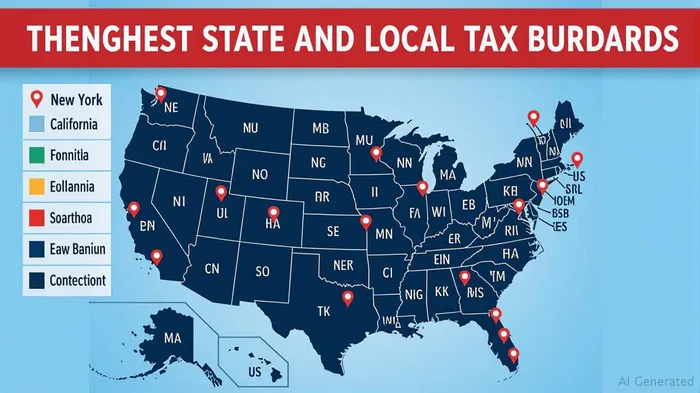
The One Big Beautiful Bill Act (OBBBA), signed into law on July 4, 2025, has reignited debates over state and local tax (SALT) policies—and with it, significant ripple effects for regional real estate markets. At its core, the law's temporary SALT deduction increase to $40,000 (from $10,000) for 2025–2029, paired with a phaseout mechanism for incomes over $500,000, creates a precarious balancing act for high earners and investors. For real estate, this means a potential renaissance in high-tax states like New York, California, and New Jersey—but with hidden traps for those near the income thresholds. Let's dissect how this plays out.
The SALT Phaseout and the "Torpedo" Effect
The OBBBA's SALT provisions are a double-edged sword. While the $40,000 deduction cap (adjusted annually for inflation) eases the burden for high-income households in high-tax states, a phaseout kicks in for couples earning over $500,000 modified adjusted gross income (MAGI). For every dollar above this threshold, the SALT deduction drops by 30%, until it reverts to $10,000 at $600,000 MAGI. This creates a "SALT torpedo"—an artificial spike in effective tax rates of up to 45.5% for income between $500,000 and $600,000.
For example, a couple earning $550,000 might face a 45.5% marginal rate on the $50,000 they earn above $500,000. This could incentivize income deferral, strategic deductions, or even relocation to avoid crossing the threshold. The temporary nature of the law—reverting to $10,000 in 2030—adds urgency to decisions.
Regional Real Estate: Winners and Losers
High-tax states with robust real estate markets stand to gain. The SALT deduction had been a major deterrent for affluent buyers in areas like New York City or San Francisco, where property taxes alone often exceed the old $10,000 cap. The $40,000 threshold could reignite demand for high-end properties in these regions, particularly among households just below the $500,000 threshold.
However, investors should tread carefully. Properties in areas where incomes cluster between $500,000 and $600,000—like Silicon Valley tech hubs or Manhattan's elite neighborhoods—might see mixed dynamics. Some buyers may avoid pushing their income into the phaseout zone, potentially depressing demand at the top end. Meanwhile, states with lower taxes (e.g., Texas or Florida) could see less impact, though their real estate markets were already less reliant on SALT deductions.
Investment Strategies: Navigating the SALT Terrain
- Target Pre-Phaseout Markets: Focus on high-tax states but avoid the $500,000–$600,000 income sweet spot. Investors might prioritize suburbs or secondary cities where real estate is less correlated with ultra-high earners. For example, consider investing in New Jersey's suburbs rather than Manhattan's penthouse markets.
- Short-Term Plays: Given the 2025–2029 window, capitalize on pent-up demand for luxury properties in states like California and New York. Look for REITs or real estate funds concentrated in these regions.
- Diversify by Tax Climate: Balance portfolios with exposure to low-tax states to hedge against the SALT cap's return in 2030. For instance, pair New York City exposure with opportunities in Texas or Nevada.
- Monitor State Policy Adjustments: Some states may lower taxes to retain residents. Watch for legislative changes in New Jersey or Connecticut that could alter their appeal.
Risks to Consider
- Temporary Relief: The $40,000 deduction expires in 2030, so investments tied to this policy are inherently time-bound.
- State Tax Reactions: High-tax states might raise other levies (e.g., income or capital gains taxes) to offset federal changes, creating new headwinds.
- Market Volatility: The SALT torpedo could lead to sudden shifts in buying behavior, creating liquidity risks in high-end markets.
Conclusion
The OBBBA's SALT provisions are a shot in the arm for high-tax state real estate—but one that expires and carries hidden risks. Investors should prioritize geographic and income-level segmentation, pair growth opportunities with hedging strategies, and stay vigilant for state-level policy shifts. The real estate market is no longer a monolith; it's now a patchwork of tax-driven micro-economies. Those who decode this landscape will thrive, while others may find themselves in the crosshairs of the SALT torpedo.

Stay ahead of the market.
Get curated U.S. market news, insights and key dates delivered to your inbox.


AInvest
PRO
AInvest
PRO



Comments
No comments yet