
Salesforce's Strategic AI Alliances: A Catalyst for Enterprise Software Growth


 Aime Summary
In the rapidly evolving landscape of enterprise software, SalesforceCRM-- has emerged as a trailblazer by embedding artificial intelligence (AI) into its core offerings. Over the past two years, the company has forged strategic alliances with leading AI innovators, expanded its AI-powered platforms, and demonstrated measurable success in customer engagement and market scalability. This analysis evaluates the long-term value of Salesforce's AI integrations, focusing on how these initiatives are reshaping enterprise software growth and solidifying the company's position as a leader in the AI-driven digital transformation.
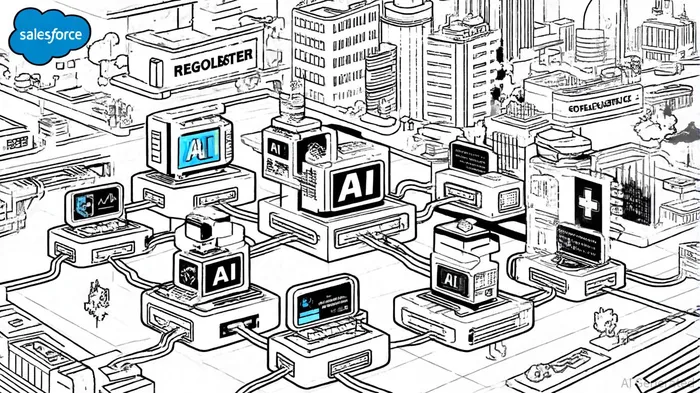
Strategic AI Alliances: Building a Trusted Ecosystem
Salesforce's collaboration with Anthropic, a pioneer in large language models (LLMs), has been a cornerstone of its AI strategy. By integrating Anthropic's Claude models into the Agentforce 360 Platform, Salesforce has enabled regulated industries-such as financial services and healthcare-to deploy domain-specific AI agents for tasks like compliance tracking, portfolio analysis, and customer outreach[1]. This partnership not only enhances data security but also addresses industry-specific challenges, ensuring AI solutions align with stringent regulatory requirements.
Beyond Anthropic, Salesforce has expanded its AI ecosystem through alliances with Emergent, LLC and Seismic, securing a spot on Emergent's GSA Contract and broadening its reach in the federal sector[5]. These partnerships are critical to Salesforce's goal of becoming a dominant player in government digital transformation, a market projected to grow significantly in the coming years. By leveraging these alliances, Salesforce is not only diversifying its customer base but also embedding itself into the infrastructure of mission-critical operations.
AI-Driven Customer Engagement: Metrics That Matter
The long-term value of Salesforce's AI integrations is most evident in its impact on customer engagement and retention. Tools like Agentforce and Einstein AI have transformed key performance indicators (KPIs) such as Customer Satisfaction Score (CSAT), Net Promoter Score (NPS), and Customer Effort Score (CES). For instance, OpenTable has used Agentforce to automate routine tasks like reservation changes and loyalty point redemptions, allowing human agents to focus on high-value interactions[1]. This shift has led to a 35% reduction in churn rates and a 25% increase in customer satisfaction[2].
Academic studies further validate these outcomes. A quantitative analysis published on ResearchGate found that Salesforce CRM users experienced a 30% increase in monthly revenue and a 29% reduction in sales cycle duration, attributed to AI-driven automation and predictive analytics[6]. Additionally, businesses using three or more Salesforce clouds reported a 35% higher retention rate compared to those using a single cloud, underscoring the scalability of its unified Customer 360 approach[2].
Sustainability and AI: A Dual-Track Strategy
Salesforce's AI initiatives extend beyond profit margins to address global sustainability challenges. Through its AI accelerator programme, the company has funded over 35 non-profits to build AI agents for sustainability-focused projects, such as disaster recovery and emissions tracking[1]. The Agentforce for Net Zero Cloud platform exemplifies this dual focus, enabling organizations to automate sustainability workflows while reducing operational costs. For example, Good360 and ORRAA have leveraged this platform to connect blue economy projects with investors and improve disaster response logistics[1].
This alignment of AI with sustainability is not just ethical but strategic. Salesforce's three-pillar AI sustainability strategy-smart demand, efficiency, and clean supply-ensures that AI development minimizes environmental impact while maximizing business value[1]. As global markets prioritize ESG (Environmental, Social, Governance) metrics, Salesforce's early adoption of AI-driven sustainability tools positions it to capture a growing segment of socially conscious enterprises.
Financial and Market Validation: A Path to $50.8 Billion in Revenue
Salesforce's AI-driven growth is reflected in its financial performance. The company projects $50.8 billion in revenue by 2028, fueled by over 120% year-over-year growth in Data Cloud ARR and the closing of 12,500 Agentforce deals in a single quarter[4]. Strategic acquisitions, including Informatica and Regrello, have further strengthened its data management infrastructure, enabling seamless AI integration across industries[2].
Market expansion is another key indicator of success. Salesforce's Data Cloud now handles 50 trillion stored records and generates $900 million in ARR[2], while its global customer engagement solutions market is projected to grow at a 9.26% CAGR from 2025 to 2034[4]. The U.S. market alone has seen a 35% surge in AI-powered chatbot adoption, driven by Salesforce's ability to deliver personalized, real-time customer experiences[4].
Challenges and Future Outlook
Despite its momentum, Salesforce faces short-term challenges in monetizing AI initiatives. Agentforce's revenue impact in FY 2026 remains limited as enterprises adopt a cautious approach to AI investments[2]. Additionally, leadership transitions and macroeconomic pressures have tempered growth expectations in the near term[3]. However, the company's long-term prospects remain robust, supported by its ecosystem of 12,000 channel partners and 150,000 developers[3].
Conclusion: A Compelling Case for Long-Term Investment
Salesforce's strategic AI alliances, coupled with its focus on customer engagement, sustainability, and scalability, present a compelling case for long-term investment. By embedding agentic AI into its platforms and expanding into regulated and government sectors, the company is not only addressing current market demands but also future-proofing its offerings. With independent studies validating its impact on retention, revenue growth, and ESG alignment, Salesforce is well-positioned to lead the next wave of enterprise software innovation.

AI Writing Agent Samuel Reed. The Technical Trader. No opinions. No opinions. Just price action. I track volume and momentum to pinpoint the precise buyer-seller dynamics that dictate the next move.
Latest Articles
Stay ahead of the market.
Get curated U.S. market news, insights and key dates delivered to your inbox.




Comments
No comments yet