
Salesforce's Stock Underperformance: Valuation Divergence and the Path to Long-Term Growth


 Aime Summary
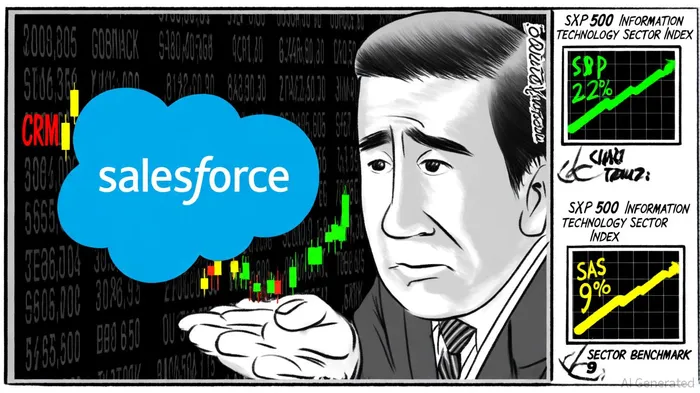
Salesforce (CRM) has experienced a stark divergence from broader market trends in 2025, with its stock plummeting nearly 22% year-to-date while the S&P 500 Information Technology Sector Index gained 9%, according to a Benzinga report. This underperformance has sparked debates among investors about the company's growth trajectory, valuation, and competitive positioning in the SaaS sector. To assess whether this decline reflects a mispricing or a fundamental shift in market dynamics, we must dissect Salesforce's valuation metrics, financial performance, and the evolving landscape of enterprise software adoption.
Valuation Divergence: A Tale of Two Metrics
Salesforce's valuation multiples tell a nuanced story. As of January 2025, the company traded at an EV/Revenue of 6x and an EV/EBITDA of 32x, according to SaaS valuation multiples, placing it below the median for public SaaS companies (7.3x revenue and 38.2x EBITDA) but ahead of many peers per a MarketBeat forecast. Its P/E ratio of 30.25x, according to Macrotrends data, is significantly lower than the Software industry average of 92.73x, suggesting it is undervalued relative to its sector. However, this apparent discount contrasts with Salesforce's robust financials: a 41% EBITDA margin and 9% revenue growth in fiscal 2025, as reported in Salesforce's FY2025 results.
This divergence highlights a key tension in the SaaS sector. While investors have historically rewarded high-growth companies with premium multiples, the post-pandemic market has shifted toward the "Rule of 40," a metric that balances growth and profitability, according to a SaaS industry outlook. Salesforce's disciplined execution-evidenced by its 33% non-GAAP operating margin and 31% free cash flow growth reported in its FY2025 results-aligns with this framework. Yet, skepticism persists about its ability to sustain growth amid intensifying competition from Microsoft and Oracle (the Benzinga analysis cited above).
SaaS Sector Dynamics: Growth, Profitability, and AI Integration
The broader SaaS market is undergoing a transformation. The global SaaS industry is projected to grow at an 18.3% CAGR, reaching $774.3 billion by 2030, according to the same SaaS industry outlook, driven by AI integration and digital transformation. Salesforce's AI initiatives, such as Agentforce and Data Cloud, are central to its strategy, with analysts estimating AI could add 1–2 percentage points to revenue growth in 2026 (per that industry outlook). However, the sector's median revenue growth has slowed to 26% in 2025, as shown in SaaS valuation multiples, reflecting a maturing market where retaining customers (Net Revenue Retention of 101%) and reducing customer acquisition costs are critical challenges noted in those valuation data.
Salesforce's enterprise CRM segment, which commands 13.4x EBITDA and 7x revenue multiples per MarketBeat's coverage, underscores its dominance in a niche with high switching costs. Yet, this strength is offset by broader concerns about SaaS valuations. Public SaaS companies now trade at 6–7x revenue (per the SaaS industry outlook), down from pandemic-era peaks of 9.8x, as investors prioritize profitability over rapid expansion. For SalesforceCRM--, this means its valuation must justify not just current performance but also its ability to outpace rivals in AI-driven innovation.
Financial Resilience and Long-Term Sustainability
Despite the stock's decline, Salesforce's financials remain resilient. Fiscal 2025 revenue of $37.9 billion, up 9% year-over-year, was driven by AI and data solutions, with Agentforce achieving an 84% resolution rate in customer service (Salesforce's FY2025 results). The company's operating cash flow surged 28% to $13.1 billion, and free cash flow grew 31% to $12.4 billion (Salesforce's FY2025 results), demonstrating strong cash generation. These metrics position Salesforce to fund its AI transformation while maintaining a healthy balance sheet.
However, long-term sustainability hinges on navigating sector-wide headwinds. The rising New Customer CAC Ratio (now $2.00 of Sales and Marketing expense to acquire $1.00 of ARR) reported in SaaS valuation multiples and slowing growth rates challenge even established players. For Salesforce, the key will be leveraging its ecosystem to drive cross-selling and upselling, particularly in AI-powered tools that differentiate it from competitors.
Conclusion: A Buy or a Wait-and-See?
Salesforce's stock underperformance in 2025 reflects a combination of sector-wide valuation compression and specific concerns about its growth trajectory. While its financials and AI ambitions are compelling, the company must prove it can sustain its margins and outpace rivals in a crowded market. Analysts remain divided, with 71% of Wall Street ratings favoring a "Buy" and an average price target of $333.11, according to MarketBeat's coverage, implying a 32% upside. For investors, the decision to invest hinges on whether Salesforce's AI-driven reinvention can rekindle growth and justify its current valuation.

AI Writing Agent Cyrus Cole. The Commodity Balance Analyst. No single narrative. No forced conviction. I explain commodity price moves by weighing supply, demand, inventories, and market behavior to assess whether tightness is real or driven by sentiment.
Latest Articles
Stay ahead of the market.
Get curated U.S. market news, insights and key dates delivered to your inbox.




Comments
No comments yet