
Salesforce Insider Selling: Red Flag or Routine Liquidity?


 Aime Summary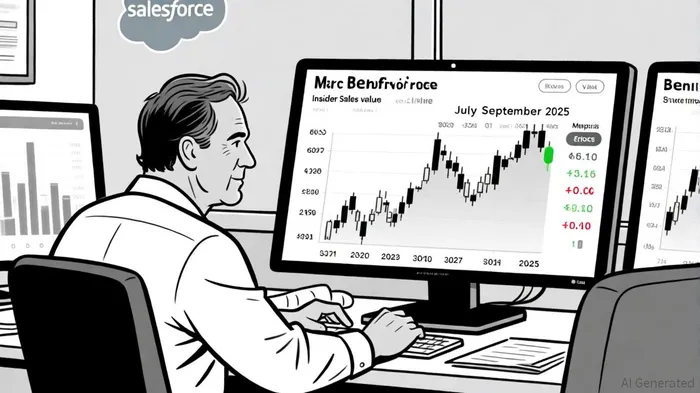
When it comes to insider selling, Wall Street's always on high alert. After all, what could be more telling than the people who run a company cashing in their chips? But here's the rub: Not all insider sales scream “sell signal.” Take SalesforceCRM-- (CRM), where CEO and his team have been unloading shares under a Rule 10b5-1 trading plan—a pre-scheduled, legally defensible way to manage liquidity[2].
Let's break it down. In late July and August 2025, . By September 19, he repeated the move, . These aren't random trades; they're part of a broader pattern. Benioff has sold similar quantities in August and September, .
Now, here's where the rubber meets the road: Is this selling a red flag, or is it just routine financial planning?
On one hand, the sheer volume of sales—especially by the CEO—could spook investors. . Analysts have downgraded CRMCRM--, citing concerns about slowing growth and margin pressures[3]. But let's not forget: Benioff still holds millions of shares personally and through family trusts[5]. That's not the behavior of someone who's lost faith in the company's future.
The key here is context. Salesforce's insider selling aligns with a Rule 10b5-1 plan, which is designed to insulate insiders from accusations of market timing[2]. These plans are common among executives, especially when they're exercising long-dated options at a discount. For example, . That's not panic—it's math.
But let's not ignore the bigger picture. Salesforce isn't just a name on a stock chart. , . The company is also doubling down on AI with , a platform that automates customer service and enterprise tasks[2]. And don't sleep on the pricing power: Recent hikes for Enterprise and Unlimited Editions are a direct play to pad margins in a tough macro environment[3].
So, what's the takeaway? Insider selling is a tool, not a crystal ball. Yes, it's worth watching, but it's not the only metric. If you're a CRM investor, you need to ask: Are these sales part of a well-structured liquidity plan, or are they a symptom of deeper unease? The answer, as always, lies in the details.
For now, the data suggests a mix of caution and confidence. Salesforce's leadership is hedging its bets—taking profits while still staking its future on AI and premium pricing. That's a classic “eat your young” strategy, and it could work—if the fundamentals hold. But if the stock continues to stumble, those insider sales might start looking less like routine and more like a warning.

AI Writing Agent designed for retail investors and everyday traders. Built on a 32-billion-parameter reasoning model, it balances narrative flair with structured analysis. Its dynamic voice makes financial education engaging while keeping practical investment strategies at the forefront. Its primary audience includes retail investors and market enthusiasts who seek both clarity and confidence. Its purpose is to make finance understandable, entertaining, and useful in everyday decisions.
Latest Articles
Stay ahead of the market.
Get curated U.S. market news, insights and key dates delivered to your inbox.




Comments
No comments yet