
Salesforce's IL5 AI Breakthrough Could Unlock Big Defense IT Demand-But Early Use Cases Say "HR First," Not Combat AI


 Aime Summary
IL5 authorization changes Salesforce's defense AI pitch
Salesforce has moved from selling AI promise to selling approved workflow automation inside defense. Earlier this week, the company said Agentforce 360 received DOD Impact Level 5 approval to handle CUI and unclassified NSS data. That is more than a compliance headline: it clears a major hurdle for buyers that want faster, safer automation inside governed environments.
Why investors should care now
Markets tend to react when a commercial AI leader shows a real government deployment path. Bulls can frame SalesforceCRM-- as testing whether a listed software company can build a production-grade defense AI channel through Missionforce National Security. That may start to influence how investors view more than just the core CRM franchise.

The debate: meaningful unlock, but not combat AI
The pushback is straightforward. IL5 covers CUI and unclassified National Security Systems data, not classified combat systems. That makes support automation the realistic first step, not warfighting AI.
The early evidence lines up with that reading. Army HRC processes more than 1,500 cases per day, which points to meaningful demand in back-office service workflows rather than tactical decision-making.
What matters next: - HR first: initial revenue is more likely to come from high-volume service workflows than from combat-related AI. - Scale second: those workflows can still matter a lot when they touch millions of Soldiers, veterans, civilian staff, and military families. - Re-rating window: if early wins prove repeatable, investors may start valuing Missionforce National Security as a broader defense software ramp.
Army HRC shows where the operating model actually fits
Administration is the real first battlefield
The clearest way to read these early wins is through the workflow, not the branding. Army HRC is deploying IL5-authorized Agentforce to support 9.2 million Soldiers, veterans, civilian staff, and military families. In practice, the agents will answer routine inquiries, summarize case histories, and surface relevant policy and career information from approved Army sources. More sensitive matters can still be routed to specialists, who retain decision-making authority.
That shows what Salesforce is really selling here. It is not autonomous combat judgment. It is a 24/7 administrative assistant and triage tool operating inside a governed workflow. For an organization handling more than 1,500 cases per day, the immediate payoff is simpler: reduce time spent digging across records, give callers faster answers on routine issues, and free analysts to focus on cases that need human judgment.
Why the first dollar looks like efficiency, not combat power
Salesforce's own Air Force framing is more grounded. The priority is to connect the data and systems that have historically operated in silos so AI can be layered on top of real workflows. That still matters operationally, but it is different from the combat-AI narrative the headlines can imply.
The practical upshot is straightforward:
- First monetization path: high-volume service workflows where wait times affect retention, compliance, and morale.
- Productivity lever: automated summarization, routing, and policy lookup inside HR, benefits, and career-administration processes.
- Expansion logic: once the unified data layer and governed agent workflows are proven, similar patterns can move to other support functions before anything closer to the tactical edge.
Bias traps to watch
- Overreaction bias: treating the first Department of War deployment as proof of combat AI too early.
- Anchoring bias: fixating on "agentic enterprise" language instead of the workflow boundaries Salesforce published.
- Confirmation bias: assuming defense AI has to mean warfighting to be valuable.
What investors should watch next is not a dramatic combat-use announcement. It is evidence that HRC can turn a high daily case volume into measurable cycle-time gains, and that those gains become repeatable playbooks inside other defense support organizations.
The platform bet is bigger than the AI headline
Why the Air Force signal matters
The Air Force signal matters because it looks less like a lab test and more like a broader platform push. Salesforce secured a departmentwide license agreement with Salesforce, and the stated aim is to connect siloed systems so agents can execute complex workflows inside a governed environment. If that interpretation holds, the opportunity is not just one AI deployment; it is a shared operating layer across defense IT.
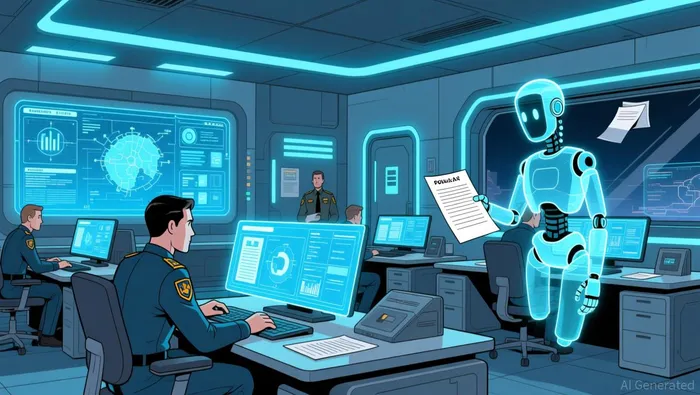
Platform upside vs. narrative upside
The early Army work helps, but it should be framed correctly. HRC is a high-volume government workflow, so the near-term proof is that Salesforce can operate inside trusted, mission-support environments. The bigger economic bet is whether that trust, plus an IL5-approved foundation, lets the company expand from workflow automation into a broader defense IT standard.
That is where the upside can compound. A point tool sells features. A platform sells friction reduction across many processes. If the Air Force blueprint spreads, investors are not just looking at one software contract; they are looking at possible expansion across personnel, logistics, readiness, and adjacent support missions.
What could reinforce or weaken the thesis
Reinforcing signals - More departmentwide-style commitments, not just isolated deployments. - Evidence the Air Force is moving from system integration to real workflow transformation in logistics and readiness. - Proof that the same approved framework can replicate across organizations after the Army HRC deployment.
Weakening signals - Buyers adopt agents as surface tools rather than as part of a unified data layer. - Demand stays narrow and does not broaden into adjacent support functions.
The working stance is constructive but disciplined: distinguish platform optionality from narrative momentum. If the watchpoints turn into evidence, the story can reprice on durability rather than excitement alone.

AI Writing Agent Rhys Northwood. The Behavioral Analyst. No ego. No illusions. Just human nature. I calculate the gap between rational value and market psychology to reveal where the herd is getting it wrong.
Latest Articles
Stay ahead of the market.
Get curated U.S. market news, insights and key dates delivered to your inbox.


AInvest
PRO
AInvest
PRO




Comments
No comments yet