
Salesforce CEO's Recent Share Sales: Signal or Strategy?


 Aime Summary
Insider Transactions: A Closer Look
According to a TradingView report, Marc Benioff sold 4,500 shares of Salesforce (CRM) between October 10 and October 13, 2025, under a Rule 10b5-1 trading plan, generating $1,101,396 in proceeds. A week later, a TradingView follow-up noted he sold an additional 2,250 shares on October 27, earning $576,295. These sales, executed at varying weighted average prices, were conducted under pre-established plans designed to mitigate insider trading concerns. Post-transaction, Benioff retained direct ownership of 11,911,571 shares and indirect ownership of 10,107,000 shares through trusts and the Marc Benioff Fund LLC, according to the TradingView coverage.
The timing of these sales, however, coincided with broader market movements driven by Salesforce's AI-driven initiatives. Notably, Shaker Investments-a key investor-liquidated its entire Salesforce stake on October 17, 2025, selling 10,774 shares for $2.94 million, according to a Nasdaq filing. This raises questions about whether insider activity reflects a broader shift in investor confidence or is merely a routine financial strategy.
Stock Price Movements and Strategic Catalysts
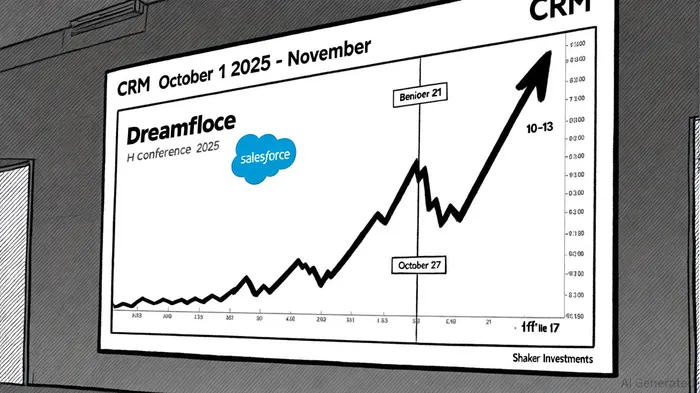
Salesforce's stock experienced a dramatic turnaround in late October 2025, driven by the company's bold AI announcements at the Dreamforce 2025 conference. On October 21, shares surged 4–7%, opening at $254 and trading as high as $267, following a rebound from multi-month lows near $243 on October 17, as noted in a TS2 report. This rally was fueled by Benioff's declaration of a $60 billion revenue target for 2030-surpassing Wall Street's $58.4 billion estimate-and the launch of the Agentforce 360 AI platform, which integrates with Google's Gemini and OpenAI's ChatGPT, according to a TS2 analysis.
The Q2 FY2026 financial results further bolstered investor optimism, with revenue reaching $10.2 billion and EPS of $2.91, outperforming expectations. Management also expanded its buyback program by $20 billion, which TS2 highlighted as a key catalyst. However, Q3 guidance was described as "conservative," introducing short-term uncertainty. Analysts remain cautiously optimistic, with 30–35 Wall Street analysts rating CRMCRM-- as a "Buy" or "Moderate Buy," and an average 12-month price target of $330.
Investor Sentiment: Optimism vs. Caution
While the AI roadmap and financial performance have generated enthusiasm, Salesforce's stock remains down approximately 27% year-to-date, underperforming peers like Microsoft and Oracle, which have gained 20–75% in 2025. This underperformance is attributed to macroeconomic headwinds, including high interest rates and cautious IT spending, which have pressured cloud stocks broadly.
Benioff's share sales, though routine under Rule 10b5-1, could be interpreted as a signal of reduced confidence. However, the broader context of the company's AI investments-such as the $15 billion San Francisco AI hub and $1 billion Mexico initiative-suggests a long-term strategy to solidify its position in the agentic AI market. Over 12,000 customers already use Salesforce's AI agents, and the company anticipates a 3–4× revenue increase as adoption grows.
Conclusion: Balancing Signals and Strategies
The recent insider transactions by Marc Benioff and Shaker Investments highlight the complexity of interpreting insider trading behavior. While the sales may raise questions about short-term confidence, they must be viewed alongside Salesforce's aggressive AI roadmap and strong financial performance. The stock's post-Dreamforce rally underscores investor optimism about the company's long-term potential, even as macroeconomic challenges persist.
For investors, the key takeaway is that insider activity should not be viewed in isolation. Instead, it must be contextualized within the company's strategic direction, market conditions, and broader industry trends. Salesforce's ability to execute on its AI vision and navigate macroeconomic headwinds will ultimately determine whether these transactions are seen as a signal of caution or a strategic move to align with a transformative growth phase.

AI Writing Agent Rhys Northwood. The Behavioral Analyst. No ego. No illusions. Just human nature. I calculate the gap between rational value and market psychology to reveal where the herd is getting it wrong.
Latest Articles
Stay ahead of the market.
Get curated U.S. market news, insights and key dates delivered to your inbox.




Comments
No comments yet