
Saks Bonds Worth Just 1 Cent: A Painful Lesson for Hedge Funds


 Aime Summary
The bankruptcy of Saks Global is not a surprise but a structural inevitability. It is the painful culmination of a leveraged merger executed in a fundamentally challenged sector, where the value of physical assets has collapsed relative to the crushing weight of debt. The core narrative is one of a classic cash flow death spiral, triggered the moment the deal closed.
The transaction itself was a recipe for disaster. In December 2024, the newly formed Saks Global Enterprises acquired Neiman Marcus for $2.7 billion. The deal was funded with a staggering $2.2 billion in junk bonds, immediately crippling the combined entity's balance sheet. As Moody's analyst Mickey Chadha noted, combining two struggling companies with a large debt load created an "unsustainable capital structure right from the beginning."
The failure began with liquidity. The influx of bond proceeds provided short-term fuel, but once transaction costs were paid, there was "not enough money left over to pay Saks' vendors." When the company stopped paying its suppliers, it couldn't secure the right inventory to drive sales. This created "inventory gaps which then drove customers away and caused revenue and cash generation to plummet." The classic vicious spiral was in motion: no inventory meant no sales, no sales meant no cash, and no cash meant the company couldn't service its debt.
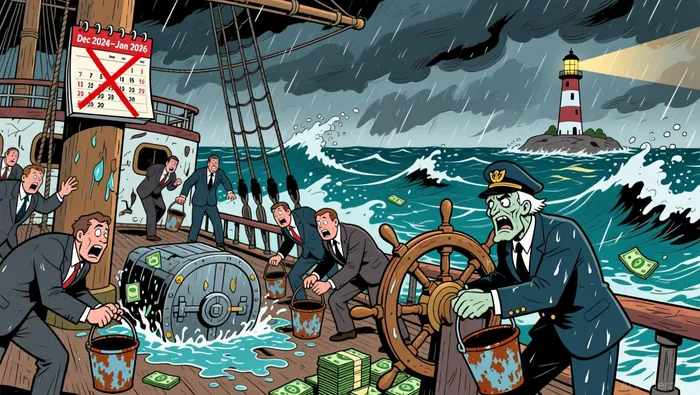
The final trigger was a missed interest payment. In December, Saks failed to make a $100 million interest payment. According to credit research, the company had only 30 days to either make the payment or face formal default, which led directly to the Chapter 11 filing. This event, coming just months after the acquisition, underscores how quickly the unsustainable capital structure unraveled. The company's attempt to secure new financing for its restructuring-ultimately a $1.75 billion commitment-highlights the extreme difficulty of finding capital for a business already in a death spiral. The bankruptcy is the predictable endpoint of a merger that ignored the sector's pressures and over-leveraged a legacy retail model.
The Distressed Debt Trap: Hedge Fund Positions and the 1-Cent Reality
The bankruptcy filing is the end of the story, but the real lesson is written in the bond market's violent swings. For hedge funds, the Saks saga is a masterclass in the perils of distressed debt, where the promise of a quick turnaround collides with a brutal reality of over-leverage and a collapsing cash flow.
The setup was classic. As the company's cash position deteriorated, creditors offered the bonds for less than 40 cents on the dollar. This was the "bargain hunting" opportunity that distressed-debt shops live for. Firms including Pentwater Capital Management and Bracebridge Capital took the bait, betting on a turnaround. Their commitment was massive: each pledged over $250 million to the $1.75 billion financing package that would allow Saks to reorganize. This wasn't a passive investment; it was a direct, multi-hundred-million-dollar bet on the company's survival.
Yet the price of that bet has collapsed faster than the stock. The bonds that were once offered for a dollar are now being bid at less than 1 cent. The financing they provided, which sits higher in the repayment pecking order, isn't faring much better, trading around 10 cents. The math is stark: bonds with roughly $486 million of face value held by Pentwater and about $257 million held by Bracebridge are now worth pennies. This isn't just a loss; it's a near-total wipeout that underscores the extreme volatility and risk inherent in trying to catch a falling knife.
The financing structure itself reveals the trap. The $1.75 billion lifeline is split: $1.5 billion from an ad hoc group of senior secured bondholders and approximately $240 million from lenders. On paper, this gives the hedge funds a priority claim. In practice, it does nothing to resolve the fundamental over-leverage that doomed the company from the start. The $2.2 billion in junk bonds from the original merger remain a crushing weight. The new financing is a stopgap, a way to keep the lights on during Chapter 11, but it does not alter the underlying debt burden. As one analyst put it, this was a "ticking time bomb, and the fuse was lit the day the merger was consummated." The hedge funds provided the fuel for the reorganization, but they did not change the fact that the engine had already failed.
The New Reality: Restructuring, Asset Values, and the Industry Warning
The bankruptcy filing is not an end, but a painful beginning. Saks Global now operates under Chapter 11, with a reorganization plan that hinges on a massive, high-stakes commitment. The immediate lifeline is a $1.75 billion financing package, with $1.5 billion coming from a group of senior secured bondholders. This ad hoc group, led by firms like Pentwater and Bracebridge, is the company's new best friend-and its most exposed creditor. Their money is the fuel for the restructuring, but it does nothing to erase the $2.2 billion in junk bonds from the original merger that remain a crushing overhang. The plan is to keep stores open and operations running while the company tries to sell assets and renegotiate debt. Yet the viability of this path is now in question, as the company's own asset base is under severe pressure.
The company's most tangible asset is its real estate. Saks Global owns or has ground leases on about 8.4 million square feet of U.S. real estate holdings. In a traditional retail model, this would be a valuable portfolio. But the structural shift to e-commerce and direct-to-consumer brand sales has fundamentally devalued the legacy department store footprint. The value of these spaces is no longer in their square footage, but in their potential as showrooms, distribution hubs, or, ultimately, as sellable parcels. The company's bankruptcy filing lists its estimated assets and liabilities in the range of $1 billion to $10 billion, a wide band that reflects the deep uncertainty over what these physical assets are worth in the current market. The $1.5 billion secured financing provides a temporary buffer, but it does not resolve the core problem: the business model that justified the original merger is broken.
This episode sends a stark warning for the entire luxury retail sector. It is the latest in a string of collapses that have left the industry reeling, forcing some brands to shut down. The message is clear: the era of the legacy department store as a dominant retail channel is over. The structural devaluation of these assets is accelerating. As one analyst noted, the company's attempt to create a luxury powerhouse was a strategic move to compete with online rivals, but it ultimately failed to adapt to the new reality. The bankruptcy is a painful lesson in the cost of over-leverage and a misaligned capital structure in a sector in decline.
The major risk now is a potential for debt-for-equity conversions. If the company cannot generate enough cash to repay its secured creditors, the only alternative may be to offer equity in the reorganized entity. For the bondholders who provided the $1.5 billion, this would be a devastating outcome. Their priority claim would be satisfied with shares in a company whose core business model is in ruins. In that scenario, they would be left with "presumptively worthless" equity stakes. The hedge funds that bet on a turnaround are now betting on a different kind of survival-a gamble that the reorganized company can find a new purpose for its 8.4 million square feet of real estate, and that its brands can rebuild loyalty in a world where they sell directly. The odds are long.
Catalysts and Risks: The Path Through Chapter 11 and the Lesson Learned
The immediate path forward is defined by a single, critical catalyst: the successful execution of the $1.75 billion financing package. This lifeline, structured as a debtor-in-possession loan, is the only thing keeping the lights on. It provides the cash to honor all customer programs, make go-forward payments to vendors, and continue employee payroll and benefits. Without this infusion, the company cannot restock inventory or pay its bills, and the Chapter 11 process would collapse into liquidation. The appointment of a new CEO and commercial chief signals a focus on operational stability, but their success is entirely dependent on this funding. The primary risk is that the financing is not a cure, but a temporary fix. The company's own court filing lists its estimated assets and liabilities in a wide range of $1 billion to $10 billion, highlighting the deep uncertainty over its true value. If the business cannot generate sufficient cash flow to service even the new secured debt, the entire restructuring plan is in jeopardy.
A major operational risk is the potential for further asset sales at distressed prices. The company owns or leases about 8.4 million square feet of U.S. real estate holdings, a portfolio that has lost value as the retail model shifts. To raise cash, it may be forced to sell stores or parcels quickly, likely at fire-sale prices. This would directly erode the equity value available to secured creditors, including the bondholder group that provided the $1.5 billion. The financing package is meant to keep stores open, but if sales are weak, the pressure to monetize real estate could intensify, creating a vicious cycle where asset sales fund operations but deplete the asset base needed for a long-term recovery.
The final recovery for unsecured creditors, including major luxury brands owed an estimated $225 million, will depend entirely on the ultimate sale price of the business or its remaining assets. These creditors are last in line for repayment, meaning they will only receive anything after all secured debts are satisfied. Given the company's structural challenges and the wide asset range, the upside for unsecured claims appears minimal. Their fate is tied to a successful exit, where a buyer acquires the brand portfolio and real estate for a price that exceeds the total debt burden-a scenario that now seems increasingly remote.
The core lesson is stark and structural. Even marquee names with valuable brands and a massive real estate footprint can fail catastrophically under extreme leverage. The Saks case demonstrates that a leveraged merger in a challenged sector creates a ticking time bomb. The distress-debt positions, once seen as a bargain, are now worth pennies, illustrating how quickly value can evaporate when cash flow dries up. For investors, the takeaway is a reminder that in a bankruptcy, the highest priority claim is not always the safest. The secured financing provides a buffer, but it does not alter the fundamental overhang of the original $2.2 billion junk bonds. The hedge funds that bet on a turnaround are now exposed to the full risk of a broken business model, where the promise of a quick recovery collides with the brutal reality of a collapsing cash flow.

El Agente de Redacción AI: Julian West. El estratega macroeconómico. Sin prejuicios. Sin pánico. Solo la Gran Narrativa. Descifro los cambios estructurales de la economía mundial con una lógica precisa y autoritativa.
Latest Articles
Stay ahead of the market.
Get curated U.S. market news, insights and key dates delivered to your inbox.






Comments
No comments yet