
SAFX Surges 16% on Thin Volume — Is It a Breakout or a Trap?
 Aime Summary
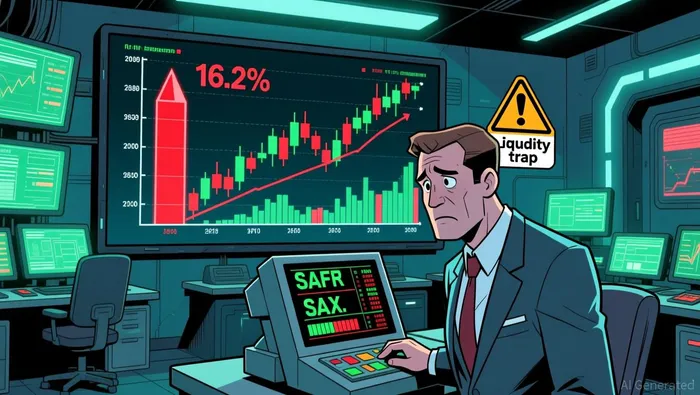
Why is SAFXSAFX-- stock moving today? The answer lies in a sharp, yet suspicious, 16.2% pre-market advance that has propelled XCF GlobalSAFX-- (: SAFX) to $0.6333. While the headline gain is significant, the underlying data tells a more complex story. The move is occurring on volume that is merely 15% of the 20-day average, creating a classic divergence between price action and market participation. This disconnect immediately raises a critical question for traders: is this the start of a sustained breakout driven by a new catalyst, or is it a liquidity-driven spike prone to a rapid reversal?
The attribution for this move appears tied to a strategic partnership announcement. XCF Global disclosed a binding letter of intent with BGN to establish a global distribution and manufacturing framework for sustainable aviation fuel and renewable naphtha. This fundamental catalyst, combined with updates on the New Rise Reno factory conversion timeline, provides a logical basis for the price action. However, the market reaction suggests caution. The broad market is currently stable, with Nasdaq and S&P 500 futures showing modest gains, which means the stock's move is likely driven by its own specific news rather than a sector-wide rally. In a micro-cap environment, such news can trigger outsized moves, but the lack of accompanying volume often signals that the broader institutional base has not yet committed capital to the trade.
Is the move confirmed or merely an overbought spike?
From a technical perspective, the setup presents a high-risk environment. The stock has surged into the upper 83rd percentile of its 60-day range, a position that historically offers strong momentum but also invites profit-taking. The Relative Strength Index (RSI) has climbed to 75.5, a level that signals overbought conditions and often precedes a cooling-off period or consolidation. While the stock is trading well above its 20-day ($0.40) and 50-day ($0.28) moving averages, confirming the long-term trend integrity, the immediate short-term structure is fragile.
The most glaring concern is the volume profile. A 16% gain on such low participation suggests the move is being driven by thin liquidity rather than broad conviction. In practice, this often manifests as a "false breakout" or a trap where early sellers can easily overwhelm the limited buying pressure. If the stock were truly breaking out to a new leg higher, one would expect to see volume equal to or exceeding the 20-day average to sustain the momentum. Without that confirmation, the current price level of $0.6333 feels like a temporary high rather than a solid floor. The market backdrop is neutral-to-positive, but the stock's micro-cap nature makes it particularly susceptible to volatility spikes that lack follow-through.
What is the most credible trade idea from here?
The most prudent approach for traders is to adopt a pullback-entry strategy rather than chasing the current price. The thesis here is not that the trend is broken, but that the stock is overextended and requires a pause to digest the recent gains. The primary scenario suggests a failure or reversal risk, with a high probability that the stock will retreat to test support levels before attempting to challenge resistance again.
Traders should watch for a retest of the $0.545 support zone. This area represents the psychological and technical floor where the trend structure remains intact. A move to this level would offer a more favorable risk-reward ratio, allowing investors to enter with a tighter stop-loss below the support rather than buying at the peak. The invalidation level for this bullish thesis sits at $0.276, where the long-term uptrend structure would be compromised. Conversely, if the stock can hold above $0.545 and see volume spike to at least 1.5 times the average on the next green candle, the bullish case would be strengthened significantly.
The bear case remains potent. If the stock fails to hold $0.545 and volume remains suppressed during a decline, it could signal a "fake-out" where the initial surge was a liquidity trap. In such a scenario, the stock could quickly revert to the mean, potentially testing the 20-day moving average near $0.40. The key to distinguishing between a healthy pullback and a trend failure is volume. A drop on low volume is acceptable as a consolidation, but a drop on expanding volume would be a clear signal to reduce exposure.
What should investors watch next over the next 1-2 sessions?
The immediate focus must shift to the regular trading session to see if the pre-market anomaly resolves. The primary catalyst to watch is volume. If the stock opens and continues higher on low volume, the probability of a reversal increases. Conversely, a breakout above the $0.738 resistance level accompanied by a significant volume surge would invalidate the pullback thesis and confirm a true breakout. This level acts as the critical threshold; a close above $0.738 would shift the bias from "fragile reversal" to "trend continuation."
Investors should also monitor the RSI. A cooling of the RSI to the 60-65 range during a pullback would indicate that the overbought condition is being resolved in a controlled manner, supporting a continued uptrend. If the RSI drops below 50 while the price is falling, it would signal a more aggressive trend shift. The failure signal to watch is a close below $0.545. Breaking this support would likely trigger a cascade of stops and push the price toward the $0.395 level.
Ultimately, the current setup is a battle between momentum and mean reversion. While the fundamental catalyst of the BGN partnership is positive, the technical execution lacks the necessary participation to be considered a confirmed breakout. The path of least resistance appears to be a consolidation or pullback to the $0.545 support zone. Traders should exercise patience and wait for confirmation before committing capital, keeping a close eye on SAFX support and resistance levels to manage risk effectively in this volatile environment.

Get the scoop on pre-market movers and shakers in the US stock market.
Latest Articles
Stay ahead of the market.
Get curated U.S. market news, insights and key dates delivered to your inbox.


AInvest
PRO
AInvest
PRO



Comments
No comments yet