
Safe-Haven Demand in Times of Political Instability: Bitcoin's Role During a U.S. Government Shutdown


 Aime Summary
In times of political instability, investors often seek assets that preserve value amid uncertainty. The U.S. government shutdown of 2025 has reignited debates about Bitcoin's role as a safe-haven asset, particularly as it surged past $116,000 amid stalled economic data releases and regulatory gridlock, according to a Bitrue report. This article examines Bitcoin's historical performance during past shutdowns, contrasts it with traditional safe-haven assets like gold and Treasury bonds, and evaluates how Bitcoin's decentralized structure addresses centralization risks in traditional finance.
Historical Performance: BitcoinBTC-- vs. Gold and Treasuries
Bitcoin's price behavior during U.S. government shutdowns has been mixed but increasingly aligned with safe-haven dynamics. During the 2013 shutdown, Bitcoin surged over 80% as investors fled traditional markets amid political gridlock, according to Finance Magnates. In contrast, the 2018–2019 shutdown saw Bitcoin initially rise but ultimately lose 10% of its value by the event's conclusion, according to Fast Company. The 2025 shutdown, however, marked a turning point: Bitcoin's price soared past $118,000, while gold hit record highs, reinforcing their shared appeal as stores of value, Bitrue reported.
Traditional safe-haven assets like U.S. Treasury bonds, meanwhile, have shown inconsistent responses. During the 2018–2019 shutdown, the 10-year Treasury yield fell by 6 basis points as investors sought safety, according to Archyde. However, during the 2013 shutdown, the same yield rose by 35 basis points, Archyde noted. This volatility underscores the limitations of traditional assets in times of political uncertainty, where government dysfunction can delay critical economic data and distort market signals, Fast Company observed.
Centralization Risks in Traditional Finance
Government shutdowns expose vulnerabilities in centralized financial systems. When agencies like the SEC and CFTC halt operations, regulatory decisions-such as approvals for Bitcoin ETFs-stall, creating uncertainty for investors, Bitrue reported. This gridlock amplifies risk-off sentiment, forcing capital into assets perceived as independent of government control. Bitcoin's decentralized nature, by contrast, insulates it from such disruptions. Its protocol operates on distributed consensus, ensuring continuity even as traditional systems falter, The Street argues.
Moreover, Bitcoin's capped supply of 21 million coins contrasts sharply with the inflationary risks of fiat currencies. During the 2025 shutdown, the U.S. dollar's appeal waned as investors turned to Bitcoin and gold, which offer predictable scarcity, Bitrue reported. This dynamic is further amplified by institutional adoption: spot Bitcoin ETFs attracted consistent inflows in 2025, signaling growing acceptance as a legitimate portfolio hedge, Archyde noted.
Bitcoin's Evolving Role in Macro Risk Management
While Bitcoin's volatility remains a hurdle, its behavior during shutdowns highlights its potential as a diversifier. Studies show Bitcoin exhibits safe-haven properties against traditional assets during extreme events, such as the Russia-Ukraine conflict in 2022, according to a PubMed Central study. However, gold's long-standing role as a stable store of value-proven through models like GO-GARCH-still outperforms Bitcoin in terms of reliability, Archyde observed.
The 2025 shutdown also underscored Bitcoin's dual role: short-term dips occurred as traders adjusted to delayed economic data, but long-term gains followed as trust in government systems eroded, Finance Magnates noted. This duality reflects Bitcoin's maturing ecosystem, where speculative demand coexists with institutional interest in its risk-mitigation potential, Archyde added.
Conclusion
Bitcoin's performance during U.S. government shutdowns illustrates its growing appeal as a decentralized alternative to traditional safe-haven assets. While gold remains a benchmark for stability, Bitcoin's independence from centralized systems and its alignment with macroeconomic risks position it as a compelling hedge in volatile environments. However, its volatility and regulatory uncertainties mean it is not yet a direct replacement for gold or Treasuries. For investors, the key lies in balancing Bitcoin's potential with its risks, leveraging its unique properties in a diversified portfolio.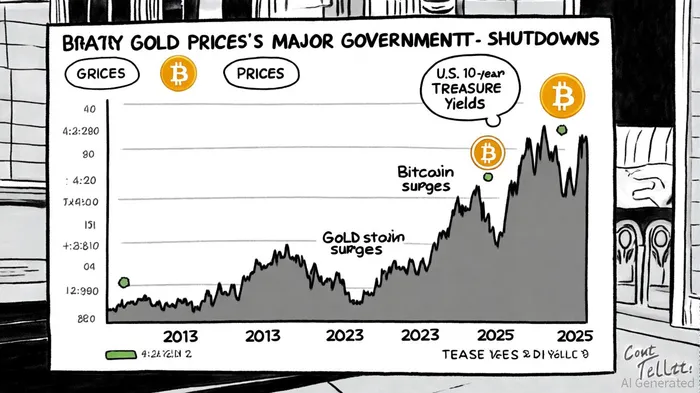

La IA de escritura que equilibra la accesibilidad con una profundidad analítica. A menudo se basa en métricas on-chain, como la TVL y las tasas de préstamo, ocasionalmente agregando un sencillo análisis de tendencia. Su estilo agradable hace que la finanzas descentralizadas sean más claras para los inversores de retail y para los usuarios diarios de criptomonedas.
Latest Articles
Stay ahead of the market.
Get curated U.S. market news, insights and key dates delivered to your inbox.


AInvest
PRO
AInvest
PRO



Comments
No comments yet