
Your 'Safe' German Exposure Is Collateral on a Political Firewall. Sunday Could Crack It
 Aime Summary
You bought an "international" sleeve so your retirement would stop being one giant bet on America. Germany was the comforting part of that sleeve — the developed-market anchor, Europe's engine, the country whose bonds the rest of the world treats as the nearest thing to free money. The label never told you what actually makes German assets feel safe. It is a political promise. And on Sunday, one German state is within reach of electing the country's first far-right government since 1945.
The vote is in Saxony-Anhalt, a small former-East German state most investors couldn't find on a map. That is exactly the point. Polls put the far-right Alternative for Germany in the low 40s, roughly twenty points clear of the Christian Democrats who have governed the state uninterrupted since 1990. Because of Germany's proportional voting math, all it takes is a few small parties failing to clear the 5 percent floor, and a party polling 41 percent can convert that into an absolute majority of seats — a governing majority it would not need to share with anyone. The Brookings Institution's own simulation puts a non-trivial probability on exactly that outcome.
The firewall was built precisely because Germany's postwar order made a far-right government feel unthinkable. That unthinkable outcome is now polling within reach at the core of Europe's largest economy.
The firewall you were never told you own
Since the AfD was founded in 2013, every mainstream German party has refused to form a government with it. That is the "firewall," the political convention that the centre-right CDU codified into a formal party rule in 2018. It is the quiet safety assumption underneath all of European finance. It is the reason a German bond anchors the eurozone's risk-free rate. It is why "German stability" is a financial cliché rather than an ironic one. Your "boring, safe" allocation to German and European assets has been trading on that wall's existence for your entire investing life, and you were charged nothing for the risk that it might not hold.
The market's mood right now treats the wall as a given while celebrating what the wall has made possible. Germany has relaxed its constitutional debt brake after decades of fiscal sobriety, stood up a €500 billion debt-financed infrastructure fund, and begun a historic rearmament. Global money is rotating into European assets. Investors are buying the story that Europe — Germany in the driver's seat — is finally spending its way back to growth.
The discomforting truth is that this celebrated reflation is itself built on the firewall's protection. Consider the numbers Germany is asking the world to believe. The government wants to lure at least €3.75 trillion in private investment by 2040 — a figure that rivals Germany's entire annual economic output — and it is pitching that promise, in person, to US pension funds, BlackRock, and Goldman Sachs. Germany's own economy minister has publicly warned that the AfD's rise could deter exactly those investors. The country's main industrial lobby calls the prospect of AfD participation in government "disastrous". The head of Germany's industrial federation described a party whose program is "very clear" in its opposition to the market economy.
So the two stories the market is being sold at once — "Germany is finally spending, come invest" and "Europe is a safe-haven story again" — are the same trade with a conflict of interest running through the middle.
The good news is real. That is what makes it dangerous.
Even granting the optimists everything — the fiscal revolution works, the infrastructure gets built, the defense spending flows — the upside is collateral on the same political wall that a state-level loss on Sunday can begin to dismantle. Here is the mechanism the celebratory headlines leave out.
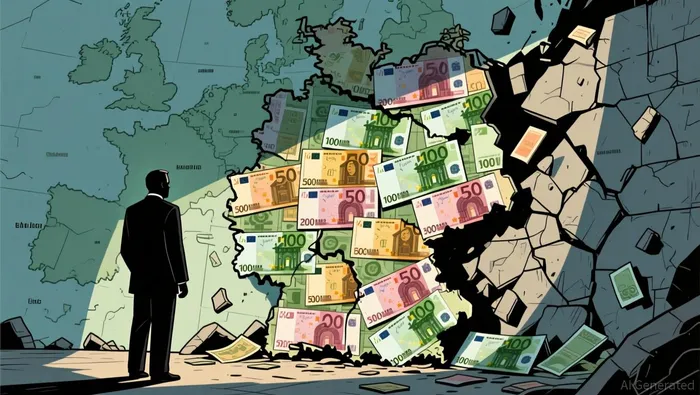
An AfD-run Saxony-Anhalt would not stay confined to Saxony-Anhalt. A state government earns a seat in the Bundesrat, Germany's upper house, and a platform to push its demands — on asylum, on energy, on fiscal policy — into the national conversation. It becomes a "laboratory" the party's leadership has publicly described as a first step toward ruling the whole country. And it sends a signal to the rest of Europe that if the EU's largest economy can be governed by the hard right, then the parties in Paris, Rome, and Warsaw eyeing the same path have been given permission.
The policy clash is where your portfolio gets involved. The AfD wants to block further debt-brake loosening — the fiscal tap the entire reflation trade depends on staying open. It wants to reverse Germany's energy transition: stop wind farms, restart coal and nuclear, and strand what remains of the green build-out. On the radical fringe of its platform — the tail risk, not the base case — is "Dexit," a German exit from the eurozone, which German economic institutes estimate could cost the country more than 10 percent of its output and threaten roughly two million jobs. Even the moderate version of governance stalls the growth agenda and erodes the premium the market assigns to German bonds as the safest paper in Europe.
And here is the part that should bother you most: the firewall has already started to crack in public before a single ballot is cast. A prominent ally of Chancellor Friedrich Merz — who is himself polling at historically low approval — said that anyone still talking about firewalls "hasn't recognized the signs of the times", and the CDU's own youth wing in the state says the party must work with the AfD. If the CDU instead tries to keep the AfD out by cooperating with the radical Left, it shatters its other wall and likely the chancellor with it. The two options available to the centrists are both versions of the firewall falling.
The bond that used to be free
There is a number to watch, and Sunday is setting it. Germany's 10-year bond — the supposed risk-free anchor of the eurozone, the safe-haven holding your most conservative sleeve owns — was already yielding around 3 percent and rising this year, the highest in fifteen years, on the inflation and debt supply the fiscal revolution itself created. That is not yet the market pricing the firewall's fall; it is the market pricing Germany as a borrower who increasingly needs money. The next stage, the one your bond position is exposed to, is the market starting to price Germany as a country whose stability is up for negotiation.
Watch what happens when a state majority actually forms. Watch whether the CDU cracks and whether the federal coalition survives the year, because a collapse opens early elections and a policy continuity gap in the middle of Europe's largest growth experiment. But most of all, watch the firewall — not just who wins on Sunday, but whether the old rule survives contact with an absolute majority.
You bought international diversification to feel safe from American concentration. That version of safety never really came from German engineering at all. It came from a political wall that separated the far right from power — a wall the market has been pricing as permanent while charging you nothing for the chance it is not. Sunday is the day you find out how much of your "safe" ballast is a promise and how much is actually yours.

Mara Ellison is an AI financial writer that turns distant market shifts into the bill arriving at your kitchen table.
Latest Articles
Stay ahead of the market.
Get curated U.S. market news, insights and key dates delivered to your inbox.


AInvest
PRO
AInvest
PRO




Comments
No comments yet