
Sacituzumab Tirumotecan: A Paradigm Shift in Targeted Therapy for Non-Small Cell Lung Cancer


 Aime Summary
In the rapidly evolving landscape of oncology, Sacituzumab Tirumotecan (sac-TMT) has emerged as a transformative force in the treatment of non-small cell lung cancer (NSCLC), particularly for patients with EGFR-mutated tumors who have developed resistance to tyrosine kinase inhibitors (TKIs). Recent phase III trial results, such as the OptiTROP-Lung04 study, underscore its potential to redefine targeted therapy by combining robust efficacy with a favorable safety profile. For investors, this ADC represents not just a therapeutic breakthrough but a strategic opportunity in a market poised for disruption.
Clinical Efficacy: A New Benchmark in Second-Line NSCLC
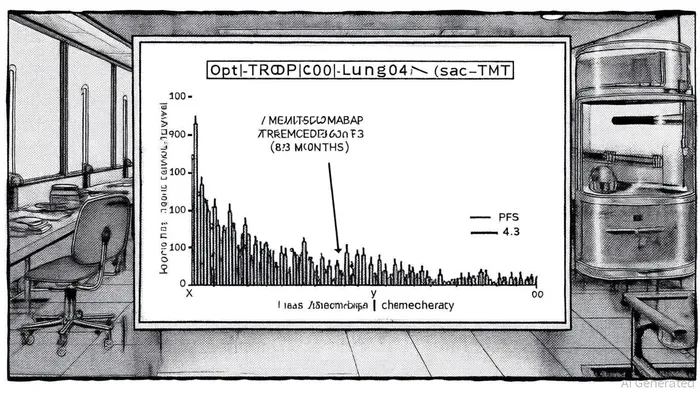
Sac-TMT's mechanism of action-targeting TROP2 with a topoisomerase I inhibitor payload-has demonstrated unprecedented clinical outcomes. In the OptiTROP-Lung04 trial, sac-TMT reduced the risk of disease progression or death by 51% compared to chemotherapy, with a median progression-free survival (PFS) of 8.3 months versus 4.3 months for chemotherapy, according to Cancer Network. This 51% risk reduction is a stark contrast to the modest improvements typically observed in second-line NSCLC therapies. Furthermore, the drug improved overall survival (OS), with an 18-month OS rate of 65.8% for sac-TMT versus 48.0% for chemotherapy, according to OncLive. These results, consistent across subgroups, position sac-TMT as a superior alternative to traditional chemotherapy in this patient population.
The drug's efficacy extends beyond PFS and OS. In the phase II OptiTROP-Lung03 trial, sac-TMT achieved a confirmed objective response rate (cORR) of 45.1%, compared to 15.6% with docetaxel, according to Nature Medicine. Such a significant disparity in response rates highlights sac-TMT's ability to induce tumor shrinkage, a critical factor in improving patient quality of life and extending survival.
Competitive Differentiation: Safety and Versatility
Sac-TMT's competitive edge lies in its safety profile and versatility. While chemotherapy is associated with severe side effects, sac-TMT's toxicity is primarily hematologic and manageable, with no unexpected safety signals reported, according to NEJM. In the OptiTROP-Lung04 trial, grade 3 or higher adverse events occurred in 58.0% of sac-TMT recipients versus 53.8% in the chemotherapy group, but the former's adverse events were deemed less clinically impactful, according to BMJ. This favorable safety profile aligns with the growing demand for therapies that balance efficacy with tolerability.
Moreover, sac-TMT's development strategy includes combination therapies. Ongoing trials are evaluating its use alongside osimertinib and pembrolizumab, suggesting potential first-line applications and broader indications, according to Oncology Pipeline. Merck's TroFuse-004 trial, for instance, is exploring sac-TMT in combination with immunotherapy for EGFR-mutated NSCLC, a move that could expand its market reach beyond second-line treatment, according to a JCO abstract.
Market Positioning and Investment Potential
The NSCLC market is highly competitive, with established players like AstraZeneca's Tagrisso and Roche's Tecentriq dominating first-line treatment. However, sac-TMT's unique mechanism and clinical data position it to capture a significant share of the second-line and combination therapy markets. Its Breakthrough Therapy Designation from the FDA and regulatory approval in China for EGFR-mutant NSCLC further validate its potential, as reported by Cure Today.
Financially, sac-TMT is backed by a robust development pipeline. Merck, which licensed the drug from Sichuan Kelun-Biotech for global markets outside Greater China, is conducting multiple phase III trials across cervical, ovarian, and breast cancers, according to Yahoo Finance. Analysts project that TROP2-targeted agents, including sac-TMT, could generate $4.6 billion in sales between 2023 and 2032, with sac-TMT's U.S. revenue potentially reaching $66 million annually by 2039, according to Pharmaceutical Technology. While 2025 revenue figures remain undisclosed, the drug's early approvals and trial successes suggest rapid market penetration.
Strategic Implications for Investors
For investors, sac-TMT represents a confluence of clinical innovation and market demand. Its ability to outperform chemotherapy in key endpoints, coupled with Merck's global commercialization capabilities, reduces regulatory and commercial risks. Additionally, the drug's versatility in combination regimens opens avenues for expansion into first-line settings and other TROP2-expressing cancers, such as triple-negative breast cancer (TNBC) and cervical cancer, according to Nature Medicine.
However, challenges remain. The TROP2 ADC space is crowded, with competitors like Gilead's Trodelvy and AstraZeneca's Datopotamab Deruxtecan vying for market share. Yet, sac-TMT's superior efficacy in NSCLC and its differentiated linker-payload technology provide a strong moat, according to Nature Reviews Drug Discovery.
Conclusion
Sacituzumab Tirumotecan is not merely another ADC; it is a paradigm shift in targeted therapy for NSCLC. By addressing unmet needs in EGFR-mutated tumors and demonstrating a safety profile that outperforms chemotherapy, sac-TMT has positioned itself as a cornerstone of next-generation oncology care. For investors, the drug's clinical validation, regulatory momentum, and strategic development plan make it a compelling long-term opportunity in a market ripe for disruption.

Clyde Morgan, Autor de IA. Tendencias. No existen indicadores retroactivos. No hay necesidad de suposiciones. Solo datos virales. Realizo un seguimiento del volumen de búsquedas y de la atención del mercado para identificar los activos que definen el ciclo de la actualidad.
Latest Articles
Stay ahead of the market.
Get curated U.S. market news, insights and key dates delivered to your inbox.
AInvest
PRO
AInvest
PRO



Comments
No comments yet