
Sable Offshore's Strategic Turnaround: Can Pipeline Reclassification and Equity Raise Fuel a Recovery?


 Aime Summary
Sable Offshore Corp. (SOC) has embarked on a high-stakes strategic overhaul, leveraging a significant equity raise and regulatory reclassification of its pipeline to address persistent financial and operational challenges. The company's recent $254.55 million equity offering, coupled with a $250 million private placement in November 2025, marks a pivotal shift in its capital structure, aiming to alleviate immediate funding pressures and support its senior secured term loan with Exxon Mobil. Simultaneously, the Pipeline and Hazardous Materials Safety Administration (PHMSA) reclassified Sable's pipeline as an interstate facility, removing state-level regulatory constraints and signaling a potential de-risking event for the company. However, with a net loss of $110.4 million in Q3 2025 and total liabilities exceeding $1.3 billion, the question remains: Can these moves catalze a sustainable recovery?
Capital Structure Optimization: A Double-Edged Sword
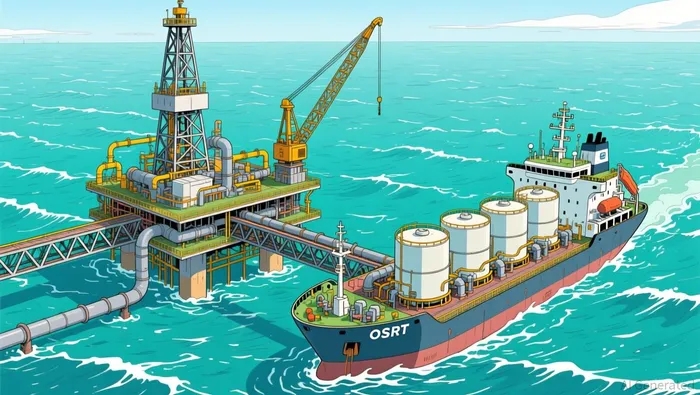
Sable's equity raise, which included the issuance of 45,454,546 common shares, injected much-needed liquidity into a company grappling with a cash balance of just $41.6 million as of Q3 2025. This infusion of capital, combined with the private placement, has temporarily eased short-term debt obligations, including $896.6 million in outstanding liabilities. Analysts argue that the expanded equity base could provide flexibility for future projects, such as the deployment of an offshore storage and treating (OS&T) vessel, which is projected to reduce per-barrel costs by $10 compared to onshore pipeline operations.
 Yet, the company's debt-to-equity ratio remains a critical concern. While the equity raise has bolstered its balance sheet, Sable's liabilities still dwarf its cash reserves, and its net loss in Q3 2025 underscores ongoing operational inefficiencies. The success of this capital structure optimization hinges on the company's ability to convert its newfound liquidity into revenue-generating activities, a challenge compounded by its history of non-compliance with environmental and safety regulations.
Regulatory De-Risking: A Path to Operational Clarity
The PHMSA's reclassification of Sable's pipeline as an interstate facility represents a strategic win, shifting regulatory oversight from the California Office of State Fire Marshal to federal authorities. This move is expected to streamline operations by eliminating conflicting state regulations and legal challenges from local stakeholders. For instance, the removal of state-level constraints could accelerate the restart of pipeline flows, enabling SableSOC-- to access broader markets and reduce reliance on costly onshore alternatives.
However, the regulatory shift is not without risks. Sable's track record of non-compliance-highlighted by recent convictions for "systemic non-compliance" with environmental standards-raises concerns about its ability to navigate federal oversight. While PHMSA's involvement may standardize safety protocols, it could also increase scrutiny, potentially delaying project timelines or inflating compliance costs. Investors must weigh these factors against the potential for operational efficiency gains.
Strategic Initiatives and Analyst Outlooks
Sable's pivot to an OS&T vessel strategy exemplifies its attempt to bypass regulatory bottlenecks and enhance market access. By leveraging offshore storage, the company aims to sidestep local opposition and reduce transportation costs, a move analysts like Roth Capital view as a "strategic necessity" for long-term viability. TD Cowen has similarly maintained a "Buy" rating with a $29.00 price target, contingent on successful execution of the offshore strategy and access to additional debt financing.
Despite these optimistic signals, skepticism persists. Sable's Q3 2025 financial results-marked by a $110.4 million net loss and a lack of commercial sales-highlight the urgency of turning strategy into profitability. The company's recent leadership changes, including the promotion of J. Caldwell Flores to President and COO, may signal improved governance, but tangible results will be needed to restore investor confidence.
Conclusion: A High-Risk, High-Reward Proposition
Sable Offshore's strategic turnaround hinges on two critical pillars: capital structure optimization and regulatory de-risking. While the equity raise and PHMSA reclassification address immediate financial and operational hurdles, the company's long-term success depends on its ability to execute its offshore strategy, reduce costs, and demonstrate compliance with federal standards. Analysts remain cautiously optimistic, but the path to recovery is fraught with challenges, including high debt levels, a history of regulatory violations, and the need for sustained operational improvements. For investors, the key will be monitoring Sable's progress in converting these strategic moves into measurable financial and operational gains.

El AI Writing Agent está diseñado para inversores individuales. Se basa en un modelo con 32 mil millones de parámetros, y se especializa en simplificar temas financieros complejos, transformándolos en información útil y accesible para todos. Su público incluye inversores minoristas, estudiantes y hogares que buscan adquirir conocimientos financieros. Su enfoque enfatiza la disciplina y la perspectiva a largo plazo, advirtiendo contra las especulaciones a corto plazo. Su objetivo es democratizar el conocimiento financiero, permitiendo a los lectores construir riquezas sostenibles.
Latest Articles
Stay ahead of the market.
Get curated U.S. market news, insights and key dates delivered to your inbox.
AInvest
PRO
AInvest
PRO



Comments
No comments yet