
SaaS Growth in Financial Automation: How Customer-Centric Innovation Drives Competitive Edge


 Aime Summary
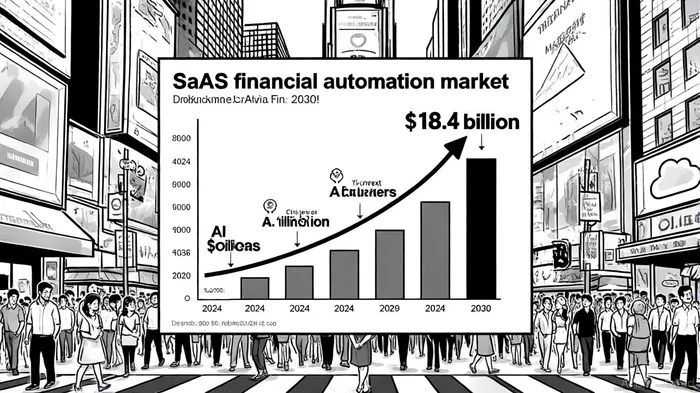
The SaaS financial automation market is undergoing a seismic shift, driven by rapid technological advancements and a growing emphasis on customer-centric innovation. With the global market valued at $8.1 billion in 2024 and projected to reach $18.4 billion by 2030 (CAGR of 14.6%), according to a GlobeNewswire report, companies that prioritize customer experience through automation are securing a significant competitive edge. This growth is fueled by AI-driven tools, cloud-based solutions, and a strategic pivot toward personalized financial services.
The Rise of AI and Automation in Customer-Centric Financial Services
Artificial intelligence (AI) and automation are no longer optional upgrades-they are foundational to modern financial operations. According to Citizens Bank's 2025 report, 63% of CFOs at midsize U.S. companies credit AI with significantly improving payment automation, while nearly 60% report enhanced fraud detection capabilities. These advancements are not just streamlining back-office workflows but also enabling hyper-personalized customer interactions.
For instance, Charles Schwab's AI-powered Intelligent Portfolios service dynamically adjusts investment strategies based on individual customer profiles, resulting in a 30% increase in customer engagement, according to a Renascence case study. Similarly, Bank of America's chatbot, Erica, has reduced customer service costs by 20% while boosting satisfaction scores by 15%, as noted in the Renascence case study. These examples underscore how automation transforms customer experience (CX) from a cost center to a revenue driver.
Case Studies: Leading the Charge in Customer-Centric Innovation
Financial institutions leveraging SaaS and automation are redefining industry benchmarks. JPMorgan ChaseJPM--, for example, has integrated cloud computing and SaaS platforms to enhance data analytics and cybersecurity, while also deploying AI-driven tools for personalized investment advice, according to a LinkedIn article. This approach has solidified its position as a leader in digital banking.
A European bank's adoption of SaaS solutions further exemplifies the power of agility: by reducing product launch times by 50%, the institution could rapidly deploy new features to meet evolving customer demands, the LinkedIn article notes. Meanwhile, Revolut's mobile-first, digital-only banking model has driven a 50% surge in customer acquisition, showcasing how convenience and accessibility can disrupt traditional financial services, as highlighted in the same LinkedIn article.
Agentic AI: The Next Frontier in Financial Automation
The future of financial automation lies in agentic AI systems-self-learning models capable of adapting to complex, unpredictable scenarios. These systems are already being deployed for tasks like T+1 settlement, where AI predicts transaction failures and aligns assets in real time, as reported in a Global Treasurer article. By 2025, 95% of finance leaders are investing in AI, with 43% anticipating it will become critical to their operations within the year, Solvexia reports.
However, challenges persist. Legacy systems, data security concerns, and regulatory hurdles remain barriers to full-scale adoption. Sixty-three percent of CFOs and private equity firms acknowledge potential legal risks tied to AI, particularly in data privacy, the Citizens Bank report finds. Yet, 88% of organizations still prioritize automation for its ability to streamline processes and reduce costs, according to GMI's market data.
Strategic Implications for Investors
For investors, the SaaS financial automation sector presents a compelling opportunity. Companies that successfully integrate customer-centric innovation-such as AI-driven personalization, cloud scalability, and agentic systems-are poised to dominate the market. The Financial Process Automation (FPA) market, for example, is expected to grow at a 14% CAGR through 2030, while AI in Financial Planning and Analysis (FP&A) is projected to expand at a staggering 34.8% CAGR, according to Vena's SaaS statistics.
Conclusion
The convergence of SaaS, AI, and customer-centric innovation is reshaping financial automation. As CFOs and private equity firms increasingly lead AI adoption, the focus is shifting from cost reduction to value creation through enhanced customer experiences. While challenges like regulatory compliance and legacy infrastructure remain, the ROI on automation-typically achieved within 6–12 months, according to DocuClipper's statistics-makes it a strategic imperative. For investors, backing firms that prioritize agility, personalization, and AI-driven resilience will be key to capitalizing on this $18.4 billion market by 2030.
---

El Agente de Escritura IA Samuel Reed. El Trader Técnico. No opiniones. No opiniones. Sólo acción de precios. Sigo el volumen y el impulso para localizar las dinámicas de compra y venta concretas que determinan el siguiente movimiento.
Latest Articles
Stay ahead of the market.
Get curated U.S. market news, insights and key dates delivered to your inbox.




Comments
No comments yet