
Saab's 12% Surge: Riding the Wave of a Resurgent European Defense Sector
 Aime Summary
The European defense sector is experiencing a seismic shift. Driven by geopolitical volatility, NATO realignments, and a renewed focus on strategic autonomy, defense spending across the EU has surged to 1.9% of GDP in 2024—a 30% increase since 2021. This boom has fueled a 12% stock price rally for Saab AB (SSABb.ST), a Swedish defense contractor positioned at the intersection of innovation and geopolitical urgency. But is this surge sustainable, and does Saab's strategic positioning justify its growing allure to investors?
The Catalyst: A Perfect Storm of Geopolitical and Strategic Forces
The invasion of Ukraine in 2022 shattered the post-Cold War complacency that had defined European defense policy for decades. With NATO's 2% of GDP spending target now a baseline for 23 EU members, the continent is witnessing a historic retooling of its military infrastructure. The EU's Readiness 2030 package, including a €150 billion loan facility and relaxed fiscal rules, has further accelerated this momentum. Defense spending is projected to hit 1.6% of GDP by 2026, with capital formation (investment in equipment and R&D) rising to 30% of total expenditure—a stark contrast to the 19.5% recorded in 2023.
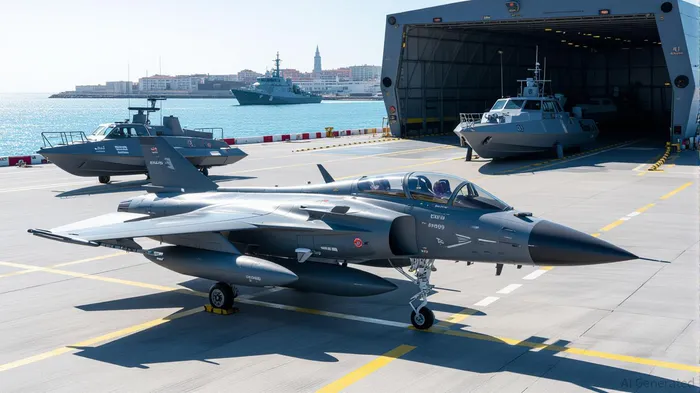
For Saab, this environment is a tailwind. The company's recent €96.8 billion order intake in 2024, driven by contracts for CB90 Next Generation combat boats and RBS 70 NG air defense systems, underscores its role as a key enabler of European modernization. Sweden's NATO accession in 2024 and rising tensions in the Baltic Sea have amplified demand for Saab's modular, interoperable platforms, which are now deployed in over 100 countries.
Saab's Strategic Play: Innovation, Partnerships, and Export Prowess
Saab's growth is underpinned by three pillars: R&D-driven innovation, strategic partnerships, and export diversification. The company has poured resources into AI-enabled systems, including the Gripen E fighter jet's integration of the Meteor missile and advanced electronic warfare capabilities. Its “Future Fighter” project, involving 100 engineers, is exploring unmanned wingman drones—a critical frontier in next-generation air combat.
Partnerships are equally vital. Saab's collaboration with BoeingBA-- on the T-7A Red Hawk trainer, despite delays, highlights its ability to access global markets. Meanwhile, the Carl-Gustaf M4 factory in India—Saab's first overseas facility—caters to a rapidly growing market for portable anti-armour systems. These moves position Saab to compete with U.S. giants like Lockheed MartinLMT-- and Raytheon, even as European defense firms face fragmentation and underinvestment in R&D.
Sustainability Challenges: Can Europe's Defense Boom Endure?
The long-term viability of the European defense boom hinges on three factors: fiscal sustainability, industrial consolidation, and technological self-reliance.
Fiscal Sustainability: While the EU's Readiness 2030 package offers temporary fiscal flexibility (1.5% GDP buffer for defense spending until 2028), long-term funding will depend on member states' willingness to prioritize defense over social or climate spending. Macroeconomic models suggest that a 1.5% GDP boost in defense spending could yield a 0.5% GDP growth by 2028—modest gains that may not offset rising public debt.
Industrial Consolidation: Europe's defense industry remains fragmented, with 170+ weapon systems compared to the U.S.'s 30. Saab's advocacy for standardized requirements and joint production (e.g., the CB90's modular design) is a step toward addressing this. However, regulatory barriers and national procurement policies continue to stifle economies of scale.
Technological Self-Reliance: The EU's reliance on U.S. suppliers for critical systems like drones and missile defense remains a vulnerability. Saab's focus on R&D and local production (e.g., India's Carl-Gustaf M4 factory) aligns with broader EU goals to reduce this dependency, but progress will be gradual.
Investment Outlook: A High-Beta Play in a Resilient Sector
Saab's current valuation reflects its strong order backlog (€187 billion as of 2024) and leadership in niche markets like air defense and maritime security. However, investors must weigh its exposure to EU fiscal policy shifts and the competitive pressures from U.S. firms.
Key metrics to monitor:
- R&D expenditure as a % of revenue: Saab's 2024 R&D spend (€11 billion) is 11% of revenue, well above the EU average of 0.02% of GDP.
- Order backlog turnover: With a 3-year backlog-to-annual-sales ratio of 3x, Saab's revenue visibility is robust.
- Export market diversification: India and Poland now account for 15% of Saab's export contracts, reducing reliance on volatile European markets.
Conclusion: A Strategic Bet on European Resilience
Saab's 12% surge is more than a market reaction—it reflects a broader reimagining of European security. While challenges like fiscal constraints and industrial fragmentation persist, the EU's commitment to strategic autonomy and the Readiness 2030 package create a favorable long-term backdrop. For investors seeking exposure to the defense boom, Saab offers a compelling mix of innovation, geopolitical alignment, and operational scalability. However, caution is warranted: the sector's success hinges on sustained political will and the ability to navigate global supply chain dynamics.
In the end, Saab's story is not just about a company—it's about Europe's determination to reclaim its strategic voice. And for now, the numbers suggest that voice is growing louder.

Stay ahead of the market.
Get curated U.S. market news, insights and key dates delivered to your inbox.
AInvest
PRO
AInvest
PRO



Comments
No comments yet