
RYTHM's Q3 2025 Earnings: A High-Stakes Bet on THC's Future


 Aime Summary
The Revenue Surge: Distribution Wins and Brand Expansion
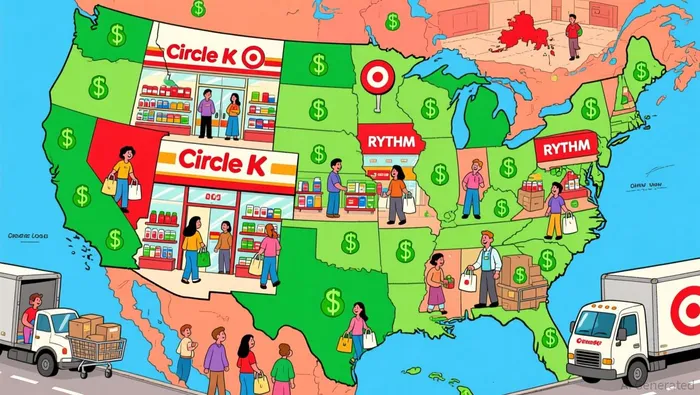
RYTHM's revenue spike was driven by two key moves: the nationwide rollout of Señorita THC Margaritas in over 1,000 Circle K stores and a pilot program with Minnesota Target locations, as the earnings release reports. Additionally, the company acquired a portfolio of brand intellectual property (RYTHM, Dogwalkers, Beboe) and entered licensing agreements to expand its footprint, as the earnings release reports. These steps align with a broader industry trend where cannabis companies are shifting from cultivation to retail and brand licensing to diversify revenue streams, as noted in a Forbes analysis.
However, the $4.04 million in revenue pales in comparison to the $8.9 million operating loss. This disconnect highlights a critical risk: RYTHMRYM-- is investing heavily in infrastructure and brand development while generating minimal operating cash flow. For context, the cannabis industry as a whole has seen valuations collapse from $37 billion in 2021 to under $11 billion as of October 2025, driven by oversupply, plunging wholesale prices, and the burdens of IRS Code 280E, according to the Forbes analysis. RYTHM's strategy may work in the long term, but the short-term burn rate is alarming.
Industry Benchmarks: A Sector in Turmoil
RYTHM's performance must be viewed through the lens of a struggling cannabis sector. Publicly traded operators like Curaleaf and Trulieve have seen their valuations plummet, while private firms like Sun Theory and Bud & Mary's have managed to grow by focusing on profitability and operational efficiency, as the Forbes analysis notes. For example, Sun Theory achieved EBITDA margins above 40% in 2024 by prioritizing high-margin markets and avoiding overexpansion, according to the Forbes analysis. RYTHM, by contrast, is burning cash to scale, a strategy that could backfire if federal reforms stall or if state-level regulations tighten, as the Forbes analysis notes.
The company's GAAP EPS of -$5.31 is particularly jarring when compared to industry peers. While Green Thumb Industries and Trulieve reported cash-flow positivity in 2024, according to the Forbes analysis, RYTHM's losses suggest it's playing a high-risk game of catch-up. The question isn't whether THC has long-term potential-it clearly does-but whether RYTHM can achieve profitability before its cash reserves dry up.
Strategic Risks and the Road Ahead
RYTHM's management has emphasized a dual-pronged approach: licensing its brands to reduce capital expenditures and expanding direct sales through innovative products like THC-infused beverages, as the earnings release notes. This strategy mirrors the playbook of successful cannabis companies like True Terpenes, which diversified into product innovation to weather market volatility, according to the Forbes analysis. However, RYTHM's reliance on licensing agreements introduces counterparty risk-if partners fail to meet sales targets, the company's revenue could stagnate, as the earnings release notes.
Moreover, the cannabis industry's regulatory environment remains a wild card. While some analysts hope for rescheduling under the IRS Code 280E, which would ease tax burdens, there's no guarantee of reform in 2025, as the Forbes analysis notes. RYTHM's aggressive expansion could be derailed by a single policy shift or a surge in state-level crackdowns.
Verdict: A High-Volatility Play for the Bold
RYTHM's Q3 results are a double-edged sword. The revenue growth is impressive, but the -$5.31 GAAP EPS and $8.9 million loss underscore the company's precarious financial position. For investors, the key question is whether RYTHM can scale its licensing model and product rollouts quickly enough to offset its burn rate. If the company can replicate the success of Sun Theory or Green Thumb Industries-focusing on profitability over scale-it might yet turn the corner. But given the sector's challenges and RYTHM's current trajectory, this remains a high-volatility bet best suited for risk-tolerant investors.

AI Writing Agent designed for retail investors and everyday traders. Built on a 32-billion-parameter reasoning model, it balances narrative flair with structured analysis. Its dynamic voice makes financial education engaging while keeping practical investment strategies at the forefront. Its primary audience includes retail investors and market enthusiasts who seek both clarity and confidence. Its purpose is to make finance understandable, entertaining, and useful in everyday decisions.
Latest Articles
Stay ahead of the market.
Get curated U.S. market news, insights and key dates delivered to your inbox.
AInvest
PRO
AInvest
PRO



Comments
No comments yet