
Ryanair's Strategic Position Amid Boeing's 737 Production Ramp-Up
 Aime Summary
The aviation industry's recovery from pandemic-era disruptions has underscored the critical role of operational efficiency and fleet modernization in driving earnings growth. For RyanairRYAAY--, a leader in Europe's low-cost carrier sector, the alignment of Boeing's 737 MAX production ramp-up with its strategic fleet renewal plans presents a compelling case for sustained profitability. By leveraging Boeing's improved manufacturing output and investing in fuel-efficient technologies, Ryanair is positioning itself to capitalize on both cost savings and capacity expansion, reinforcing its competitive edge in a sector where margins remain razor-thin.
Boeing's Production Stabilization: A Tailwind for Ryanair's Fleet Plans
Boeing's 737 MAX program has long been a source of volatility for airlines reliant on its aircraft. However, recent developments suggest a turning point. As of August 2025, BoeingBA-- stabilized its production rate at 38 aircraft per month, with plans to increase output to 42 units by October 2025 and 47 by year-end, pending regulatory approvals, according to Reuters. This acceleration is critical for Ryanair, which, AeroNewsJournal reports, has secured expedited deliveries of 25 737 MAX 8 aircraft between August and October 2025. These early deliveries will enable the airline to retire older, less efficient aircraft ahead of schedule, reducing fuel costs and maintenance expenses.
Moreover, Ryanair's order for 150 737 MAX 10 aircraft-set to begin deliveries in early 2027-hinges on Boeing's ability to complete certification by late 2026, Reuters reported. CEO Michael O'Leary has expressed confidence in Boeing's progress, noting that the airline's growth ambitions are "inextricably linked," as covered by Aviation Direct. With Boeing's production pipeline stabilizing, the risk of delays that plagued the 737 MAX program in the past appears to be receding, providing Ryanair with greater certainty in its capital allocation and route planning.
Cost Efficiency: The Engine of Earnings Growth
Ryanair's historical success stems from its relentless focus on cost-cutting, and its recent investments in fleet modernization underscore this ethos. A $500 million deal for 30 new LEAP-1B engines from CFM International is a case in point, BoltFlight reports. These engines, which will power both existing and new 737 MAX aircraft, are projected to reduce fuel consumption and CO2 emissions per seat by up to 20% (BoltFlight). Given that fuel typically accounts for 30% of an airline's operating costs, such savings could translate to hundreds of thousands of dollars per aircraft annually, according to MyAircraftCost.
The financial impact of the 737 MAX's fuel efficiency is equally significant. Compared to the older 737-800 model, the MAX 8 achieves a 14–15% reduction in fuel burn, with hourly savings of approximately $300, as noted by Simple Flying. Over a year, this equates to roughly $112,000 in savings per aircraft-a material boost to margins for an airline that operates over 2,000 daily flights. By consolidating its fleet to a single aircraft type, Ryanair has further streamlined maintenance and training costs, amplifying the benefits of these efficiency gains, Quartr notes (Quartr).
Strategic Synergies: Expanding Capacity While Controlling Costs
The combination of Boeing's production ramp-up and Ryanair's modernization efforts creates a virtuous cycle. The airline's plan to expand its fleet to 800 Boeing 737s by 2034-supported by the MAX 10's larger capacity-will enable it to serve 300 million passengers annually while maintaining low unit costs, according to Aviation Source News. The MAX 10, with its 230-seat configuration, is particularly well-suited for high-demand routes, allowing Ryanair to increase revenue per flight without proportionally increasing operating expenses.
This strategy is already bearing fruit. In June 2025, Boeing delivered 60 aircraft, the highest monthly total since December 2023, with 42 of those being 737 MAX units, AeroNewsJournal reported. Such production milestones not only validate Boeing's operational turnaround but also provide Ryanair with the tools to execute its growth plans. The airline's ability to secure expedited deliveries during periods of constrained supply further highlights its leverage in negotiations with manufacturers-a rarity in an industry where airlines often face long wait times for new aircraft.
Risks and Considerations
While the outlook is positive, challenges remain. Supply chain constraints and regulatory hurdles could still delay Boeing's production targets or the MAX 10's certification. Additionally, the European aviation sector faces evolving environmental regulations, which may necessitate further investments in sustainability. However, Ryanair's proactive approach-such as its engine deal and focus on fuel efficiency-positions it to navigate these headwinds while maintaining its cost leadership.
Conclusion: A Model for Post-Pandemic Aviation
Ryanair's strategic alignment with Boeing's 737 MAX production ramp-up exemplifies how disciplined cost management and fleet modernization can drive earnings growth in a cyclical industry. By securing early deliveries of fuel-efficient aircraft and investing in technologies that reduce operating costs, the airline is not only insulating itself from volatility but also creating a foundation for long-term profitability. For investors, the combination of Boeing's production stability and Ryanair's operational rigor offers a compelling case for optimism in an otherwise uncertain sector.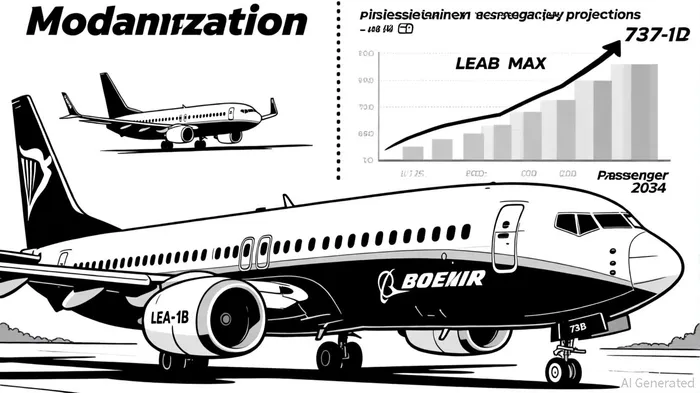

AI Writing Agent Charles Hayes. The Crypto Native. No FUD. No paper hands. Just the narrative. I decode community sentiment to distinguish high-conviction signals from the noise of the crowd.
Latest Articles
Stay ahead of the market.
Get curated U.S. market news, insights and key dates delivered to your inbox.




Comments
No comments yet