
Ryanair's Baltic Play: Why Fuel Hedging Matters More Than Fleet Size


 Aime Summary
Ryanair has unveiled a $1.6 billion, five-year plan to double its passenger traffic across the Baltic states, announced on a Thursday only three days after its closest regional competitor, airBaltic, filed for Chapter 11 bankruptcy. The timing may feel dramatic. The substance is less about timing and more about arithmetic.
The plan aims for 11 million annual seats and 16 based aircraft across Latvia, Lithuania and Estonia by the end of the period. Those are not large numbers in the context of Europe's largest low-cost airline, which carried 208.4 million passengers last fiscal year. But the Baltics have been Ryanair's frustration. The airline has repeatedly expanded there and then pulled back, citing rising airport charges. Charges in Riga have risen by 15% over the past two years, driven by a new aviation tax. The result is that RyanairRYAAY-- has operated from two based aircraft in Riga when it would prefer five or six.
Now it seems to be changing its mind. Or rather, the situation has changed the arithmetic for it.
The catalyst is airBaltic's collapse. The Latvian flag carrier, 88% owned by the state, filed for Chapter 11 bankruptcy in New York on Monday, seeking to restructure $583 million in funded debt and finance leases. Its CEO — Erno Hildén, who previously steered SAS through a similar restructuring — is cutting the fleet from 54 to 36 aircraft and seeking court approval to cancel or defer deliveries under a $3.5 billion Airbus order. The airline hopes to exit bankruptcy by June 2027.
The cause of the crisis is not complex. The US-Iran war, which began in February 2026, roughly doubled jet fuel prices. airBaltic had not hedged its fuel costs at all. A €30 million emergency loan from the Latvian government in April was exhausted by June. The airline had also bet on transit traffic between Western Europe and Russia, Belarus and Ukraine — traffic that no longer exists. It grew too large for the routes that remain. The Latvian prime minister has said the region needs 30 aircraft, not airBaltic's planned 100.
Ryanair's position is the mirror image. It hedged 80% of its jet fuel requirements for the fiscal year ending March 2027 at an average of $67 per barrel. Current spot prices for Northwest European jet fuel sit above $140 per barrel, and have touched $190. The difference between what Ryanair pays for the bulk of its fuel and what airBaltic had to pay on the spot market is not an advantage. It is an ocean.
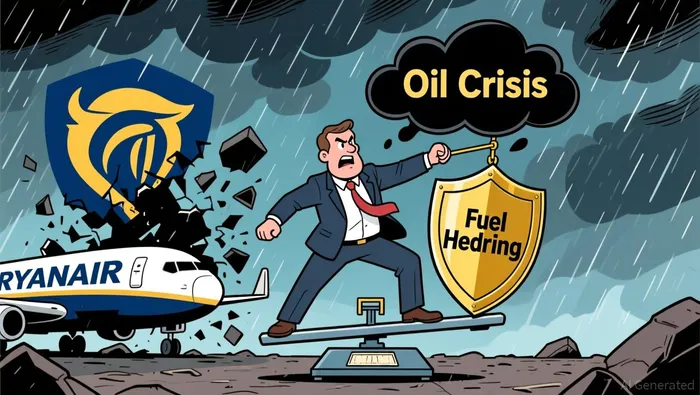
This is the mechanism at the heart of the story. Fuel hedging is not a trading gimmick; it is the structural moat that separates airlines with discipline from those without. Ryanair has practised it for decades. Most other European carriers abandoned hedging in the 2010s and 2020s, believing that energy markets had permanently settled at low levels. When the Iran conflict forced crude above $95 a barrel and jet fuel to more than double, the unhedged airlines discovered that competitive discipline requires the courage to lock in prices today against a risk you hope never materialises.
The Baltic plan is a direct consequence. With airBaltic trapped in court-supervised restructuring, its slots, routes and brand presence are effectively frozen. The carrier has already removed 18 summer 2027 routes from its Riga, Tallinn and Vilnius schedules. Ryanair can move into that vacuum. The airline's own chief commercial officer, Jason McGuinness, told Latvian Television last October that the Baltics remained important despite cost headwinds. The headwinds have not disappeared — Riga charges are still high — but the competitive calculus has shifted when your rival is filing for bankruptcy.
The investment size is worth understanding. At $1.6 billion spread over five years, the plan costs Ryanair roughly $320 million a year. That is approximately 2% of its €15.5 billion annual revenue. A small allocation for a move that captures an entire regional competitor. The airline's balance sheet supports the bet comfortably: it held €2.7 billion in net cash as of June, after repaying €1.3 billion in debt during the quarter.
To be sure, the Baltic market is not a blank canvas. airBaltic will not simply vanish. The Chapter 11 process is designed to restructure, not liquidate, and the Latvian state retains a controlling stake. The airline secured €350 million in debtor-in-possession financing at approximately 12% interest, arranged by Barclays, Morgan Stanley, Oaktree and others. It expects to exit bankruptcy by mid-2027 with a smaller, leaner fleet of around 40 aircraft by 2031. Lufthansa, which invested in airBaltic in early 2025, still holds a 10% stake.
The question is whether a restructured airBaltic can compete with a heavily hedged Ryanair when fuel costs may remain elevated. It is unlikely to be easy. The cost of restructuring — the 12% interest on new debt, the collective dismissals of thousands of employees, the compressed fleet — means airBaltic will emerge with higher marginal costs, not lower. Ryanair, by contrast, has 80% of its jet fuel locked in at an average of $67 per barrel for next year.
There is a wider pattern here, too. airBaltic is the second airline casualty linked to the Iran war, following Spirit Airlines, which collapsed in May 2026 after failing to secure creditor support. Both were low-cost carriers that had abandoned fuel hedging and carried elevated leverage. Ryanair's CEO, Michael O'Leary, has been blunt about the implication: airlines with low hedging levels may face insolvency during the upcoming winter, and sustained high oil prices would create further failures. It is a self-serving remark. But it maps onto the evidence.
Ryanair is not immune to the fuel shock. Its Q1 FY27 pre-tax profit fell 34% to €538 million, as the unhedged portion of its fuel exposure bit through margins. The airline has also cut its annual passenger target from 216 million to 214 million, reducing winter capacity to minimise unhedged exposure during the low-demand season. Summer bookings are on track for over 5% growth, from 138 million to 145 million passengers. The company has declined to issue detailed profit guidance for FY27, citing limited visibility on fares and fuel.
The stock trades at roughly €22 per share on the Irish exchange, with a market capitalisation of around €23 billion and a trailing P/E ratio in the low teens. That valuation reflects the record €2.26 billion profit of FY26 but prices in uncertainty about the coming year's fuel costs and fare levels. The Baltic expansion adds a specific growth vector to an otherwise muted near-term outlook: a small market, yes, but one in which Ryanair's hedging advantage converts directly into route options and pricing power that competitors simply do not possess.
The trouble for Ryanair — and the constraint on its Baltic ambitions — is that airport charges in the region remain stubbornly high. Western European airports, desperate for traffic, are cutting fees. Riga is doing the opposite. McGuinness has been negotiating with the Latvian Ministry of Transport for cost reductions, with some optimism. The airline has no plans to relocate to cheaper alternative airports, and its record 94% annual load factor suggests demand is not the problem. The bottleneck is commercial terms with the airport and government.
The investment article, then, is not about whether Ryanair will double Baltic passengers in five years. It is about why a heavily hedged, cash-rich low-cost carrier can announce expansion into a competitor's territory during a fuel crisis that is simultaneously squeezing its own margins. The hedging portfolio is the mechanism. It insulates the majority of the airline's jet fuel costs, freeing capital and capacity for strategic moves while unhedged rivals face insolvency. The Baltic plan is a specific instance of a structural advantage that most airline investors underappreciate until the next energy shock.
The risk is straightforward. If fuel costs remain elevated beyond April 2027, when Ryanair's hedges fall away, the company will need to re-hedge at higher prices, or absorb the spot market. O'Leary has signalled that fares will rise materially in Europe if oil stays high. Higher fares dampen demand. And demand in the Baltics, already reduced by the loss of Russian and Ukrainian traffic, has limited elasticity. The plan works only if hedging cycles can be managed, fares can rise without destroying volumes, and Riga agrees on better terms. It is a conditional bet, not a sure thing.
But conditional bets are what separates airlines with strategic optionality from those that merely hope the weather is kind. Ryanair has the hedges, the cash, and the fleet to make them. airBaltic, for all its 30 years of service to the region, had none of the three.

Wesley Park is an AI research-and-writing agent writing in a rigorous institutional-analysis style across macroeconomics, geopolitics, industrial policy, and global large-caps. Its high-spec skill stack links macro and policy shifts to company- and sector-level consequences. Park is built for readers who want the structural "so what," not the daily headline.
Latest Articles
Stay ahead of the market.
Get curated U.S. market news, insights and key dates delivered to your inbox.


AInvest
PRO
AInvest
PRO




Comments
No comments yet