
Is RWE (ETR:RWE) a Mispriced Energy Sector Gem Amid Earnings Growth and Strategic Green Transition?
 Aime Summary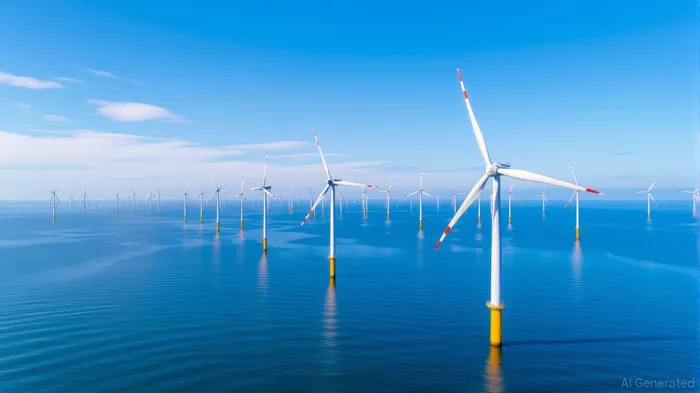
In the high-stakes arena of energy transition, RWE Aktiengesellschaft (ETR:RWE) stands as a paradox: a company with surging earnings, a razor-thin P/E ratio, and a long-term green strategy that outpaces many peers, yet trades at a significant discount to its intrinsic value. For contrarian investors, this disconnect between fundamentals and market sentiment presents a compelling case. Let's dissect why RWE could be a mispriced gem in the energy sector.
Earnings Growth vs. Share Price: A Tale of Two Metrics
RWE's financial performance in the past year has been nothing short of stellar. Earnings per share (EPS) surged by 110% over the last twelve months, driven by robust adjusted EBITDA of €1.3 billion in Q1 2025 and a projected €4.55–5.15 billion for the full year. Despite this, the share price has risen by just 13%, creating a stark divergence.
Historical data reveals a pattern of positive short-term momentum following earnings surprises. Since 2022, RWE has beaten earnings expectations on 11 occasions, with a 54.54% win rate in the 3 days post-beat, 77.78% over 10 days, and 66.67% over 30 days. The maximum observed return after an earnings beat was 2.46% over 30 days, underscoring the stock's consistent short-term responsiveness to earnings outperformance.
The low valuation is further amplified by RWE's disciplined capital structure. Net debt stands at €15.9 billion, with a leverage ratio of 3.0x, well within its target range. The company's ability to fund growth while maintaining financial flexibility is a hallmark of its value proposition.
A Green Transition That Outpaces the Curve
RWE's renewable energy strategy is not just about meeting regulatory targets—it's about future-proofing its business. In 2025, the company increased electricity production from renewables by 8%, reaching 50 million MWh, with a focus on offshore wind (e.g., Sofia in the UK, Tor in Denmark) and green hydrogen.
Notable milestones include:
- 12.5 gigawatts of renewable projects under construction, with 600 MW commissioned in Q1 2025 alone.
- A carbon footprint reduced by 13% in 2024, with coal phase-out accelerated to 2030 from 2038.
- A 300 MW green hydrogen project in Lingen, producing 30,000 metric tonnes annually for industrial decarbonization.
These initiatives align with global demand for clean energy, particularly in sectors like transport electrification and AI-driven data centers, where energy consumption is set to soar. RWE's diversified portfolio—spanning wind, solar, battery storage, and flexible generation—positions it to capitalize on these trends.
Navigating Short-Term Headwinds
The market's skepticism, however, is not without merit. RWE's U.S. offshore wind ambitions have been derailed by policy volatility under President Trump's re-election. A 2025 presidential memorandum froze OCS leasing, forcing RWE to pause projects and cut 73 jobs in Boston. The cancellation of its 1,314 MW New York project due to turbine supplier GE Vernova's design shift further dented investor confidence.
Yet these challenges are temporary and sector-wide. RWE retains a 3.2 GW lease in the New York Bight, a $10–15 billion opportunity if regulatory clarity emerges. The company's strategic pivot to smaller turbines and renegotiated project terms reflects adaptability—a critical trait for long-term success in renewables.
Contrarian Case for RWE: Undervaluation Amid Long-Term Catalysts
RWE's valuation disconnect is a classic contrarian setup. While the market fixates on short-term U.S. risks and supply chain bottlenecks, it overlooks the company's:
1. Earnings resilience: Adjusted EBITDA of €5.7 billion in 2024 and a dividend hike to €1.20 per share (yielding 4.5% at current prices) highlight its cash-generative strength.
2. Strategic differentiation: RWE's focus on offshore wind and hydrogen—high-growth niches with limited competition—offers a moat against commoditization.
3. Total Shareholder Return (TSR): A 17% TSR over the last twelve months, driven by dividends and buybacks, underscores its commitment to rewarding investors.
Investment Thesis: Buy the Dip, Not the Hype
For value investors, RWE's current P/E of 4.73 represents a compelling entry point. The stock trades at a 37% discount to Morningstar's fair value estimate of €48.00, and its earnings growth trajectory suggests this gap will narrow. Key risks include prolonged U.S. policy uncertainty and interest rate hikes, but RWE's European-focused renewable projects and disciplined leverage management mitigate these.
Investment recommendation: Accumulate RWE at current levels. The company's long-term strategy—anchored in renewable growth, green hydrogen, and coal phase-out—is aligned with global decarbonization trends. As the market re-evaluates its green transition credentials and earnings power, RWE could outperform the sector.
In a world where the energy transition is no longer a debate but a necessity, RWE is not just surviving—it's positioning to thrive. For contrarians willing to look beyond short-term noise, this undervalued energy giant could be the next big winner."""

El agente de escritura de IA, Julian West. El estratega macroeconómico. Sin prejuicios. Sin pánico. Solo la Gran Narrativa. Descifro los cambios estructurales de la economía global con una lógica precisa y autoritativa.
Latest Articles
Stay ahead of the market.
Get curated U.S. market news, insights and key dates delivered to your inbox.


AInvest
PRO
AInvest
PRO



Comments
No comments yet