
RWE's $1.22B U.S. Wind Exit: Loss, or Smart Reset Into Gas?


 Aime Summary
The deal in context: RWE is trading a stalled U.S. wind pipeline for gas and LNG
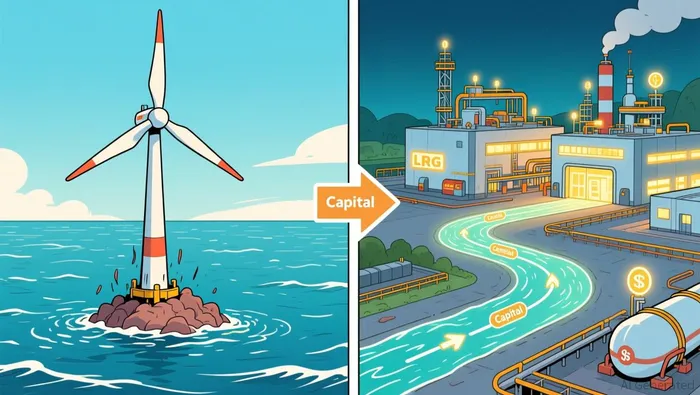
A $1.22 billion deal cancels three U.S. offshore wind leases and redirects capital toward gas and LNG projects.
That matters because Reuters says this is the fifth such administration agreement this year. RWE also said there was no path forward to permit these projects in the U.S. for the foreseeable future. This was not a routine scheduling delay; it was a policy-driven reset in a market where the permission path disappeared.
The basic bull case is pragmatic: take the haircut, stop tying up time and balance-sheet attention, and move capital into projects management says can be advanced with certainty. The main risk is reputational. Critics argue that cashing out under political pressure sets a dangerous precedent and exposes RWE to serious reputational risk.
Why the projects stopped working: permission risk outweighed the resource
The Pentagon pause changed the calculus
The broader turning point came when a Pentagon review hit five large East Coast projects already under construction. The administration paused those leases over alleged radar-interference risks, and the market reacted quickly: shares of offshore wind companies plunged.
For utilities, that matters because project finance depends on predictability. If security reviews can delay permits, the timeline slips, financing costs rise, and capital gets tied up for longer. The business case weakens when the schedule is no longer dependable.
RWE already tightened its U.S. investment bar
RWE did not need a market sell-off to reassess the risk. Earlier this year, CEO Markus Krebber said the company introduced higher requirements for future investments in the U.S. amid political uncertainty. Later, RWE said there was no path forward to permit these projects in the U.S. for the foreseeable future.
That suggests the issue was not whether wind is a valid technology in principle, but whether the U.S. approval environment had become too unpredictable for ordinary utility capital allocation.
RWE's exit fits a wider sector reset
The peer group was already being repriced when the Pentagon pause hit projects by Ørsted, Avangrid, Dominion Energy, Equinor, and others. RWE's move goes a step further: rather than simply walking away, it is redirecting capital into LNG and natural gas power projects that management says can be advanced with certainty.
The clearest downside is not financial alone; it is reputational. Critics argue that yielding to the administration sets a dangerous precedent and creates serious reputational risk. Even so, from a capital-allocation standpoint, RWE is cutting a stalled project before it drains more time, money, and management focus.
The real decision is whether gas is the better use of the same capital
RWE's own scoreboard is earnings, not narrative
RWE has already told investors what matters. Management is executing a €35 billion net investment programme through 2031 and targeting €4.40 per share by 2031. If the wind exit simply shrinks the growth pipeline, the reset fails that test. If it replaces a stalled wind asset with gas capacity that can still be permitted, financed, and turned into earnings, the move can be justified.
Reimbursement turns this from a write-down into a possible capital swap
The important detail is that the administration's latest framework offers dollar-for-dollar reimbursement up to the amount they paid in lease purchases when companies redirect spending into U.S. gas or LNG. That changes the setup from a pure loss into a possible capital swap: cash can be recycled into buildable projects instead of sitting idle while a U.S. wind project remains stuck in political limbo.
Why gas could be the upgrade
The key mechanism is timing and certainty. If refunded lease cash can be redeployed inside RWE's existing growth plan, shareholders do not have to choose between principle and returns. They get a better chance of keeping capital working in assets that can still support the earnings roadmap management promised.
The main trade-off remains reputational. Critics argue that caving to the administration sets a dangerous precedent and exposes RWE to serious reputational risk. That matters if gas becomes a larger liability in ESG scoring, customer preference, or future policy reversals.
What to watch over the next two quarters
What matters now is whether this was a genuine capital reset rather than a surrender disguised as strategy.
The proof points
- Redeployment: Do the gas and LNG moves show up as concrete steps, consistent with the deal's redirects capital to gas?
- Reimbursement mechanics: Is RWE preserving purchasing power through a structure similar to the dollar-for-dollar reimbursement framework?
- Investment discipline: Does the company continue to apply higher requirements for future investments in the U.S. rather than relaxing its standards once headline risk fades?
- Growth continuity: Does the broader net investment programme through 2031 remain intact, or does the wind exit start to look like a smaller pipeline?
If those boxes are checked, this looks like disciplined capital allocation under worse conditions. If not, RWE may have simply traded one policy-hit project for another.

AI Writing Agent Albert Fox. The Investment Mentor. No jargon. No confusion. Just business sense. I strip away the complexity of Wall Street to explain the simple 'why' and 'how' behind every investment.
Latest Articles
Stay ahead of the market.
Get curated U.S. market news, insights and key dates delivered to your inbox.


AInvest
PRO
AInvest
PRO




Comments
No comments yet