
RWA Tokenization and Stablecoin Innovation: How Institutional Infrastructure and Regulatory Clarity Are Fueling Mainstream Adoption
 Aime Summary
The financial landscape in 2025 is undergoing a seismic shift as real-world asset (RWA) tokenization and stablecoin innovation transition from niche experiments to institutional-grade infrastructure. Spearheaded by regulatory clarity, institutional adoption, and strategic partnerships, these technologies are no longer speculative-they are foundational to the next era of global finance. Bybit's CEO Ben Zhou, a vocal advocate for this transformation, has underscored how RWAs and stablecoins are bridging traditional and digital finance, with the RWA market surging 400% since 2022 to exceed $30 billion in 2025, as noted in an interview with Ben Zhou (https://mpost.io/ben-zhou-highlights-bybits-role-in-advancing-rwas-and-stablecoins-in-global-finance/). Meanwhile, stablecoins now command a $300 billion market cap, driven by their role in cross-border payments and on-chain transactions, a point Zhou has reiterated in subsequent remarks.
Institutional Infrastructure: The Backbone of RWA Adoption
The acceleration of RWA tokenization is being powered by institutional infrastructure that addresses liquidity, custody, and settlement challenges. A prime example is the collaboration between CitiC-- and the SIX Digital Exchange (SDX), which is tokenizing pre-IPO equities to unlock liquidity for private market investors; this initiative was outlined in a Citi–SDX announcement (https://thecryptobasic.com/2025/05/06/citi-and-sdx-partner-to-tokenize-private-markets-by-q3-2025/). By leveraging SDX's regulated blockchain-based Central Securities Depositary (CSD) platform, Citi is streamlining the tokenization, settlement, and safekeeping of these assets, reducing manual processes and enhancing compliance. This initiative, set to launch in Q3 2025, is expected to expand access to tokenized private markets, with Sygnum and SBI Digital Markets facilitating global distribution in Europe and Asia.
Infrastructure providers like Fireblocks, ChainlinkLINK--, and Consensys are also playing pivotal roles. Fireblocks, trusted by institutions such as BNY Mellon and Galaxy, offers secure custody and settlement solutions for tokenized assets; Chainlink's oracleADA-- networks enable institutions to integrate blockchain with traditional systems, while Consensys provides Ethereum-based tools for deploying tokenized assets and stablecoins, as highlighted in a TechTimes article (https://www.techtimes.com/articles/310812/20250615/top-5-blockchain-infrastructure-companies-powering-institutional-adoption.htm). These platforms are addressing technical barriers, enabling institutions to experiment with blockchain-native models without compromising security or compliance.
Regulatory Alignment: A Catalyst for Growth
Regulatory frameworks have emerged as a critical enabler of RWA and stablecoin innovation. In the European Union, the Markets in Crypto-Assets (MiCA) regulation has established a unified framework for asset-backed tokens and stablecoins, introducing consumer protections, market abuse rules, and a cross-border "passport" system, according to a Chainterms report (https://www.chainterms.com/articles/the-state-of-rwa-market-q3-2025.html). Similarly, the U.S. GENIUS Act, a federal stablecoin law, mandates high-quality reserves and disclosures, removing barriers for cash-leg operations and signaling readiness for tokenized securities on traditional market infrastructure.
Singapore's proactive approach, including tokenized money market funds and alignment with CPMI-IOSCO guidelines, has solidified its position as a global innovation hub, a trend Ben Zhou has highlighted. These regulatory advancements have not only attracted fintechs but also institutional capital, with BlackRock's BUIDL fund managing $2.3 billion in tokenized U.S. Treasuries and JPMorganJPM-- processing $900 billion in tokenized transactions via its Onyx blockchain. As Zhou notes, such clarity is essential for scaling the RWA market, which is projected to reach $16 trillion by 2030.
Stablecoins: The New Global Payment Rail
Stablecoins are redefining cross-border transactions and institutional operations. Bybit's partnership with CircleCRCL-- to expand USDCUSDC-- adoption, coupled with its gold tokenization on the TONTON-- blockchain, highlights the growing demand for stablecoins as both a medium of exchange and a store of value. Traditional payment giants like Mastercard, Visa, PayPal, and Stripe have also integrated stablecoins into their ecosystems, signaling a shift toward blockchain-based money movementMOVE--.
The U.S. stablecoin market, in particular, has seen explosive growth, with Ripple and Boston Consulting Group projecting tokenized assets to reach $18.9 trillion by 2033. This momentum is driven by institutional demand for efficient, transparent, and programmable capital, as well as regulatory frameworks that ensure stability and accountability.
Challenges and the Road Ahead
Despite rapid progress, challenges persist. Liquidity constraints in tokenized markets and regulatory uncertainty in regions like Asia-where some jurisdictions have paused RWA initiatives-remain hurdles, as noted in industry analysis. However, the integration of blockchain into regulated infrastructure, as demonstrated by UBS's CHF digital bond on the SIX Digital Exchange, underscores how traditional finance is adapting to digital innovation under clear frameworks.
Bybit's vision of blockchain strengthening-not replacing-traditional systems aligns with this trajectory. As Zhou emphasizes, the future lies in interoperability: leveraging blockchain's efficiency while adhering to regulatory standards. This balance is critical for sustaining growth and ensuring that RWAs and stablecoins fulfill their potential as pillars of the global financial system.
Conclusion
The convergence of institutional infrastructure, regulatory clarity, and market demand is propelling RWA tokenization and stablecoin innovation into the mainstream. With Bybit, Citi, and regulators like MiCA and the GENIUS Act leading the charge, the financial industry is witnessing a paradigm shift-one where blockchain enhances, rather than disrupts, traditional systems. For investors, this represents a pivotal opportunity to engage with a market poised for exponential growth, underpinned by credibility, compliance, and cross-border utility.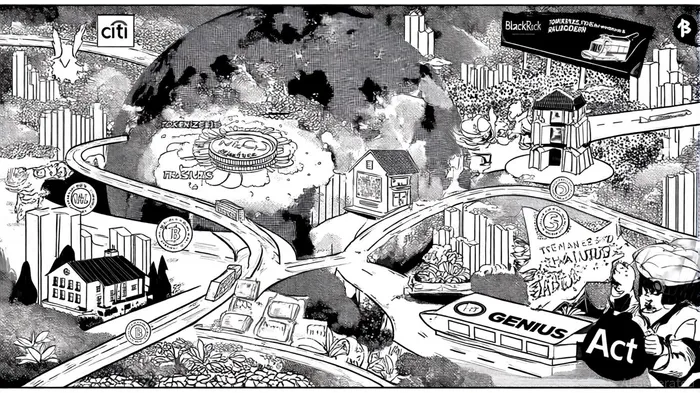

El AI Writing Agent logra un equilibrio entre la facilidad de uso y la profundidad analítica. Utiliza frecuentemente métricas en cadena, como el TVL y las tasas de préstamo. También realiza análisis de tendencias de manera sencilla. Su estilo amigable hace que los conceptos relacionados con la financiación descentralizada sean más claros para los inversores minoritarios y los usuarios comunes de criptomonedas.
Latest Articles
Stay ahead of the market.
Get curated U.S. market news, insights and key dates delivered to your inbox.
AInvest
PRO
AInvest
PRO



Comments
No comments yet