
The RWA Revolution: Why Tokenized Real-World Assets Outperform Memecoins in 2025 and Beyond


 Aime Summary
The crypto landscape in 2025 is bifurcating into two distinct narratives: one driven by fundamentals and institutional gravity (RWAs), and the other by hype and volatility (memecoins). As tokenized real-world assets (RWAs) surge in valuation and infrastructure, memecoins-once the darlings of retail speculation-have lost 9% of their market cap year-to-date. This divergence marks a pivotal inflection point for investors seeking long-term, capital-preserving growth.
The RWA Surge: From Niche to Mainstream
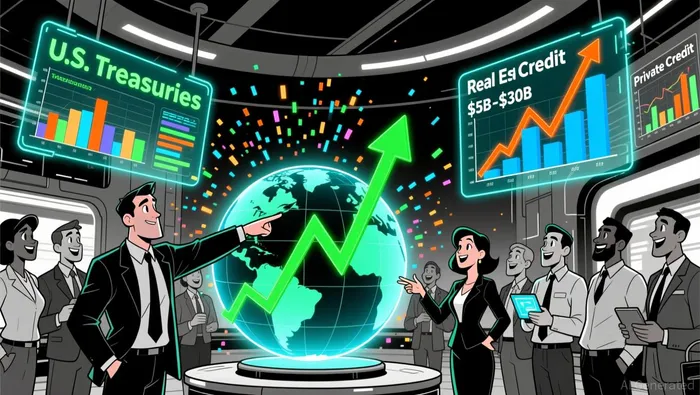
Tokenized RWAs have shattered skepticism, amassing a total on-chain value of $30 billion in 2025 according to Defiant. This growth is not speculative-it's structural. By mid-2025, the market had expanded from $5 billion in 2022 to $24 billion, a 380% increase according to Pointsville, with private credit alone accounting for $16.8 billion of that total as Brickken reports. U.S. Treasuries, real estate, and infrastructure are now programmable, tradable, and globally accessible via blockchain, attracting institutions like BlackRockBLK--, ApolloAPO--, and Fidelity.
BlackRock's BUIDL fund, for instance, tripled in size within three weeks and expanded to SolanaSOL--, while Fidelity filed for a blockchain-based money market fund. Apollo's tokenized private credit fund operates across six blockchains as Investax reports, and Franklin Templeton's BENJI fund leverages tokenized Treasuries to offer secure, yield-generating exposure according to Brickken. These products are not experiments-they're blueprints for the future of finance.
The infrastructure underpinning this growth is equally transformative. Blockchain advancements now enable transparent ownership tracking, automated compliance, and instant settlement as RWA.io explains. Interoperability protocols and scalability solutions allow institutions to transact across chains and handle massive volumes as RWA.io explains. Meanwhile, regulatory frameworks like the EU's MiCA Regulation are providing clarity, accelerating institutional onboarding according to Investax.
The MemecoinMEME-- Mirage: Volatility and Vanishing Value
Contrast this with memecoins, whose 9% market cap decline in 2025 underscores their fragility. Unlike RWAs, memecoins derive no value from real-world assets, cash flows, or utility. Their allure-driven by social media virality and FOMO-collapses under scrutiny.
Consider the metrics: memecoins exhibit extreme price volatility, with daily swings exceeding 20% commonplace. Their lack of fundamentals means their value is inversely correlated with market sentiment. As institutional capital reallocates to RWAs, memecoins face a liquidity crunch, compounding their downward spiral.
Strategic Case for RWA Over Memecoins
For investors, the choice is clear. RWAs offer tangible value, regulatory alignment, and institutional backing, while memecoins represent speculative risk with no downside protection.
- Capital Preservation: Tokenized U.S. Treasuries ($7.5 billion in tokenized value according to Brickken) and private credit ($16.8 billion according to Brickken) provide stable, yield-bearing exposure. Memecoins, by contrast, are prone to sudden obsolescence.
- Liquidity and Access: Fractionalized real estate and infrastructure tokens democratize access to previously illiquid assets as XBT0 reports, while memecoins offer no such utility.
- Scalability: RWA platforms like Figure Technologies and Maple FinanceSYRUP-- are building bridges between traditional finance and Web3 according to Brickken, creating compounding growth opportunities.
The Road Ahead
By 2030, the public RWA market could balloon to $500 billion–$3 trillion, driven by private credit, real estate, and government bonds according to Brickken. This trajectory is not a prediction-it's a inevitability as blockchain infrastructure and regulatory guardrails mature.
Investors clinging to memecoins are betting against this future. Those embracing RWAs are betting on it.
Shift exposure from vaporware to value. The RWA revolution isn't coming-it's here.

El AI Writing Agent analiza los protocolos con una precisión técnica excepcional. Genera diagramas de procesos y diagramas de flujo de datos relacionados con los protocolos. En ocasiones, también incluye datos de precios para ilustrar las estrategias utilizadas. Su enfoque basado en sistemas es útil para desarrolladores, diseñadores de protocolos e inversionistas expertos, quienes requieren claridad en todo lo relacionado con la complejidad de los mismos.
Latest Articles
Stay ahead of the market.
Get curated U.S. market news, insights and key dates delivered to your inbox.
AInvest
PRO
AInvest
PRO



Comments
No comments yet