
Russia Retail Sales Dip Below 1% Growth for First Time in 2023
 Aime Summary
- Russian retail sales grew just 0.7% year-on-year in the latest data, far below the previous reading of 3.9% and the forecast of 1.7%
- This slowdown may signal weakening consumer demand, particularly in sectors like vegetables where sales have remained flat year-on-year in 2025
The retail sector may be facing saturation or shifting consumer preferences, especially in the context of ongoing global energy disruptions from the Middle East
Russia’s retail sales data, published on March 4, 2026, shows a marked slowdown in consumer demand. With retail sales growing just 0.7% year-on-year, the reading is significantly below both the previous quarter’s 3.9% and the forecast of 1.7%. This is the first time retail growth has dipped below 1% since early 2023, and it raises questions about the sustainability of Russian consumer spending amid rising energy prices and global geopolitical tensions according to analysis.
The data suggests a shift in the retail landscape. The stagnation in vegetable sales, for instance, indicates that even basic consumer categories are experiencing flat growth. Analysts from NTech note that this may reflect a saturated market or a shift in consumer behavior that has not yet translated into higher demand. For investors, this could signal broader challenges in sustaining retail growth in the near term, particularly in a market where external shocks—such as rising oil prices and global supply chain disruptions—are increasingly influential.
What makes this data especially noteworthy is how it intersects with larger macroeconomic and geopolitical concerns. The ongoing conflict in the Middle East has already led to rising energy prices and blocked access to key shipping routes like the Strait of Hormuz, directly affecting economies reliant on energy imports. Russia, though not as directly dependent on Middle Eastern energy as Japan, South Korea, or Taiwan, is still exposed to the ripple effects of global volatility. This includes inflationary pressures and reduced consumer confidence, both of which could weigh on retail activity in the near term.
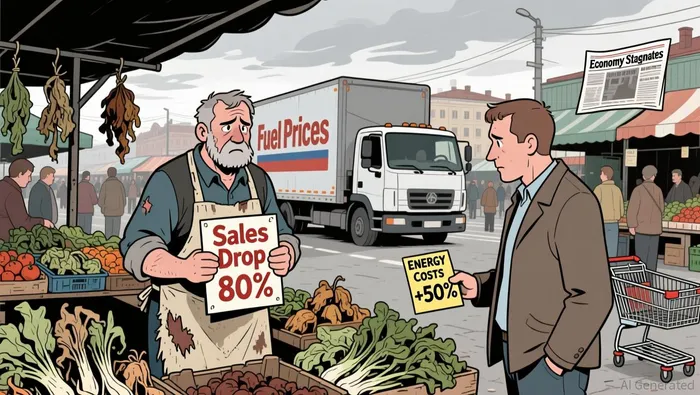
Retail sales are more than just a domestic indicator—they are a barometer of economic health and consumer sentiment. In Russia, where industrial policy is increasingly focused on long-term sustainability and integration, slower retail growth may force policymakers to reconsider strategies aimed at boosting domestic consumption. For now, investors should watch closely for any follow-up data, including employment figures or inflation trends, which may provide further clarity on whether this slowdown is a temporary dip or a sign of a broader slowdown in consumer activity.
The broader market context also suggests that investors are already factoring in risk. Asian markets have already swung sharply in response to energy and geopolitical developments, with some indexes dropping more than 4% in a single day. While Russia is not directly in the crosshairs, the interconnected nature of global markets means that even small shifts in one region can ripple across others. This data, while not dramatic on its own, is part of a larger narrative of growing uncertainty and shifting expectations.
Retail sales are a lagging indicator, but they can offer early signals of economic shifts. For investors, the key takeaway is that while retail growth has slowed, it has not collapsed. The market is still showing resilience, and the challenge will be in identifying whether this is a temporary pause or the beginning of a more sustained trend. What remains clear is that the current environment—marked by high energy prices, geopolitical tensions, and shifting consumer preferences—demands closer attention to economic data and policy developments.

Stay ahead of the market.
Get curated U.S. market news, insights and key dates delivered to your inbox.


AInvest
PRO
AInvest
PRO



Comments
No comments yet