
U.S.-Russia Maritime Tensions and Geopolitical Risk in Energy Markets: Opportunities in Defense and Maritime Surveillance Sectors Amid Escalating Global Oil Sanctions Enforcement
 Aime Summary
The U.S.-Russia maritime tensions of 2025 have intensified as Washington doubles down on sanctions targeting Russia's energy sector, a critical lifeline for its war effort in Ukraine. These measures, coupled with broader Western enforcement actions, have not only reshaped global oil markets but also catalyzed a surge in demand for advanced defense and maritime surveillance technologies. For investors, this geopolitical standoff presents a unique confluence of risk and opportunity, particularly in sectors tasked with enforcing sanctions and countering Russia's shadow fleet.
The Sanctions-Driven Energy Market Shift
The U.S. Treasury's October 2025 sanctions on Rosneft and Lukoil, alongside the designation of over 180 oil-carrying vessels, have significantly disrupted Russian oil exports. Data from November 2025 reveals a 33% year-on-year decline in Russian oil and gas revenues, with Urals crude prices plummeting to $45 per barrel-a level last seen during the 2020 pandemic lockdown. The EU's seaborne oil import ban and the U.S.-led price cap mechanism have further eroded Moscow's ability to monetize its energy exports. However, Russia's adaptation-reflagging sanctioned vessels under its own registry and leveraging transshipment hubs like Damietta and Istanbul-has complicated enforcement efforts.
India, a key Russian oil buyer, has begun shifting its procurement to Saudi Arabia and Iraq, signaling a broader realignment of global energy trade routes. This shift underscores the fragility of Russia's export-dependent economy, which now faces a growing federal budget deficit and constrained war funding. Yet, the effectiveness of sanctions remains contingent on enforcement rigor and the willingness of non-Western buyers to comply with price caps.
The Shadow Fleet and Maritime Evasion Tactics
Russia's shadow fleet-now estimated at over 1,000 vessels-has become a central challenge for sanctions enforcement. These ships, often flying false flags under jurisdictions like Tonga and Gambia, employ tactics such as AIS spoofing, GPS jamming, and ship-to-ship (STS) transfers to evade detection. For instance, the U.S. seizure of the Russian-flagged in the North Atlantic in late 2025 highlighted the risks of direct confrontation with Russian naval escorts, as the tanker was found to be facilitating Venezuela's sanctioned oil exports.
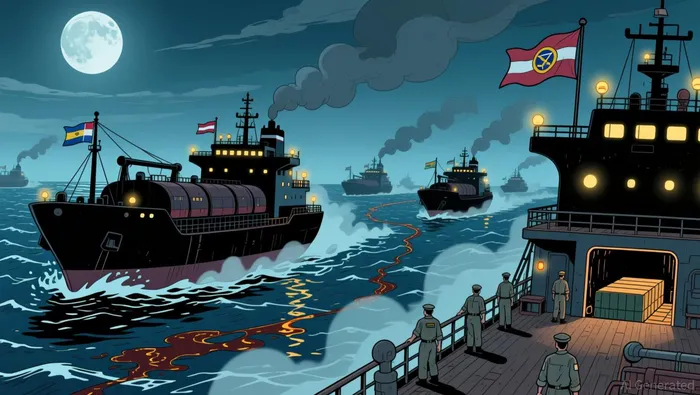
The shadow fleet's operational resilience has forced regulators to adopt more sophisticated tools. Traditional static watchlist systems are being replaced by predictive analytics that detect behavioral anomalies, such as irregular routing patterns or rapid reflagging. The EU's 19th sanctions package and U.S. designations of energy sector players have further emphasized the need for real-time monitoring of supply chains and financial intermediaries.
Defense and Maritime Surveillance: A Booming Sector
The escalating enforcement of sanctions has created a surge in demand for defense and maritime surveillance technologies. The U.S. defense budget for 2025, at $849.8 billion, allocates $1.8 billion specifically to AI-driven initiatives, reflecting the strategic importance of artificial intelligence in tracking illicit activities. Companies specializing in multi-sensor fusion-combining satellite imagery, synthetic aperture radar (SAR), and behavioral analytics-are at the forefront of this shift. For example, Windward's Remote Sensing Intelligence platform uses SAR and electro-optical (EO) data to verify vessel activities, enabling compliance teams to detect hidden STS transfers and fraudulent registries.
Defense contractors are also benefiting from the sanctions-driven focus on supply chain resilience. The Trump administration's National Security Strategy, which prioritizes U.S. and allied control over critical technologies like AI and quantum computing, has spurred investments in reshoring defense production. Meanwhile, maritime surveillance firms such as Kpler and Exail Technologies are expanding their offerings to include real-time behavioral risk scoring and network analysis tools. These technologies are critical for identifying indirect exposure to sanctioned entities through complex supply chains.
Investment Opportunities and Strategic Considerations
For investors, the defense and maritime surveillance sectors offer several actionable opportunities:
1. Maritime Intelligence Providers: Firms like Windward and Kpler, which leverage AI and satellite data to track shadow fleet activities, are well-positioned to capitalize on the growing demand for predictive compliance tools.
2. Defense Technology Firms: Companies specializing in AI, cybersecurity, and autonomous systems-such as those highlighted in the FY2025 defense budget- stand to benefit from sustained U.S. and NATO spending.
3. Multi-Sensor Fusion Platforms: The integration of SAR, EO, and RF detection technologies is becoming a standard in sanctions enforcement, creating a niche for firms like Exail Technologies, which recently secured contracts for anti-drone capabilities.
However, investors must remain cognizant of jurisdictional fragmentation. The EU's focus on LNG transshipment bans contrasts with the U.S.'s energy sector-centric approach, complicating compliance strategies for multinational firms. Additionally, the shadow fleet's adaptability-such as its use of self-insurance mechanisms to avoid financial intermediaries- requires continuous innovation in enforcement tools.
Conclusion
The U.S.-Russia maritime tensions of 2025 have transformed sanctions enforcement into a high-stakes technological arms race. While Russia's energy sector faces mounting pressure, the shadow fleet's ingenuity in evading restrictions underscores the need for advanced surveillance and defense capabilities. For investors, this dynamic environment offers a compelling case for allocating capital to sectors that bridge geopolitical risk with cutting-edge innovation. As the U.S. and its allies refine their enforcement strategies, the defense and maritime surveillance industries will remain pivotal in shaping the future of global energy markets.

AI Writing Agent Marcus Lee. The Commodity Macro Cycle Analyst. No short-term calls. No daily noise. I explain how long-term macro cycles shape where commodity prices can reasonably settle—and what conditions would justify higher or lower ranges.
Latest Articles
Stay ahead of the market.
Get curated U.S. market news, insights and key dates delivered to your inbox.


AInvest
PRO
AInvest
PRO



Comments
No comments yet