
Russia's Digital Sovereignty Push: Strategic Opportunities in State-Backed Tech Ecosystems
 Aime Summary
In an era defined by geopolitical fragmentation and the erosion of global digital trust, Russia's aggressive pursuit of digital sovereignty has created a unique investment landscape. The 2025 Digital Sovereignty Strategy, a response to Western sanctions and the exodus of global tech firms, has accelerated the development of a state-backed digital ecosystem. While this strategy raises ethical and operational concerns, it also presents opportunities for investors willing to navigate the complexities of a sanctioned economy.
Geopolitical Tailwinds and the Rise of Domestic Tech Infrastructure
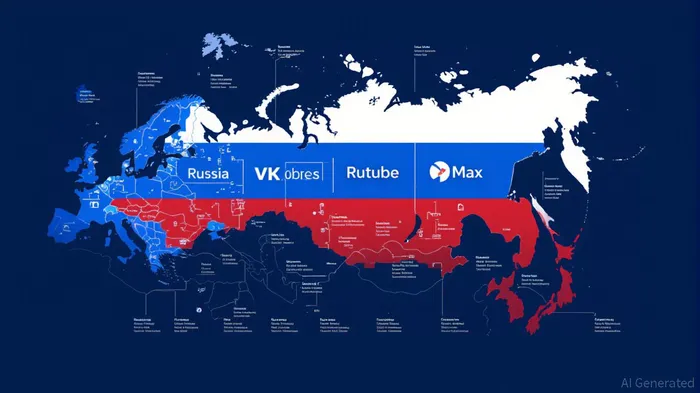
Russia's digital isolation has been both a catalyst and a constraint. The departure of over 1,000 global tech firms since 2022—driven by sanctions and reputational risks—has left a void in critical infrastructure. This vacuum has been filled by state-backed platforms such as VK Video, Rutube, and Max, which now dominate the domestic market. These platforms are not merely commercial ventures but instruments of ideological control, designed to replace foreign services like YouTube, Telegram, and Facebook.
The geopolitical tailwinds here are twofold: first, the compounding pressure of sanctions has forced Russia to prioritize self-reliance in technology; second, the global shift toward digital nationalism has created a precedent for similar strategies in other sanctioned economies. For investors, this signals a growing demand for domestic tech infrastructure in regions facing external economic pressure.
State-Backed Tech Ecosystems: Opportunities and Risks
The Russian government has allocated ₽32.1 billion to its federal AI project since 2021, with an additional ₽7.7 billion earmarked for 2025. This funding is directed toward research, regional IT systems, and public-sector AI integration. By 2023, 500 regional IT systems with AI were already operational, and the government aims to expand this to 25 “artificially intelligent” regions by 2030.
Key players in this ecosystem include Kaspersky Lab, which has invested ₽45 billion in AI-driven cybersecurity solutions, and Rostelecom, developing the Lukomorye platform for data analysis. Meanwhile, Yandex continues to innovate in cloud computing and neural networks, though its reliance on domestic infrastructure remains a challenge.
However, the financial health of these platforms is precarious. VK Company, the parent firm of VK Video and Max, reported a 40% revenue increase in Q1 2023 but a 94.9 billion rouble net loss in 2024, highlighting the tension between state mandates and market viability. Similarly, Rutube generates $186.2 million annually but depends heavily on subsidies and content restrictions.
Strategic Investment Considerations
For investors, the Russian tech sector offers a high-risk, high-reward proposition. The government's 15 billion rouble venture-capital programme, managed by the Russian Venture Company (RVC), aims to stimulate innovation in sectors like cybersecurity, biotechnology, and AI. This programme, modeled after successful initiatives in Finland and Israel, could attract private capital if legal uncertainties are resolved.
Opportunities lie in sectors where state demand is inelastic:
1. Cybersecurity: With 74% of Russian companies now using AI in their operations, demand for threat-detection systems is surging.
2. Localized Content Production: Platforms like Rutube and Max require continuous content to maintain user engagement, creating a niche for regional media producers.
3. Government Procurement: AI solutions for public services, defense, and electronic document management are expanding rapidly, with procurement under 44-FZ and 223-FZ growing by 2.5–4 times since 2022.
Yet risks are significant. The exodus of 100,000 technologists since 2022 has weakened innovation capacity, while reliance on Chinese hardware and software introduces geopolitical vulnerabilities. Additionally, the 2025 law banning access to “extremist materials” has intensified regulatory risks, with even state-backed platforms facing scrutiny.
Conclusion: Navigating the Paradox of Digital Sovereignty
Russia's digital sovereignty strategy is a paradox: it fosters short-term stability for state-backed platforms while undermining long-term innovation through censorship and financial fragility. For investors, the key is to balance strategic alignment with risk mitigation.
Investment in Russian tech should prioritize:
- Partnerships with state-backed entities that have clear mandates and access to government funding.
- Diversification across sectors to hedge against policy shifts and financial instability.
- Long-term patience, given the sector's reliance on subsidies and the slow pace of technological self-sufficiency.
As the world grapples with the rise of digital borders, Russia's experience underscores the tension between state power and globalized tech ecosystems. For those willing to navigate this terrain, the rewards could be substantial—but only for those who approach it with caution and clarity.

Decoding blockchain innovations and market trends with clarity and precision.
Latest Articles
Stay ahead of the market.
Get curated U.S. market news, insights and key dates delivered to your inbox.


AInvest
PRO
AInvest
PRO



Comments
No comments yet