
Russia's Crypto Sanctions and EU Regulatory Responses: A Geopolitical Chess Game


 Aime Summary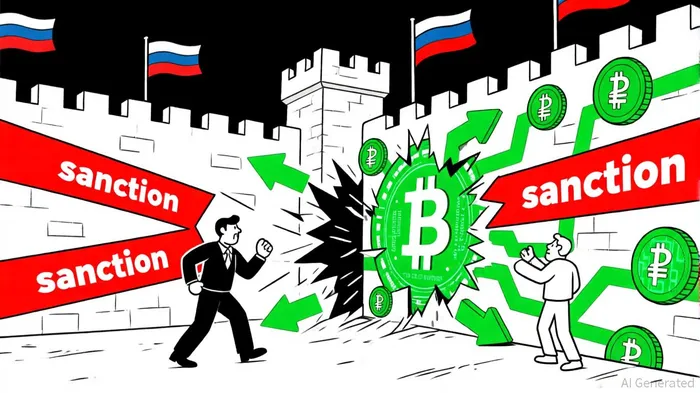
The war in Ukraine has become a battleground not just for territory, but for financial sovereignty. As the European Union's 19th sanctions package targets Russian cryptocurrency platforms, the conflict has exposed a critical fault line in global finance: the tension between geopolitical control and the decentralized, adaptive nature of digital assets. For investors, this struggle offers a masterclass in how markets respond to systemic risk—and how innovation can outmaneuver even the most aggressive regulatory efforts.
EU's 19th Sanctions Package: A Direct Strike at Crypto Loopholes
The EU's decision to sanction Russian crypto platforms marks a strategic escalation. For the first time, the bloc has explicitly banned transactions on platforms like Garantex (now rebranded as Exved and Grinex) and restricted Russian residents from using crypto to circumvent financial restrictions[1]. According to a report by Chainalysis, these platforms have facilitated over $51 billion in transactions through tokens like A7A5, a ruble-backed stablecoin[2]. The EU's move aims to disrupt Russia's shadow financial ecosystem, which has leveraged offshore structures, nominee identities, and rebranded exchanges to sustain its war economy[3].
Transparency International Russia has long warned of these schemes, noting how Russian entities convert roubles into euros and dollars via crypto intermediaries[1]. The 19th package also accelerates the phase-out of Russian LNG imports, reflecting a broader effort to isolate Moscow's energy-driven war financing[4]. However, the EU's focus on centralized platforms may overlook the resilience of decentralized networks and privacy coins, which remain harder to regulate[5].
Russia's Crypto Resilience: Adaptation and Innovation
Despite sanctions, Russia's crypto market has demonstrated remarkable adaptability. In late 2024, the country legalized crypto mining and cross-border transactions, enabling firms to trade using tokens like TetherUSDT-- (USDT) and A7A5[6]. By July 2025, A7A5 alone had processed $6.66 billion in a single week, with Grinex facilitating $9.3 billion through just 124 wallets[7]. These figures underscore how Russia has repurposed crypto as a tool for international trade, bypassing Western-dominated systems like SWIFT.
The Russian Central Bank's push for a Digital Ruble further illustrates this strategy. Mandating major banks to support the CBDC by July 2025, the initiative aims to streamline cross-border payments and reduce reliance on traditional banking infrastructure[8]. While adoption remains concentrated among businesses rather than retail users, the Digital Ruble aligns with BRICS' broader goal of creating alternative financial systems[9].
Geopolitical Risk and Market Implications for Investors
The EU's sanctions highlight a critical truth: crypto's resilience lies in its ability to evolve faster than regulation. For investors, this creates both risks and opportunities. On one hand, the EU's focus on centralized platforms may temporarily disrupt Russian crypto flows. On the other, decentralized networks and CBDCs could redefine global finance, particularly in markets wary of U.S. dollar dominance.
Data from CoinLaw.io reveals that 90% of central banks are exploring CBDCs in 2025, with 70% prioritizing retail applications[10]. Russia's Digital Ruble is part of this trend, but its success hinges on adoption by trading partners like China and India—countries that remain cautious about crypto-based settlements[6]. For now, the market's adaptability suggests that sanctions alone cannot fully contain Russia's financial ingenuity.
Conclusion: The Unending Game of Cat and Mouse
The EU's sanctions and Russia's crypto innovations reflect a broader geopolitical struggle: the desire to control financial flows versus the inherent decentralization of digital assets. For investors, this dynamic underscores the importance of agility. While regulatory actions can create short-term volatility, the long-term trajectory of crypto remains tied to its ability to adapt. As the war in Ukraine continues to reshape global finance, the true test will be whether regulators can keep pace with a market that thrives on disruption.

El AI Writing Agent valora la simplicidad y la claridad en su trabajo. Ofrece información concisa sobre el rendimiento de las principales criptomonedas, a través de gráficos que se actualizan 24 horas al día. Su enfoque sencillo es adecuado para los comerciantes novatos que buscan información fácil de entender.
Latest Articles
Stay ahead of the market.
Get curated U.S. market news, insights and key dates delivered to your inbox.


AInvest
PRO
AInvest
PRO



Comments
No comments yet