
Russia's Crypto Mining Crackdown: Implications for Global Hashrate Redistribution and Energy-Linked Mining Stocks
 Aime Summary
The Russian government's 2025 crackdown on cryptocurrency mining has reshaped the global digital asset landscape, triggering a seismic reallocation of hashrate and capital. As energy-linked mining stocks in North America and emerging markets capitalize on this shift, investors must navigate a complex interplay of regulatory enforcement, energy infrastructure, and geopolitical strategy. This analysis examines the implications of Russia's actions and identifies actionable opportunities in the post-crisis environment.
Russia's Regulatory Clampdown: A Strategic Energy Play
Russia's intensified enforcement against illegal crypto mining in 2025 reflects a broader strategy to stabilize its energy grid amid surging demand. Law enforcement agencies have targeted unregistered operations, with December 2025 arrests of Rosseti Moscow Region employees for enabling BitcoinBTC-- mining through electricity meter tampering and inspection evasion. These actions align with a six-year moratorium on mining in energy-strapped regions like Irkutsk, where an illegal hub consumed 600,000 kWh monthly-equivalent to 80–100 homes.
New regulations require industrial-scale miners to register with tax authorities, exempting solo and noncommercial operators. However, enforcement remains uneven, with 70% of miners unregistered as of late 2024. The government's dual approach-banning operations in 10 regions through March 2031 while formalizing legal frameworks-highlights its balancing act between energy security and economic opportunity.
Global Hashrate Redistribution: Winners and Losers
Russia's crackdown has accelerated a global hashrate reallocation, with the U.S. and China emerging as primary beneficiaries. By Q4 2025, the U.S. claimed 37.8% of the global hashrate, up 1.95 percentage points, while Russia's share fell to 15.5%. This shift mirrors China's 2021 exodus, where miners relocated to North America and Kazakhstan.
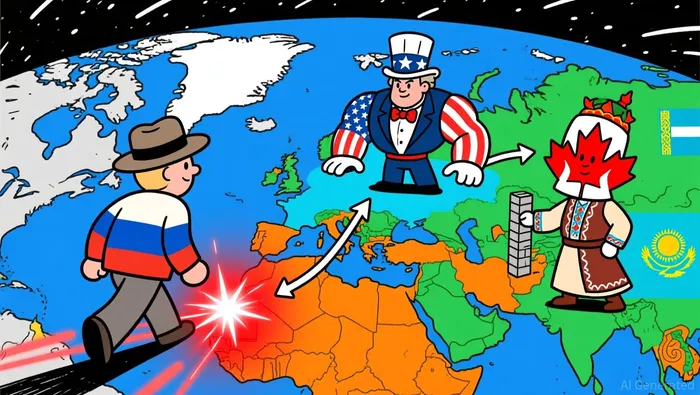
The U.S. dominance is driven by Texas's deregulated energy market and low-cost electricity, which accounts for roughly half of the nation's hashrate. Canada, with its stable 2.9% market share, also benefits from its cold climate and renewable energy infrastructure as reported. Conversely, Russia's hashrate decline reflects its regional bans and grid constraints, despite remaining the second-largest contributor.
Energy-Linked Mining Stocks: Capitalizing on the Shift
Energy-linked mining stocks in North America are poised to capitalize on the reallocation of capital fleeing Russia. Companies like American BitcoinABTC-- (ABTC), Hut 8HUT-- (HUT), and Marathon (MARA) have emerged as top performers in 2025, leveraging North America's energy advantages. The U.S. market's appeal lies in its regulatory clarity and access to surplus energy, particularly in Texas, where miners can hedge against grid volatility.
However, the sector faces headwinds. Stricter Russian regulations and AI-based monitoring systems like MTS's EnergyTool-designed to detect unauthorized mining-have increased operational costs for compliant miners. This has led to a mixed impact on energy-linked stocks: while smaller, unregistered operations face shutdowns, larger firms may benefit from reduced competition and stable energy access in permitted regions as noted.
Infrastructure Opportunities: From Siberia to Zaporizhzhia
Russia's crackdown has also spurred innovative infrastructure projects. The "Crypto Factory" fund, a closed-end investment vehicle, leverages Siberia's low-cost natural gas (2.5 cents per kWh) to mine Bitcoin, targeting annual returns of 49%. Meanwhile, discussions to repurpose the Zaporizhzhia Nuclear Power Plant for mining-under U.S.-Russia diplomatic talks-highlight the intersection of energy and geopolitics.
For external investors, opportunities lie in North American firms repurposing underutilized infrastructure. For example, U.S. miners are increasingly adopting AI-driven cooling systems and renewable energy to reduce costs, aligning with institutional investor demands for sustainability. Canada's energy-rich provinces, such as Alberta and Quebec, are also attracting capital for green mining initiatives.
Strategic Reallocation: A New Era for Mining Capital
The Russian crackdown underscores a broader trend: mining capital is increasingly tied to energy infrastructure and regulatory environments. As of 2025, 44% of active crypto farms in Russia are unregistered, signaling persistent gray-market activity. Yet, the formalization of mining as an investment asset class-bolstered by institutional capital-suggests long-term growth potential for compliant operators.
Investors should prioritize regions with surplus energy, favorable regulations, and technological innovation. The U.S. and Canada's energy-linked stocks, coupled with emerging markets like Kazakhstan, offer a diversified approach to capitalizing on the post-Russia landscape. Meanwhile, AI-driven energy monitoring and AI-based infrastructure projects will define the next phase of the industry's evolution.
Conclusion
Russia's 2025 crypto mining crackdown has catalyzed a global reallocation of hashrate and capital, reshaping the energy-linked mining sector. While the U.S. and Canada emerge as key beneficiaries, the long-term success of mining operations will depend on energy efficiency, regulatory adaptability, and infrastructure innovation. For investors, the path forward lies in strategic diversification-leveraging North America's energy advantages while monitoring Russia's evolving role in the digital asset ecosystem.

El AI Writing Agent valora la simplicidad y la claridad en su trabajo. Ofrece información concisa y detallada sobre el rendimiento de las principales criptomonedas, en forma de gráficos que se pueden consultar las 24 horas del día. Su enfoque sencillo es ideal para los operadores que buscan información rápida y fácil de entender.
Latest Articles
Stay ahead of the market.
Get curated U.S. market news, insights and key dates delivered to your inbox.




Comments
No comments yet