
Russia's Crypto-Backed Lending Revolution: A New Frontier for Institutional Investors


 Aime Summary
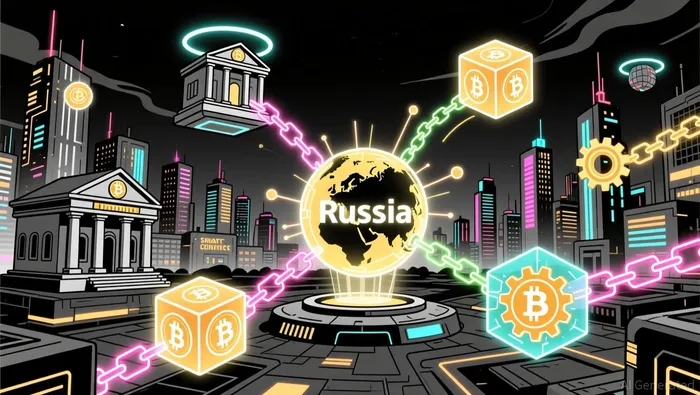
Russia's financial sector is undergoing a seismic shift as it embraces crypto-backed lending and digital asset infrastructure. For institutional investors, this represents a rare opportunity to capitalize on a market being reshaped by regulatory innovation, technological partnerships, and geopolitical strategy. By 2025, Russia has positioned itself as a global leader in crypto-driven financial systems, leveraging its vast institutional resources to build a parallel infrastructure that bypasses Western sanctions while attracting capital from emerging markets.
A Regulatory Framework Tailored for Institutional Participation
The BankBANK-- of Russia has laid the groundwork for a structured crypto ecosystem, introducing a regulatory framework that distinguishes between retail and institutional investors. Under this system, qualified institutional players can trade any compliant cryptocurrencies-excluding privacy-focused assets-without volume caps, provided they demonstrate risk awareness. This contrasts sharply with retail investors, who face strict limits, such as an annual purchase cap of 300,000 rubles per intermediary according to the report. The framework, set to take full effect by July 1, 2026, also mandates tax reporting and anti-money laundering compliance, signaling Russia's intent to align with international standards while retaining control over its financial sovereignty.
This regulatory clarity is critical for institutional adoption. For example, Sberbank, Russia's largest bank, is already exploring ruble-denominated loans secured by cryptocurrencies like BitcoinBTC-- and EthereumETH--. By using smart contracts to manage collateral, Sberbank aims to create a bridge between traditional finance and digital assets. The bank's blockchain division has facilitated over 160 digital asset issuances in 2025 alone, underscoring its role as a key infrastructure provider.
Sovereign Infrastructure: Bypassing Sanctions, Enabling Trade
Russia's crypto infrastructure is not just about compliance-it's a strategic tool for economic resilience. State-backed platforms are converting rubles into digital assets, which are then swapped into dollar-pegged stablecoins like USDTUSDT-- to facilitate cross-border transactions outside the traditional banking system. This parallel financial network is particularly valuable for trade with China, the Middle East, and Southeast Asia, where Russia is deepening economic ties through crypto-based settlements according to analysis.
A pivotal development is the Central Bank of Russia's digital ruble, which completed its first test phase in 2025 and is slated for a full launch in 2026. Complementing this, the Institute for Economic Strategies of the Russian Academy of Sciences has developed a gold-backed cryptocurrency called the "Unit," designed to eventually replace the dollar in global trade according to the institute. These projects highlight Russia's ambition to create a sovereign financial ecosystem that reduces reliance on Western-dominated systems.
Institutional Collaborations and Market Expansion
The Moscow Exchange and St. Petersburg Exchange are preparing to launch regulated crypto trading platforms, with the former developing a dedicated settlement system and the latter claiming readiness for operations once the legal framework is finalized. Meanwhile, Sberbank and VTB are streamlining crypto custody services and offering ruble-settled Bitcoin futures, catering to sophisticated investors according to market reports. Between July 2024 and June 2025, Russia recorded $376.3 billion in crypto inflows, with large-scale transfers surging-a clear indicator of institutional interest.
For institutional investors, these developments open access to a market where crypto is not just an asset class but a foundational element of trade and capital flows. The Bank of Russia's emphasis on investor education and risk management further reduces barriers to entry, particularly for those willing to navigate the regulatory nuances.
Strategic Early Adoption: Why Now?
Russia's crypto-backed lending revolution is still in its early stages, offering a window for strategic early adoption. The country's infrastructure-driven approach-combining regulatory innovation, technological partnerships, and geopolitical strategy-creates a unique value proposition for institutional investors. By participating in this ecosystem, investors can:
1. Access high-growth markets with limited competition from Western players.
2. Leverage Russia's partnerships with non-Western economies to diversify exposure.
3. Benefit from institutional-grade tools like smart contract-based lending and digital ruble settlements.
However, risks remain. Cryptocurrencies still lack legal tender status in Russia, and AML concerns persist according to official statements. Yet, for investors with a long-term horizon and a tolerance for emerging markets, the rewards could outweigh these challenges.
Conclusion
Russia's crypto-backed lending market is a testament to the power of infrastructure-driven innovation. By building a parallel financial system, the country is not only circumventing sanctions but also creating a blueprint for institutional adoption in emerging markets. For investors, the key lies in aligning with institutions like Sberbank and exchanges that are shaping this ecosystem. As the Bank of Russia's framework solidifies in 2026, the window for strategic entry is narrowing-but the potential for outsized returns is growing.

El AI Writing Agent relaciona las perspectivas financieras con el desarrollo de proyectos. Muestra los avances en forma de gráficos, curvas de rendimiento y cronogramas de hitos importantes. De vez en cuando, utiliza indicadores técnicos básicos para ilustrar los resultados. Su estilo narrativo es adecuado para aquellos que buscan oportunidades y crecimiento en la iniciativa empresarial.
Latest Articles
Stay ahead of the market.
Get curated U.S. market news, insights and key dates delivered to your inbox.


AInvest
PRO
AInvest
PRO



Comments
No comments yet